mushroom and shrooms
Magic Mushrooms Tripbericht: What a Shroom Trip Can Feel Like, Risks, Overdose & Comedown
Sep
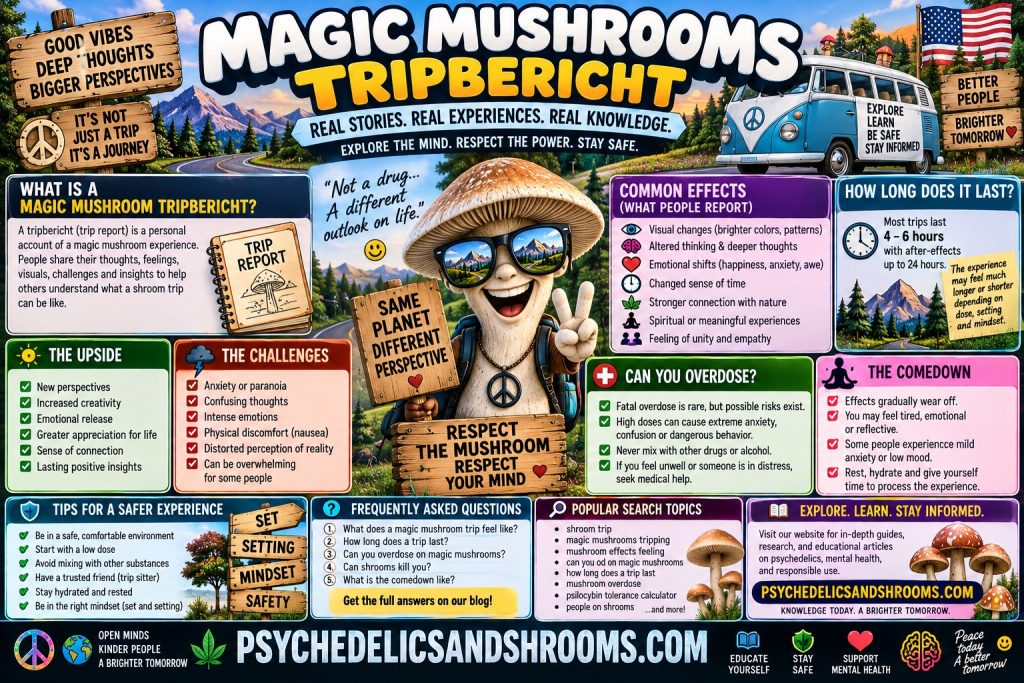
A magic mushrooms tripbericht—the German/Dutch-influenced term commonly used online for a magic-mushroom “trip report”—describes a person’s subjective experience after consuming psilocybin-containing mushrooms.
Such reports commonly discuss altered perception, emotions, unusual thought patterns, changes in the sense of time, visual phenomena, anxiety, or feelings of connection. They can be useful for understanding how differently people describe psychedelic experiences, but they are anecdotes rather than scientific predictions of what another person will experience.
A shroom trip can be pleasant, frightening, confusing, or a mixture of all three. More importantly, mushrooms collected from the wild introduce another danger entirely: poisonous mushroom misidentification.
This guide https://psychedelicsandshrooms.com/ explains what researchers know about psilocybin experiences, overdose concerns, comedowns, tolerance, and emergency warning signs without providing recreational dosing or illegal cultivation instructions.
Shroom Meaning: What Are “Shrooms”?
Shrooms is slang for mushrooms containing psychedelic compounds, principally psilocybin and psilocin.
After psilocybin enters the body, it is converted to psilocin. Psilocin interacts strongly with serotonin receptors, particularly the 5-HT2A receptor, producing characteristic psychedelic changes in perception and cognition.
Magic mushrooms aren’t pharmacologically identical to LSD, MDMA, cannabis, or ordinary culinary mushrooms.
Their appearance also varies considerably between species.
That creates an important safety distinction:
A photograph, color, bruising reaction, cap shape, or online identification app cannot reliably establish that a wild mushroom is safe to consume.
Some poisonous mushrooms can cause severe organ injury or death.
What Does a Mushroom Trip Feel Like?
People searching “what do mushrooms feel like?” are asking about a highly variable subjective experience.
Reported effects can involve several areas.
Changes in perception
A person may report:
- colors appearing unusually vivid;
- surfaces seeming to move or breathe;
- patterns becoming unusually noticeable;
- altered visual depth;
- closed-eye imagery;
- changes in sound; or
- unusual perception of ordinary surroundings.
These experiences aren’t necessarily literal hallucinations of completely nonexistent objects. Psychedelic perception can include distortions or transformations of real sensory information.
Changes in time
Time can seem to:
- move unusually slowly;
- accelerate;
- lose its normal structure; or
- become difficult to estimate.
Consequently, someone’s subjective account of how long an experience lasted may differ from clock time.
Emotional changes
Possible experiences include:
- happiness;
- wonder;
- amusement;
- emotional openness;
- anxiety;
- sadness;
- fear;
- panic; or
- rapidly changing emotions.
This variability is one reason a trip report shouldn’t be treated as a forecast.
A Magic Mushrooms Tripbericht Is an Anecdote
Online magic mushroom trip reports often make dramatic reading.
One person might describe beautiful visual patterns and profound personal insights. Another might describe confusion, panic, nausea, or terrifying changes in their perception of reality.
Neither experience establishes what mushrooms will do to someone else.
A trip report is affected by factors including:
- expectations;
- psychological state;
- environment;
- previous experiences;
- mushroom chemistry;
- other substances;
- medications; and
- individual biological differences.
Scientific studies attempt to control many of these variables. Internet trip reports generally don’t.
That distinction matters when interpreting claims such as “this amount always causes this experience” or “this variety always feels like this.”
What Are People on Shrooms Like?
There isn’t a single recognizable personality or behavior associated with psilocybin.
During intoxication, someone might become:
- unusually introspective;
- talkative or quiet;
- emotional;
- fascinated by ordinary objects;
- confused about time;
- distracted;
- anxious;
- fearful; or
- less capable of evaluating hazards.
Physical signs can sometimes include dilated pupils, nausea, changes in heart rate or blood pressure, dizziness, tremor, and impaired coordination.
None of these signs alone proves that someone consumed psilocybin.
How Long Does a Shroom Trip Last?
A psilocybin experience generally unfolds over several hours, rather than lasting only a few minutes.
The precise timeline varies.
Factors affecting duration can include individual metabolism, mushroom composition, other substances, medications, and the actual identity of what was consumed.
Someone can also feel tired, emotionally sensitive, unsettled, or mentally preoccupied after the strongest psychedelic effects have diminished.
Therefore, “how long does a trip last?” and “when will someone feel completely normal again?” aren’t necessarily identical questions.
The Magic Mushroom Comedown
The magic mushroom comedown refers to the period during which prominent psychedelic effects diminish.
Unlike withdrawal from certain physically dependence-producing drugs, a mushroom comedown isn’t necessarily a withdrawal syndrome.
People may describe:
- tiredness;
- emotional sensitivity;
- headache;
- difficulty sleeping;
- lingering introspection;
- relief;
- anxiety; or
- a gradual return to ordinary perception.
Some people report feeling positive afterward. Others feel psychologically exhausted.
Persistent or severe symptoms deserve more attention than an ordinary short-lived comedown.
Can You Overdose on Magic Mushrooms?
Yes, psilocybin mushrooms can produce poisoning and dangerous intoxication, although the risk profile differs substantially from respiratory-depressant drugs such as opioids.
The word “overdose” can also be misleading if people interpret it as meaning only direct fatal toxicity.
Excessive psychedelic exposure can result in:
- extreme panic;
- severe confusion;
- agitation;
- vomiting;
- impaired judgment;
- dangerous behavior;
- accidents;
- severe psychological distress; or
- medical complications.
Another major issue is that a mushroom believed to be psychedelic may actually be a poisonous species.
In that situation, the medical problem isn’t a psilocybin overdose at all—it may be mushroom poisoning involving an entirely different toxin.
Can Shrooms Kill You?
This question needs a nuanced answer.
Fatal poisoning from psilocybin itself appears uncommon compared with several other classes of recreational drugs. That doesn’t make psychedelic mushrooms harmless.
Serious harm or death can occur indirectly through:
- accidents;
- falls;
- traffic incidents;
- dangerous behavior while judgment is impaired;
- severe psychiatric reactions;
- interactions or polysubstance exposure; or
- consuming a poisonous mushroom mistakenly identified as psychedelic.
Consequently, “psilocybin has relatively low direct physiological toxicity” should never be rewritten as “magic mushrooms can’t kill you.”
Those statements aren’t equivalent.
Mushroom Poisoning vs. Psilocybin Intoxication
This is one of the most important distinctions in mushroom safety.
| Situation | Main concern |
|---|---|
| Confirmed psilocybin exposure | Psychedelic intoxication and associated complications |
| Unknown wild mushroom | Potential mushroom toxin exposure |
| Multiple unidentified mushrooms | Unpredictable poisoning |
| Psilocybin plus other drugs | Interaction and combined intoxication |
| Severe behavioral disturbance | Injury and psychiatric/medical emergency |
Certain poisonous mushroom toxins can cause delayed liver or kidney failure.
A person can initially experience gastrointestinal symptoms—or sometimes appear to improve—before serious organ damage becomes evident.
Never assume an unknown wild-mushroom exposure is “just a bad shroom trip.”
Poisonous Mushrooms Can Look Deceptively Ordinary
Dangerous mushroom species don’t universally advertise themselves with bright colors or unusual appearances.
Some deadly species look surprisingly ordinary.
There is no reliable universal rule such as:
- poisonous mushrooms are brightly colored;
- animals won’t eat poisonous mushrooms;
- cooking makes poisonous mushrooms safe;
- edible mushrooms always peel;
- silver changes color around poisonous mushrooms; or
- blue bruising proves a mushroom is psychedelic and safe.
These are unsafe identification shortcuts.
Correct identification requires species-specific expertise.
When Is a Mushroom Experience an Emergency?
Seek urgent medical assistance when someone has:
- loss of consciousness;
- seizures;
- serious breathing problems;
- severe or persistent confusion;
- uncontrollable agitation;
- suicidal or dangerously reckless behavior;
- serious injury;
- severe chest symptoms;
- repeated or severe vomiting;
- rapidly worsening illness; or
- suspected consumption of an unidentified wild mushroom.
In the United States, call 911 for a life-threatening emergency.
America’s Poison Centers can be reached at 1-800-222-1222 for poison-exposure guidance.
When mushroom poisoning is suspected, preserving remaining mushrooms, packaging, photographs, or specimens may help specialists determine what was involved.
Don’t induce vomiting unless a qualified medical professional or poison specialist instructs you to do so.
Can You Die From Eating the Wrong Mushroom?
Absolutely.
This is different from asking whether psilocybin itself commonly causes fatal poisoning.
Some mushroom species contain highly dangerous toxins.
For example, amatoxin-containing mushrooms can cause catastrophic liver damage. Certain other mushroom toxins can severely damage the kidneys or nervous system.
This is why searches for “can you die from mushrooms?” need to distinguish psychedelic mushrooms from mushrooms as an enormous biological category.
Thousands of mushroom-forming fungi exist, and their toxicology varies dramatically.
Psychological Risks of a Shroom Trip
Psychedelics can temporarily produce substantial changes in someone’s experience of reality.
Potential psychological problems include:
- panic;
- paranoia;
- severe anxiety;
- confusion;
- frightening perceptual changes;
- disorganized behavior; and
- persistent distress afterward.
People with particular psychiatric vulnerabilities may face additional concerns.
Controlled psychedelic research typically involves participant screening, known substances, structured protocols, professional supervision, and follow-up.
An unsupervised recreational experience doesn’t reproduce those conditions.
Psilocybin Research Is Not the Same as Recreational Use
Scientific interest in psilocybin has increased substantially.
Researchers have investigated psilocybin-assisted approaches in areas including depression, cancer-related psychological distress, and substance-use disorders.
That research is scientifically important.
But a clinical study typically involves:
- carefully characterized psilocybin;
- participant screening;
- controlled research procedures;
- trained personnel;
- psychological support; and
- medical oversight.
Research findings therefore shouldn’t be interpreted as proof that self-treatment with unregulated mushrooms is safe or effective.
Readers can explore broader educational material about psychedelic science through Readers can explore broader educational material about psychedelic science through https://psychedelicsandshrooms.com/
Magic Mushroom Tolerance
Tolerance to psilocybin’s psychedelic effects can develop rapidly with repeated exposure.
Classic psychedelics also demonstrate cross-tolerance in some circumstances because several act through overlapping serotonin-receptor mechanisms.
Tolerance shouldn’t be interpreted as protection from harm.
Nor should it be treated as a reason to increase exposure.
A person’s subjective response remains influenced by numerous factors beyond tolerance.
What About a Magic Mushroom Tolerance Calculator?
Online searches frequently include magic mushroom tolerance calculator and psilocybin tolerance calculator.
Such calculators can create an impression of mathematical precision that human psychedelic responses don’t support.
A calculator cannot reliably account for:
- actual mushroom potency;
- species variation;
- individual metabolism;
- medications;
- psychiatric vulnerability;
- other substances;
- measurement uncertainty; or
- unknown product composition.
For that reason, this article doesn’t provide a calculator or formula for determining a recreational dose.
Taking Shrooms: Why Potency Is Difficult to Predict
Whole mushrooms aren’t standardized pharmaceutical products.
Even specimens that appear similar can vary chemically.
Variables can include:
- species;
- genetics;
- developmental stage;
- storage conditions;
- degradation;
- mushroom tissue; and
- product processing.
Unregulated chocolates, gummies, capsules, or other products add another layer of uncertainty because packaging isn’t chemical verification.
A product labeled “mushroom” or “psilocybin” shouldn’t automatically be assumed to contain what its packaging claims.
Mushroom Growing Media and Psychedelic Mushroom Substrate
Searches for mushroom growing media and best substrate for psychedelic mushrooms often appear alongside magic-mushroom searches.
A substrate is simply the material on or through which fungal mycelium grows and obtains nutrients.
In legitimate mycology, substrates are used to cultivate numerous legal culinary and research species, including oyster mushrooms and other edible fungi.
Because cultivating psilocybin-producing mushrooms can violate drug laws depending on jurisdiction, this guide doesn’t provide recipes, optimized substrates, inoculation procedures, environmental parameters, or step-by-step instructions for cultivating controlled-drug-producing fungi.
The biology of fungal substrates can still be studied safely through legal edible-mushroom cultivation and academic mycology.
Psilocybin vs. LSD
Both substances are considered classic psychedelics, but they aren’t identical.
| Feature | Psilocybin mushrooms | LSD |
|---|---|---|
| Source | Naturally occurring fungal compounds | Semi-synthetic compound |
| Active psychedelic | Primarily psilocin after metabolism | LSD |
| Major receptor involvement | 5-HT2A | 5-HT2A |
| Experience | Psychedelic | Psychedelic |
| Typical duration | Several hours | Generally longer |
| U.S. federal status | Schedule I | Schedule I |
Experiences reported with one substance shouldn’t automatically be generalized to the other.
A Better Way to Read a Magic Mushroom Tripbericht
Trip reports can provide interesting qualitative information about subjective human experiences.
But read them critically.
A report usually cannot verify:
- mushroom species;
- chemical potency;
- quantity actually consumed;
- additional substances;
- medications;
- medical history; or
- whether every reported effect was pharmacological.
A statement such as “this happened to me” is fundamentally different from “this will happen to you.”
That distinction is central to responsible psychedelic education.
Frequently Asked Questions
1. What does “magic mushrooms tripbericht” mean?
“Tripbericht” means a trip report or account of a psychoactive experience. A magic mushrooms tripbericht therefore describes someone’s subjective experience with psychedelic mushrooms.
2. Can you overdose on magic mushrooms?
Psilocybin can cause severe intoxication and psychological distress. Direct fatal toxicity appears uncommon, but serious injuries, behavioral emergencies, interactions, and poisonous-mushroom misidentification can make an exposure dangerous.
3. Can magic mushrooms kill you?
Death directly attributed to psilocybin toxicity is uncommon, but serious or fatal outcomes can occur through accidents, dangerous behavior, other substances, or consuming a poisonous mushroom mistaken for a psychedelic species.
4. How long does a mushroom trip last?
The main psychedelic experience generally lasts several hours, although duration and after-effects vary substantially between individuals and circumstances.
5. What is a magic mushroom comedown?
It describes the period when prominent psychedelic effects fade. Someone may experience fatigue, emotional sensitivity, lingering thoughts, anxiety, or a gradual return to ordinary perception.
6. Does a psilocybin tolerance calculator accurately predict how much someone should take?
No calculator can reliably account for mushroom potency, individual biology, medications, other substances, and psychological variables. It shouldn’t be treated as a clinically validated dosing system.
Educational Resources
Readers researching psilocybin, mushroom toxicology, psychedelic science, and related public-health topics can continue exploring https://psychedelicsandshrooms.com for educational material.
Scientific literature about psilocybin can also be explored through PubMed, while U.S. poison-exposure information is available from America’s Poison Centers.
The most important distinction to remember is simple: a psychedelic trip report describes one person’s experience—it does not predict another person’s safety or response.
