mushroom and shrooms
Psilocybe Cyanescens: Identification, Habitat, Scientific Research, and Safety
Jul
Psilocybe cyanescens is one of the best-known species of psilocybin-containing mushrooms and has attracted the attention of mycologists, ecologists, and neuroscience researchers for decades. Known for its distinctive wavy cap, this mushroom grows naturally in temperate regions around the world and has become an important subject in scientific studies involving fungi and naturally occurring psychedelic compounds.
As public interest in mushrooms continues to increase across the United States, many people are searching for accurate information about Psilocybe cyanescens. Unfortunately, misinformation is common online. Understanding the biology, ecology, legal considerations, and current scientific research helps readers distinguish evidence-based facts from myths.
Educational resources available at https://psychedelicsandshrooms.com/ help readers learn about edible mushrooms, functional fungi, psychedelic mushroom research, and mushroom science while promoting responsible education.
What Is Psilocybe Cyanescens?
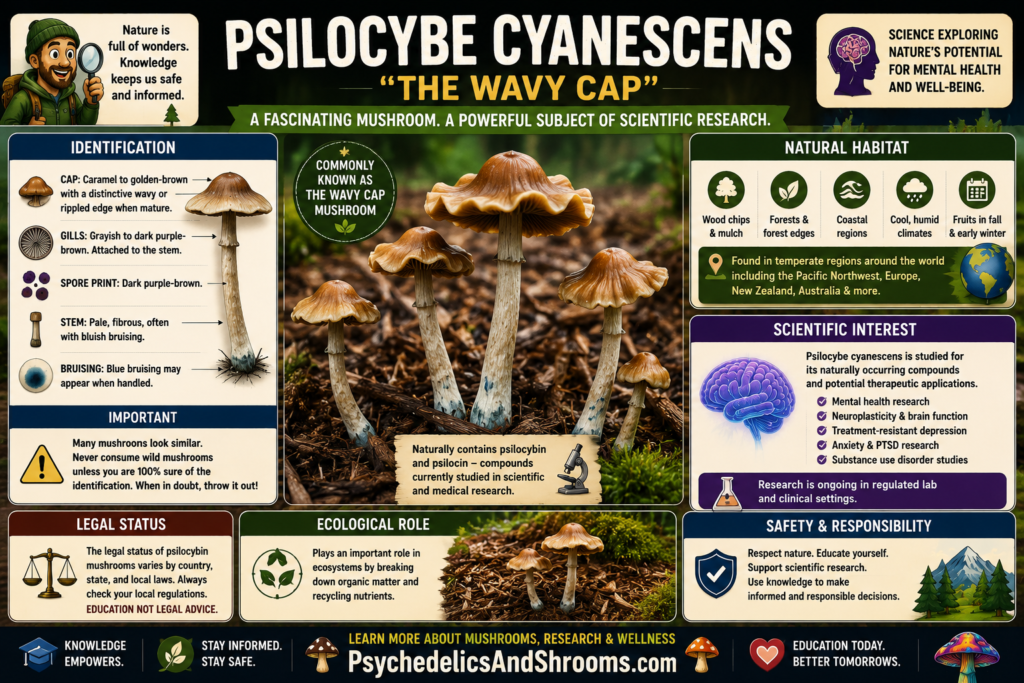
Psilocybe cyanescens is a species of mushroom belonging to the Hymenogastraceae family. It is recognized by its caramel-to-brown cap, pale stem, dark purple-brown spores, and the characteristic wavy edges that often develop as the mushroom matures.
The species naturally contains psilocybin and psilocin, compounds currently being studied in regulated scientific and medical research.
Unlike edible culinary mushrooms such as Shiitake or Oyster mushrooms, Psilocybe cyanescens is not considered a food mushroom and should not be confused with common edible species.
Why Is It Called “Wavy Cap”?
One of the most recognizable features of Psilocybe cyanescens is the mature cap, which often develops a rippled or wavy margin.
This appearance has led many mushroom enthusiasts and field guides to refer to it as the “Wavy Cap.”
Although cap shape can be helpful during identification, researchers emphasize that multiple characteristics are required for accurate species identification because many mushrooms resemble one another.
Natural Habitat
Psilocybe cyanescens typically grows in cool, humid environments rich in decomposing woody material.
It is commonly associated with:
- Wood chips
- Mulch beds
- Garden landscaping
- Forest edges
- Parks
- Coastal regions with mild climates
Its fruiting season often coincides with cooler temperatures and increased rainfall.
Understanding habitat helps scientists study fungal ecology and ecosystem dynamics.
Geographic Distribution
Researchers have documented Psilocybe cyanescens in several temperate regions worldwide.
Reports include observations from:
- Parts of the Pacific Northwest
- Western Europe
- New Zealand
- Australia
- Additional temperate regions where suitable environmental conditions exist
Distribution can vary depending on climate, habitat, and local ecological conditions.
Scientific Interest
Modern scientific interest in Psilocybe cyanescens centers primarily on the naturally occurring compounds psilocybin and psilocin.
Universities and medical research institutions continue studying these compounds to better understand:
- Brain function
- Neuroplasticity
- Consciousness
- Emotional processing
- Mental health
- Serotonin signaling
Much of this research occurs under carefully regulated clinical and laboratory conditions.
Psilocybin and Current Research
Psilocybin is being investigated in supervised clinical studies involving several mental health conditions.
Researchers continue exploring potential therapeutic applications for:
- Treatment-resistant depression
- Anxiety associated with serious illness
- Post-traumatic stress disorder (PTSD)
- Certain substance use disorders
These investigations occur under strict ethical oversight and professional supervision.
Readers interested in psychedelic science can explore additional educational resources at https://psychedelicsandshrooms.com/guides/.
The Importance of Accurate Identification
Many mushroom species appear visually similar.
Professional mycologists emphasize that visual appearance alone is not sufficient for reliable identification.
Numerous mushrooms resemble Psilocybe cyanescens, including species that are toxic or potentially dangerous.
Because of this, mushroom identification requires extensive expertise, careful observation, and multiple identifying characteristics.
Educational information should never be considered a substitute for professional identification.
Legal Considerations
The legal status of Psilocybe cyanescens varies depending on national, state, and local laws.
Some jurisdictions allow limited scientific research or regulated therapeutic programs, while others continue restricting possession or use.
Laws can change over time, making it important to consult official government resources for the most current legal information.
Educational discussions about mushroom science should not be interpreted as legal advice.
Ecological Importance
Like many fungi, Psilocybe cyanescens contributes to natural ecosystems by helping decompose organic material.
Fungi play an essential role in nutrient recycling and soil health, making them important components of forest and landscape ecosystems.
Studying fungal ecology improves our understanding of biodiversity and environmental sustainability.
Responsible Education
Growing public interest in mushrooms makes accurate education increasingly important.
Understanding the differences between edible mushrooms, functional mushrooms, medicinal fungi, and psilocybin-containing species helps reduce confusion while encouraging evidence-based learning.
Reliable information supports informed discussions about mycology, neuroscience, conservation, and public health.
Final Thoughts
Psilocybe cyanescens is one of the world’s best-known psilocybin-containing mushroom species and continues to attract scientific attention because of its unique biology and naturally occurring compounds. While researchers investigate its potential role in neuroscience and mental health, education remains essential for understanding both the opportunities and limitations of current research.
Learning about fungal biology, ecology, and responsible scientific investigation helps readers better appreciate the fascinating diversity of mushrooms.
For more educational articles about mushrooms, mycology, neuroscience, and psychedelic research, visit https://psychedelicsandshrooms.com/.
FAQs
What is Psilocybe cyanescens?
Psilocybe cyanescens is a species of psilocybin-containing mushroom recognized for its distinctive wavy cap and its importance in scientific research.
Why is it called the Wavy Cap?
The nickname comes from the mature mushroom’s cap, which often develops rippled or wavy edges.
Where does Psilocybe cyanescens naturally grow?
It is commonly found in cool, humid environments with wood chips, mulch, and other decomposing woody material.
Why are researchers interested in this mushroom?
Scientists study its naturally occurring compounds, particularly psilocybin and psilocin, as part of neuroscience and mental health research.
Is Psilocybe cyanescens an edible culinary mushroom?
No. It is not considered a culinary mushroom and should not be confused with edible species such as Shiitake or Oyster mushrooms.
Where can I learn more about mushroom science?
Visit https://psychedelicsandshrooms.com/ and https://psychedelicsandshrooms.com/guides/ for educational articles about mushrooms, mycology, and current scientific research.
