
mushroom and shrooms
Mushroom Anatomy: A Complete Guide to the Parts of a Mushroom
Jul
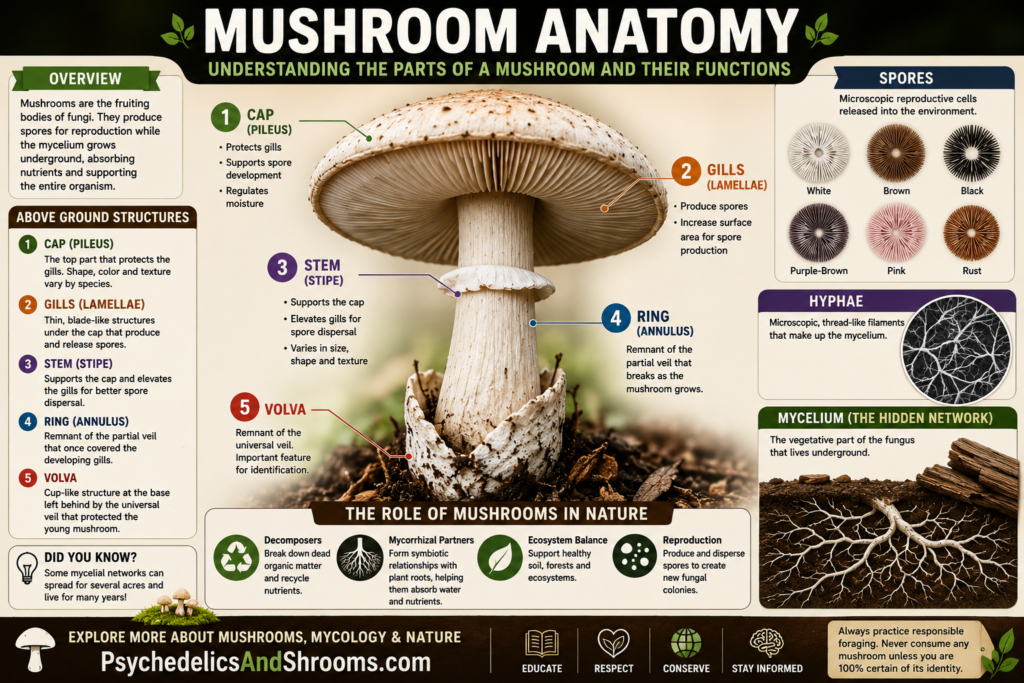
Mushrooms are fascinating organisms that play an essential role in forests, grasslands, gardens, and ecosystems around the world. Although many people recognize mushrooms by their familiar umbrella-like appearance, the visible mushroom is only one small part of a much larger fungal organism. Understanding mushroom anatomy helps explain how fungi grow, reproduce, spread, and contribute to the natural environment.
Whether you are interested in edible mushrooms, functional mushrooms, or learning about psychedelic mushroom species from a scientific perspective, understanding mushroom anatomy provides an excellent foundation for studying mycology. Educational resources available at https://psychedelicsandshrooms.com/ help readers explore mushroom biology, fungal ecology, and evidence-based mushroom science while distinguishing edible, functional, and psychedelic species.
What Is Mushroom Anatomy?
Mushroom anatomy refers to the physical structures that make up a mushroom and the larger fungal organism. Each part has a specific function that supports growth, reproduction, nutrient absorption, or spore dispersal.
While mushrooms may vary in size, color, and shape depending on the species, many share the same basic anatomical structures.
Learning these structures helps researchers, students, mushroom enthusiasts, and nature lovers better understand fungal biology.
The Cap (Pileus)
The cap, also called the pileus, is usually the most noticeable part of a mushroom.
It serves several important functions:
- Protects the spore-producing surface
- Helps regulate moisture
- Supports spore development
- Assists with spore release
Caps vary greatly between species. Some are flat, others are dome-shaped, funnel-shaped, or bell-shaped.
The cap’s texture, color, and size are often important characteristics used in mushroom identification.
The Gills (Lamellae)
Located underneath the cap, the gills, or lamellae, contain specialized structures where spores are produced.
These thin, blade-like structures greatly increase the surface area available for spore production.
Depending on the species, mushrooms may have:
- Crowded gills
- Widely spaced gills
- Attached gills
- Free gills
- Forked gills
Some mushrooms produce spores on pores or spines instead of gills.
The Stem (Stipe)
The stem, also known as the stipe, supports the cap and elevates it above the ground.
By raising the cap, the stem helps improve spore dispersal through air currents.
Stem characteristics vary widely among species and may include differences in:
- Length
- Thickness
- Color
- Texture
- Shape
- Internal structure
These features often help mycologists identify mushroom species.
The Ring (Annulus)
Some mushroom species possess a ring around the stem called the annulus.
The ring is a remnant of a protective tissue known as the partial veil that once covered the developing gills.
As the mushroom matures and the cap expands, this veil breaks, leaving the ring behind.
Not all mushroom species develop an annulus.
The Volva
Some mushrooms also possess a cup-like structure at the base of the stem called the volva.
The volva forms from a universal veil that surrounds the young mushroom before it emerges from the ground.
Its presence or absence is an important identification feature because several mushroom species with volvas resemble edible species while others are highly toxic.
Accurate identification requires evaluating multiple characteristics rather than relying on a single feature.
Spores
Spores are the reproductive units of fungi.
Rather than producing seeds like flowering plants, mushrooms release microscopic spores into the environment.
Wind, rain, insects, and animals help distribute spores to new locations where they may germinate under favorable conditions.
Spore color varies among species and may be:
- White
- Brown
- Black
- Pink
- Purple-brown
- Rust-colored
Mycologists often use spore prints as one tool for identifying mushroom species.
Mycelium: The Hidden Organism
The mushroom visible above the ground represents only a small portion of the fungus.
Most of the organism exists underground as mycelium, a network of tiny thread-like structures called hyphae.
Mycelium performs many important functions:
- Absorbs nutrients
- Breaks down organic matter
- Forms symbiotic relationships with plants
- Stores energy
- Produces mushrooms when conditions are favorable
Some mycelial networks can extend across several acres and survive for many years.
Hyphae
Hyphae are microscopic filaments that collectively form the mycelium.
These tiny structures grow through soil, wood, leaves, and other organic materials while absorbing nutrients.
As hyphae branch and expand, they create an extensive underground network capable of supporting mushroom production.
Hyphae play a central role in nutrient recycling throughout ecosystems.
Why Mushroom Anatomy Matters
Understanding mushroom anatomy benefits:
- Students
- Mycologists
- Nature enthusiasts
- Gardeners
- Ecologists
- Mushroom photographers
Knowledge of anatomical structures helps improve identification skills while increasing appreciation for fungal diversity.
Readers interested in learning more about mushroom biology and fungal ecology can explore additional educational resources at https://psychedelicsandshrooms.com/guides/.
Mushrooms and Ecosystems
Mushrooms are essential decomposers.
By breaking down dead wood, leaves, and organic material, fungi recycle nutrients back into the soil where plants and other organisms can use them.
Some fungi also form beneficial partnerships with tree roots known as mycorrhizal relationships, helping forests remain healthy and productive.
Without fungi, ecosystems would function very differently.
Final Thoughts
Understanding mushroom anatomy reveals the remarkable complexity hidden within even the simplest-looking mushroom. From the protective cap and spore-producing gills to the underground mycelium that quietly sustains the organism, every structure plays an essential role in the fungal life cycle.
Whether studying edible mushrooms, functional fungi, or psychedelic mushroom species from a scientific perspective, learning mushroom anatomy provides a solid foundation for appreciating one of nature’s most fascinating groups of organisms.
For more educational articles about mushrooms, mycology, fungal biology, and mushroom science, visit https://psychedelicsandshrooms.com/.
FAQs
What is mushroom anatomy?
Mushroom anatomy refers to the physical structures of a mushroom, including the cap, gills, stem, spores, ring, volva, and the underground mycelium.
What is the function of mushroom gills?
Gills produce and release microscopic spores that allow fungi to reproduce.
Is the visible mushroom the entire organism?
No. Most of the fungus exists underground as mycelium, while the visible mushroom is the reproductive structure.
What are spores?
Spores are microscopic reproductive cells that allow fungi to spread and establish new colonies.
Why is mycelium important?
Mycelium absorbs nutrients, decomposes organic material, supports plant relationships, and produces mushrooms when environmental conditions are suitable.
Where can I learn more about mushroom biology?
Visit https://psychedelicsandshrooms.com/ and https://psychedelicsandshrooms.com/guides/ for educational resources about mushroom science, fungal biology, and mycology.
