mushroom and shrooms
Lion’s Mane Mushroom Powder: A Complete Guide to Benefits, Uses, and Nutrition
Jul
Lion’s Mane mushroom powder has become one of the most popular functional mushroom products in the United States. Made from the Lion’s Mane mushroom (Hericium erinaceus), this fine powder is commonly added to coffee, smoothies, soups, teas, and recipes as a convenient way to enjoy this unique edible fungus. Interest in Lion’s Mane continues to grow because researchers are studying its naturally occurring compounds and nutritional properties.
While scientific research is ongoing, Lion’s Mane mushroom powder is widely appreciated for its versatility, mild flavor, and convenience. It should be viewed as one component of a balanced lifestyle rather than a replacement for professional medical care or prescribed treatments.
Educational resources available at https://psychedelicsandshrooms.com/ help readers understand mushroom biology, functional fungi, nutrition, and the differences between edible, medicinal, functional, and psychedelic mushrooms.
What Is Lion’s Mane Mushroom Powder?
Lion’s Mane mushroom powder is produced by drying and finely grinding the fruiting body, mycelium, or standardized extracts of Hericium erinaceus. Depending on the manufacturer, the powder may contain whole mushroom material or concentrated extracts prepared using specialized extraction methods.
Many people choose mushroom powder because it is easy to measure, store, and incorporate into everyday meals and beverages.
Nutritional Profile
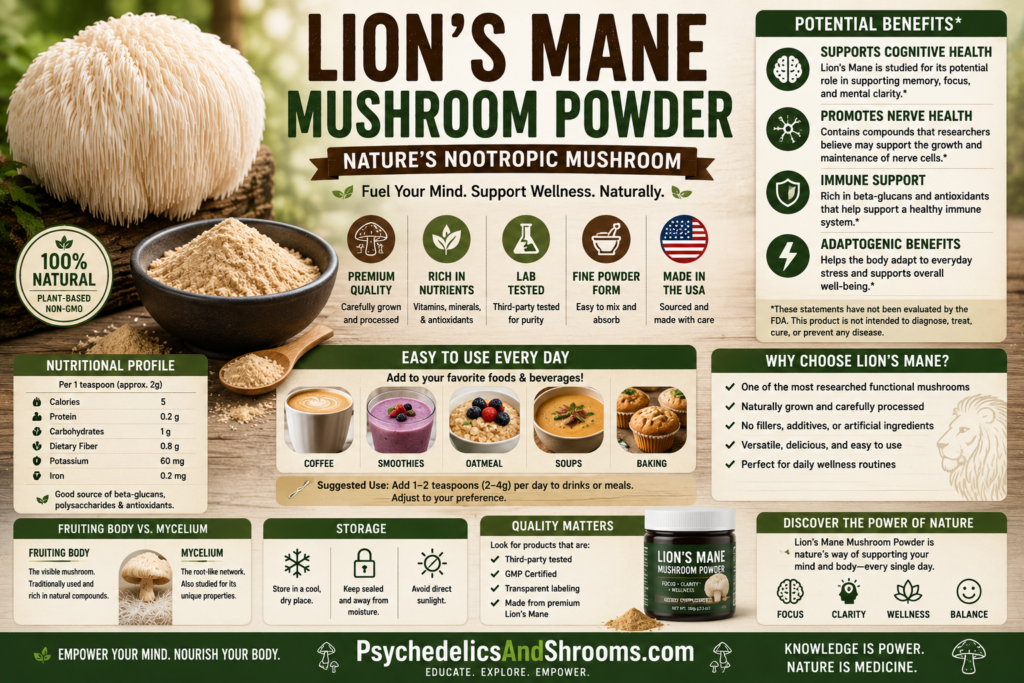
Lion’s Mane mushroom naturally contains several valuable nutrients and bioactive compounds, including:
- Dietary fiber
- Beta-glucans
- Potassium
- Phosphorus
- B vitamins
- Antioxidants
- Polysaccharides
- Ergothioneine
Researchers continue studying these naturally occurring compounds to better understand their biological activity.
Potential Benefits of Lion’s Mane Mushroom Powder
Current scientific research is exploring several areas of interest.
Supports Cognitive Health Research
Lion’s Mane is one of the most widely studied functional mushrooms in neuroscience research because of its unique naturally occurring compounds.
Provides Antioxidant Compounds
The mushroom contains antioxidant compounds that help protect cells from oxidative stress as part of normal metabolism.
Supports a Healthy Diet
Lion’s Mane powder can be incorporated into a balanced diet while adding naturally occurring nutrients and functional mushroom compounds.
Convenient Daily Use
The powder format makes it simple to add Lion’s Mane to smoothies, coffee, oatmeal, yogurt, soups, and baked recipes.
Popular Ways to Use Lion’s Mane Mushroom Powder
Many people incorporate the powder into everyday foods and beverages.
Popular options include:
- Coffee
- Tea
- Smoothies
- Protein shakes
- Oatmeal
- Soups
- Sauces
- Baking recipes
Always follow the serving guidance provided by the product manufacturer.
Fruiting Body vs. Mycelium
When shopping for Lion’s Mane products, you may notice that some use fruiting bodies while others use mycelium.
The fruiting body is the visible mushroom, while mycelium is the underground network of fungal threads. Both appear in commercial products, and manufacturers may use different production methods depending on the formulation.
Reading product labels helps consumers understand what is included.
Choosing a Quality Product
When selecting Lion’s Mane mushroom powder, consider:
- Clearly identified mushroom species
- Transparent ingredient labels
- Extraction method information
- Third-party testing when available
- Good Manufacturing Practices (GMP)
- Reputable manufacturers
Choosing products with clear labeling helps consumers make informed decisions.
Storage Tips
To maintain freshness:
- Store in a cool, dry place.
- Keep the container tightly sealed.
- Avoid moisture and direct sunlight.
- Follow the manufacturer’s storage recommendations.
Proper storage helps preserve quality.
Safety Considerations
Although Lion’s Mane is widely consumed as a food and dietary supplement, it may not be suitable for everyone.
Individuals who are pregnant, breastfeeding, have mushroom allergies, take prescription medications, or have underlying medical conditions should consult a qualified healthcare professional before using dietary supplements.
Lion’s Mane vs. Other Functional Mushrooms
Lion’s Mane differs from other well-known functional mushrooms such as:
- Reishi
- Turkey Tail
- Chaga
- Maitake
- Cordyceps
- Shiitake
Each species contains its own unique naturally occurring compounds and continues to be studied independently.
Readers interested in learning more about functional mushrooms and mushroom science can explore additional educational resources at https://psychedelicsandshrooms.com/guides/.
Final Thoughts
Lion’s Mane mushroom powder offers a convenient way to enjoy one of the most extensively researched functional mushrooms. Its versatility, nutritional profile, and growing scientific interest have made it a popular addition to many wellness routines. Choosing quality products and relying on evidence-based information helps consumers make informed decisions.
For more educational articles about mushrooms, functional fungi, mushroom nutrition, and mycology, visit https://psychedelicsandshrooms.com/.
FAQs
What is Lion’s Mane mushroom powder?
It is a finely ground powder made from Hericium erinaceus, commonly used in foods, beverages, and dietary supplements.
How can I use Lion’s Mane mushroom powder?
It can be mixed into coffee, tea, smoothies, soups, oatmeal, yogurt, and baking recipes.
Does Lion’s Mane mushroom powder contain nutrients?
Yes. It naturally contains beta-glucans, dietary fiber, antioxidants, B vitamins, and minerals.
How should I store Lion’s Mane mushroom powder?
Store it in a cool, dry place with the container tightly sealed and away from direct sunlight.
How do I choose a quality Lion’s Mane product?
Look for transparent ingredient labels, reputable manufacturers, third-party testing when available, and GMP manufacturing.
Where can I learn more about mushroom science?
Visit https://psychedelicsandshrooms.com/ and https://psychedelicsandshrooms.com/guides/ for educational mushroom resources.
