
mushroom and shrooms
Scientific Name for Mushroom: A Complete Guide to Mushroom Classification
Jul
Scientific name for mushroom helps researchers, educators, and mushroom enthusiasts accurately identify fungal species around the world. While many mushrooms have several common names that vary by region and language, each recognized species is assigned a unique scientific name using the internationally accepted system of biological classification known as binomial nomenclature.
Scientific names help eliminate confusion and allow scientists to communicate clearly about mushroom biology, ecology, nutrition, and conservation. Whether studying edible mushrooms, medicinal fungi, or wild species, learning scientific names provides a strong foundation in mycology.
Educational resources available at https://psychedelicsandshrooms.com/ help readers explore mushroom science, fungal biology, taxonomy, and the differences between edible, functional, medicinal, and psychedelic mushrooms through evidence-based information.
What Is the Scientific Name for a Mushroom?
There is no single scientific name that applies to all mushrooms because mushrooms belong to thousands of different fungal species.
Instead, each species has its own scientific name.
For example:
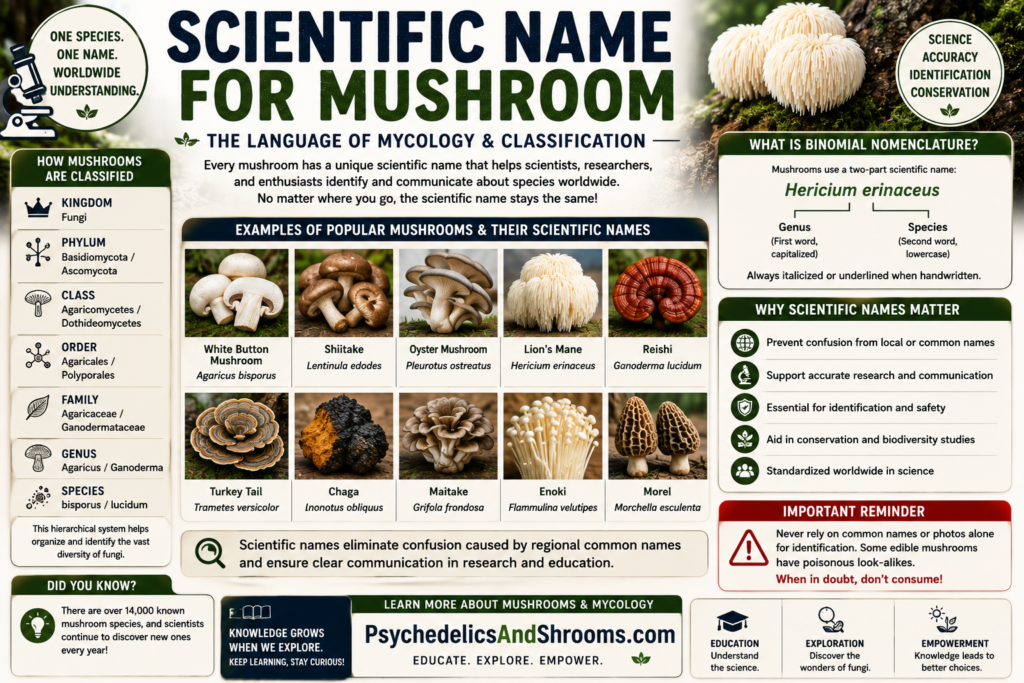
- White Button Mushroom — Agaricus bisporus
- Shiitake — Lentinula edodes
- Oyster Mushroom — Pleurotus ostreatus
- Lion’s Mane — Hericium erinaceus
- Reishi — Ganoderma lucidum
- Turkey Tail — Trametes versicolor
- Chaga — Inonotus obliquus
- Maitake — Grifola frondosa
- Enoki — Flammulina velutipes
- Morel — Morchella esculenta
Each scientific name uniquely identifies a species regardless of local common names.
What Is Binomial Nomenclature?
Scientific names follow the system of binomial nomenclature, developed by Swedish botanist Carl Linnaeus.
Every species receives two names:
- Genus
- Species
For example:
Hericium erinaceus
- Hericium = Genus
- erinaceus = Species
Scientific names are written in italics, with the genus capitalized and the species name in lowercase.
Why Scientific Names Matter
Scientific names are important because they:
- Prevent confusion caused by regional common names.
- Improve communication among scientists.
- Support accurate research.
- Help identify edible and poisonous species.
- Aid conservation efforts.
- Standardize mushroom classification worldwide.
How Mushrooms Are Classified
Mushrooms are classified through biological taxonomy.
The major levels include:
- Kingdom: Fungi
- Phylum
- Class
- Order
- Family
- Genus
- Species
Each level groups organisms according to shared evolutionary characteristics.
Examples of Popular Mushroom Scientific Names
Edible Mushrooms
- Agaricus bisporus — White Button, Cremini, Portobello
- Pleurotus ostreatus — Oyster Mushroom
- Lentinula edodes — Shiitake
- Flammulina velutipes — Enoki
Functional and Medicinal Mushrooms
- Hericium erinaceus — Lion’s Mane
- Ganoderma lucidum — Reishi
- Grifola frondosa — Maitake
- Trametes versicolor — Turkey Tail
- Inonotus obliquus — Chaga
Psilocybin-Containing Species
Scientists have identified several species that naturally contain psilocybin, including:
- Psilocybe cubensis
- Psilocybe semilanceata
- Psilocybe cyanescens
These species are studied in mycology and regulated scientific research. Their legal status varies depending on local laws.
Scientific Names vs. Common Names
Common names can vary widely between regions.
For example, Agaricus bisporus may be sold as:
- White Button
- Cremini
- Baby Bella
- Portobello
Although these names differ, they all refer to varieties of the same species.
Scientific names eliminate this confusion.
Mushroom Identification
Proper mushroom identification requires much more than knowing a scientific name.
Researchers examine:
- Cap shape
- Gills or pores
- Stem characteristics
- Spore print color
- Habitat
- Microscopic features
Because many edible and poisonous mushrooms appear similar, identification should never rely on photographs alone.
Why Mushroom Taxonomy Matters
Taxonomy helps scientists:
- Study biodiversity
- Track fungal evolution
- Improve conservation
- Conduct nutritional research
- Support medical and ecological studies
Accurate naming allows researchers worldwide to discuss the same species without ambiguity.
Readers interested in mushroom science and mycology can explore additional educational resources at https://psychedelicsandshrooms.com/guides/.
Final Thoughts
There is no single scientific name for mushroom because mushrooms represent thousands of different fungal species. Instead, every species has its own unique scientific name that reflects its classification within the fungal kingdom. Learning these names improves communication, supports accurate identification, and provides a deeper appreciation of mushroom diversity.
For more educational articles about mushrooms, fungal biology, mycology, and mushroom science, visit https://psychedelicsandshrooms.com/.
FAQs
Does every mushroom have a scientific name?
Yes. Every recognized mushroom species has its own scientific name.
What is the scientific name of the White Button Mushroom?
The scientific name is Agaricus bisporus.
Why are scientific names important?
They provide a universal system for identifying species and reduce confusion caused by regional common names.
Who developed the scientific naming system?
Carl Linnaeus developed the modern system of binomial nomenclature.
Are scientific names written differently from common names?
Yes. Scientific names are italicized, the genus begins with a capital letter, and the species name is lowercase.
Where can I learn more about mushroom science?
Visit https://psychedelicsandshrooms.com/ and https://psychedelicsandshrooms.com/guides/ for educational resources about mushrooms and mycology.
