
mushroom and shrooms
Mushroom Identification Guide: How to Identify Mushrooms and Fungi Safely
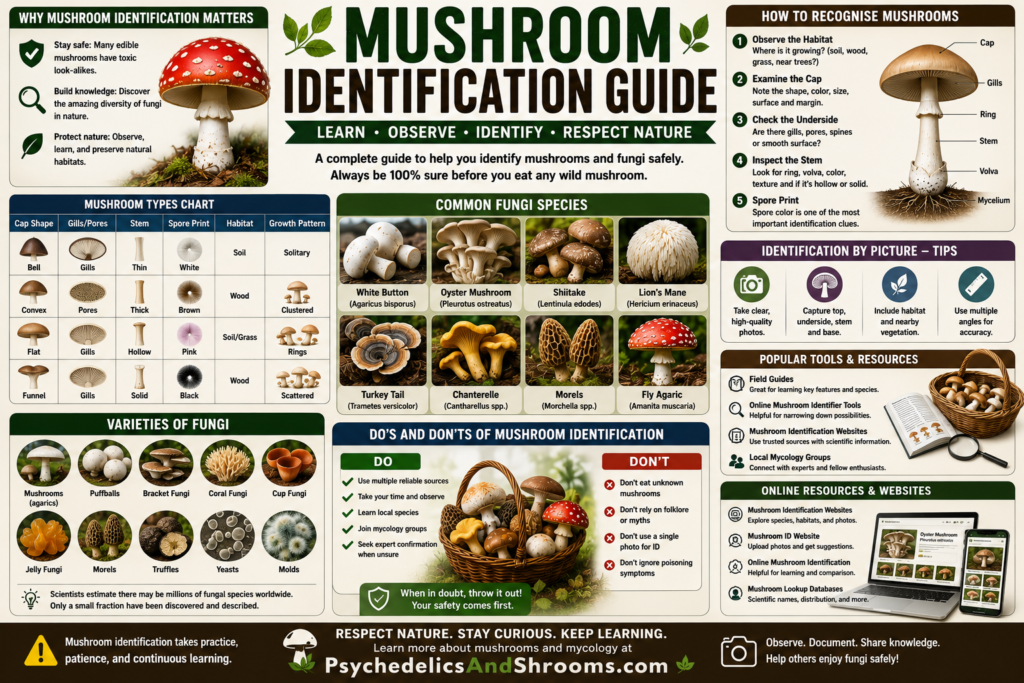
Aug
A reliable Mushroom Identification Guide is one of the most valuable resources for anyone interested in mushrooms, fungi, and the natural world. Whether you enjoy hiking, nature photography, gardening, or learning about mycology, understanding how to identify mushrooms correctly is essential. While many mushrooms are edible, others are poisonous or even deadly, making accurate identification a critical safety practice.
Today, mushroom enthusiasts have access to traditional field guides, digital references, online mushroom identifier tools, and scientific resources that make learning easier than ever. However, no single method should be relied upon when identifying wild mushrooms. Successful identification requires careful observation of physical characteristics, habitat, spore color, and other important features.
At https://psychedelicsandshrooms.com/, readers can explore educational resources covering mushroom biology, fungal science, mycology, mushroom cultivation, and current research related to edible, medicinal, functional, and psychedelic mushrooms.
Why Mushroom Identification Matters
Proper fungi identification helps people appreciate fungal diversity while reducing the risk of accidental poisoning. Thousands of mushroom species exist worldwide, and many closely resemble one another despite having very different properties.
Learning proper fungus identification allows enthusiasts to:
- Better understand fungal biodiversity
- Recognize edible and poisonous species
- Support conservation efforts
- Improve mushroom photography and documentation
- Develop mycology skills
- Study fungal ecology responsibly
Accurate identification is especially important because appearance alone is rarely enough to distinguish similar species.
How to Recognise Mushrooms
One of the most common questions beginners ask is how to recognise mushrooms correctly.
Experienced mycologists examine several characteristics rather than relying on a single feature.
Important identification characteristics include:
- Cap shape
- Cap texture
- Cap color
- Stem characteristics
- Gills, pores, or teeth
- Ring presence
- Volva or cup at the base
- Spore print color
- Odor
- Habitat
- Season
- Growth pattern
Every observation contributes to a more accurate identification.
Basic Mushroom Identification Technique
A proper mushroom identification technique follows a systematic process rather than making assumptions based on appearance.
A typical approach includes:
Step 1: Observe the Habitat
Determine whether the mushroom grows:
- On soil
- On wood
- On living trees
- In grasslands
- Near specific tree species
Habitat often provides important clues.
Step 2: Examine the Cap
Notice:
- Size
- Shape
- Color
- Surface texture
- Margin characteristics
Step 3: Study the Underside
Look for:
- Gills
- Pores
- Spines
- Smooth surfaces
These structures help narrow identification considerably.
Step 4: Inspect the Stem
Check for:
- Ring
- Bulb
- Volva
- Texture
- Color changes
- Hollow or solid interior
Step 5: Take a Spore Print
Spore print color is one of the most useful tools in fungus mushroom identification.
Fungi Identification Chart
Many beginners benefit from using a fungi identification chart or mushroom types chart.
Common features included on identification charts are:
| Feature | Examples |
|---|---|
| Cap Shape | Bell, convex, flat, funnel |
| Gills | Free, attached, crowded |
| Stem | Thick, thin, hollow, solid |
| Spore Print | White, pink, brown, black |
| Habitat | Soil, wood, grass |
| Growth Pattern | Solitary, clustered, rings |
Charts simplify comparisons between similar species.
Common Types of Fungi
Understanding the common types of fungi helps place mushrooms within the broader fungal kingdom.
Major groups include:
- Mushrooms
- Puffballs
- Bracket fungi
- Coral fungi
- Cup fungi
- Jelly fungi
- Morels
- Truffles
- Yeasts
- Molds
Each group has distinctive characteristics.
Common Fungi Species
Learning common fungi species builds confidence before attempting more difficult identifications.
Frequently encountered mushrooms include:
- White Button Mushroom (Agaricus bisporus)
- Oyster Mushroom (Pleurotus ostreatus)
- Shiitake (Lentinula edodes)
- Lion’s Mane (Hericium erinaceus)
- Turkey Tail (Trametes versicolor)
- Chanterelles (Cantharellus species)
- Morels (Morchella species)
Many species also have poisonous look-alikes, emphasizing the importance of accurate identification.
Cup Mushroom Identification
Cup mushroom identification focuses on fungi that develop cup-shaped fruiting bodies rather than the typical cap-and-stem structure.
Characteristics include:
- Cup-shaped fruiting body
- Smooth inner surface
- Spores produced inside the cup
- Often growing on wood or forest debris
Because several cup fungi resemble one another, microscopic examination is sometimes necessary.
Mushroom Lookup Resources
Modern mushroom lookup tools help enthusiasts compare observations with scientific descriptions.
Useful resources include:
- Printed field guides
- Regional mycology societies
- University databases
- Museum collections
- Scientific publications
These resources often provide more reliable information than image-only comparisons.
Online Mushroom Identifier Tools
An online mushroom identifier can help narrow possible matches based on photographs and descriptive characteristics.
However, no online mushroom identification system should be considered completely accurate.
Artificial intelligence and image recognition continue improving, but photo-based identification has important limitations.
Never consume a wild mushroom based solely on an app or photograph.
Mushroom Identification Websites
A reputable mushroom identification website provides more than photographs.
Quality educational websites typically include:
- Scientific names
- Habitat information
- Geographic distribution
- Spore print colors
- Seasonal appearance
- Similar species
- Safety notes
Using multiple references improves accuracy.
Fungus Identification by Picture
Many people search for fungus identification by picture because smartphone technology makes photographing mushrooms easy.
Photographs should include:
- Top of the cap
- Underside
- Stem
- Base
- Habitat
- Nearby vegetation
Multiple images provide far more useful information than a single photograph.
What Fungus Is This?
The question “What fungus is this?” is one of the most common online searches.
Unfortunately, experts often cannot identify a mushroom confidently from one image alone.
Additional information such as:
- Location
- Habitat
- Odor
- Spore print
- Size
- Seasonal timing
usually improves identification accuracy.
Identifying Fungi Safely
Safe identifying fungi practices include:
- Never tasting unknown mushrooms.
- Avoid relying on folklore.
- Use multiple identification resources.
- Learn local mushroom species.
- Join local mycology groups.
- Study poisonous look-alikes.
- Seek expert confirmation when necessary.
Responsible identification protects both people and ecosystems.
Varieties of Fungi
The varieties of fungi found worldwide are incredibly diverse.
Scientists estimate there may be several million fungal species, although only a fraction have been formally described.
Fungi perform important ecological roles by:
- Decomposing organic matter
- Recycling nutrients
- Supporting forest ecosystems
- Forming partnerships with plants
- Contributing to soil health
Why Evidence-Based Identification Matters
Accurate mushroom identification requires observation, patience, and reliable scientific references. While mobile apps and online tools continue to improve, they should complement—not replace—careful field observations and expert guidance. Building identification skills gradually helps enthusiasts appreciate fungal diversity while reducing unnecessary risks.
Readers interested in mushroom science, mycology, cultivation, and identification techniques can explore additional educational resources at https://psychedelicsandshrooms.com/guides/.
Final Thoughts
A comprehensive Mushroom Identification Guide is one of the best tools for learning about fungi safely and responsibly. By understanding key identification features, using mushroom identification charts, consulting reputable mushroom identification websites, and applying systematic identification techniques, beginners and experienced enthusiasts alike can build stronger mycology skills. Remember that accurate identification is essential, especially because many edible mushrooms have poisonous look-alikes.
For more educational resources about mushrooms, fungal biology, mycology, mushroom cultivation, and scientific research, visit https://psychedelicsandshrooms.com/.
Frequently Asked Questions
What is the best mushroom identification technique?
The best approach combines habitat observation, cap and stem examination, spore print analysis, and multiple scientific references.
Can an online mushroom identifier accurately identify every mushroom?
No. Online tools can help narrow possibilities but should never be the sole basis for identifying or consuming wild mushrooms.
What is a fungi identification chart?
A fungi identification chart compares characteristics such as cap shape, gills, stem features, habitat, and spore color to help distinguish species.
Are mushroom identification websites reliable?
Some are highly reliable, particularly those maintained by universities, mycological societies, or scientific organizations. Comparing several trusted sources is recommended.
What should I photograph for fungus identification by picture?
Capture the cap, gills or pores, stem, base, surrounding habitat, and nearby vegetation from multiple angles.
Why is mushroom identification important?
Proper identification helps distinguish edible species from poisonous look-alikes, supports scientific learning, and promotes safe enjoyment of nature.
