Uncategorized
Types of Mushroom: 10 Popular Varieties, Cooking Uses and Identification
Aug
Mushrooms represent one of the most diverse groups of organisms people encounter in forests, gardens, grocery stores, restaurants, and scientific research. Searching for types of mushroom can therefore produce everything from familiar white button mushrooms to unusual woodland fungi.
Understanding the different types of mushrooms starts with an important fact: a mushroom is a fungus, not a plant.
Scientists have described tens of thousands of mushroom-forming fungal species, while the total number of fungal species on Earth is thought to be vastly greater. Only a comparatively small selection of mushroom species regularly appears in American grocery stores.
This guide examines common mushroom varieties, their names, appearance, culinary roles, and basic identification concepts. It also looks at wild mushrooms in Michigan and Minnesota, where identification becomes a matter of safety rather than simply culinary curiosity.
For additional educational material covering mushrooms, fungi, and psychedelic research topics, readers can explore psychedelicsandshrooms.com.
Is a Mushroom a Plant?
Despite phrases such as mushroom plant type, mushrooms aren’t plants.
They belong to the kingdom Fungi.
Plants generally obtain energy through photosynthesis. Fungi instead obtain nutrients by breaking down organic material or through relationships with other organisms.
The mushroom we see above ground is often only the reproductive structure of a much larger organism.
Much of the fungus exists as mycelium—a network of microscopic filaments called hyphae growing through soil, wood, leaf litter, or another substrate.
This distinction explains why removing a visible mushroom does not necessarily remove the organism producing it.
How Many Types of Mushrooms Are There?
Questions such as how many types of mushrooms are there and how many kinds of mushrooms are there sound straightforward, but there isn’t one simple number.
Fungi constitute an enormous biological kingdom, and scientists continue discovering and classifying species.
Furthermore, not every fungus produces the classic cap-and-stem structure people associate with the word mushroom.
Mushroom-forming fungi include familiar gilled mushrooms as well as puffballs, brackets, morels, chanterelles, coral fungi, tooth fungi, and numerous other forms.
Consequently, a mushroom types list represents only a tiny fraction of global fungal diversity.
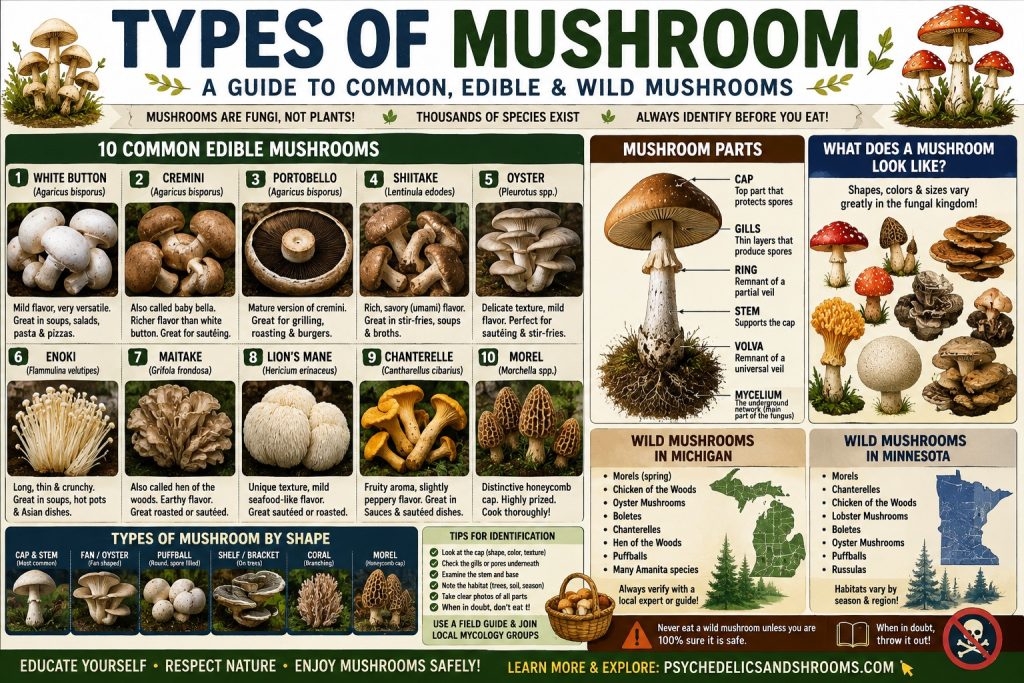
10 Types of Mushroom Commonly Known in the USA
For people searching 10 types of mushroom, these varieties provide a useful introduction to edible mushrooms encountered in American food culture.
| Mushroom | Typical appearance | Common culinary role |
|---|---|---|
| White button | Small, white rounded cap | Pizza, salads, sauces, soups |
| Cremini | Firm brown cap | Sautéing, pasta, soups |
| Portobello | Large, mature brown cap | Grilling and roasting |
| Shiitake | Brown umbrella-shaped cap | Stir-fries, soups, broths |
| Oyster | Fan-shaped clusters | Sautéing and stir-fries |
| Enoki | Very long thin stems | Soups and Asian dishes |
| Maitake | Layered, feather-like clusters | Roasting and sautéing |
| Lion’s mane | White cascading spines | Sautéing and roasting |
| Chanterelle | Yellow/orange funnel-like cap | Sauces and sautéed dishes |
| Morel | Distinctive honeycomb cap | Seasonal cooked dishes |
These popular mushrooms differ substantially in texture, flavor, appearance, availability, and price.
1. White Button Mushrooms
White button mushrooms are among the most recognizable common store mushroom types in the United States.
They have smooth white caps, relatively short stems, and pale flesh.
White buttons are immature forms of Agaricus bisporus. Interestingly, cremini and portobello mushrooms are also forms of the same species.
Their mild flavor makes them extremely versatile.
They commonly appear in pizza, omelets, pasta, salads, soups, sauces, and sautéed dishes.
For someone searching white mushroom types, the white button mushroom is usually the most familiar example.
2. Cremini Mushrooms
Cremini mushrooms are also called baby bella or baby portobello mushrooms.
They belong to Agaricus bisporus, just like white button mushrooms, but have brown caps and a somewhat deeper flavor.
They work particularly well in soups, pasta, sauces, and sautéed dishes.
This demonstrates why different names for mushrooms can sometimes create confusion: multiple commercial names may refer to the same biological species at different stages or varieties.
3. Portobello Mushrooms
Portobellos are mature Agaricus bisporus mushrooms.
Their large brown caps and substantial texture make them popular for grilling and roasting.
Button, cremini, and portobello mushrooms therefore provide a useful lesson in mushroom terminology.
Three different supermarket names do not necessarily mean three separate species.
4. Shiitake Mushrooms
Shiitake mushrooms, Lentinula edodes, are widely associated with East Asian cuisine but are now commonplace in American supermarkets.
They generally have brown caps and pale stems.
Shiitake mushrooms contribute a pronounced savory or umami character to soups, noodles, stir-fries, sauces, and broths.
Dried shiitakes are also popular because drying concentrates certain flavor characteristics.
5. Oyster Mushrooms
Oyster mushrooms belong primarily to the genus Pleurotus.
Instead of the conventional symmetrical mushroom shape, oyster mushrooms frequently grow in overlapping, fan-shaped clusters.
Their caps may be white, gray, tan, or other colors depending on the species and variety.
Oyster mushrooms have become particularly popular among home cooks because of their texture and versatility.
6. Enoki: The Classic Long Stem Mushroom
If someone searches for a long stem mushroom, they may be thinking of cultivated enoki.
Commercial enoki mushrooms usually have extremely long, slender white stems topped by small caps and grow in dense clusters.
They are common in soups, hot pots, and various East Asian dishes.
Wild forms can look considerably different from the pale, elongated cultivated form, demonstrating how growing conditions can influence mushroom appearance.
7. Maitake
Maitake, sometimes called hen of the woods, grows as clusters of overlapping gray-brown fronds.
Its unusual structure makes it quite different from a classic cap-and-stem mushroom.
Maitake has become increasingly popular in American cooking and is often roasted, sautéed, or incorporated into savory dishes.
It should not be confused with unrelated wild mushrooms simply because they grow in clusters.
8. Lion’s Mane
Lion’s mane is one of the easiest commercially cultivated mushrooms to recognize visually.
Rather than producing a traditional cap with gills, it forms cascading white tooth-like or hair-like structures.
Its unusual appearance has also made lion’s mane prominent in discussions about functional mushrooms.
Research into mushroom compounds is scientifically interesting, but supplement marketing claims should always be distinguished from clinically established medical benefits.
9. Chanterelle Mushrooms
Chanterelles include highly valued wild edible mushrooms, often with yellow to orange coloration and a funnel-like form.
However, wild mushroom identification requires expertise.
Color alone cannot establish identity.
Several unrelated mushrooms can share superficial characteristics. Anyone interested in wild chanterelles should therefore rely on multiple diagnostic features and experienced local identification rather than internet photographs alone.
10. Morel Mushrooms
Morels are famous spring mushrooms with distinctive caps containing pits and ridges resembling a honeycomb.
They are especially popular among foragers in parts of the Midwest.
Morels should be properly identified and cooked before consumption.
False morels and other superficially similar fungi demonstrate why a mushroom that “looks close enough” should never automatically be considered edible.
Common Cooking Mushrooms
For everyday grocery shopping, the most practical mushroom types food list is considerably shorter than a scientific species catalog.
Common choices include button, cremini, portobello, shiitake, oyster, enoki, and occasionally maitake and lion’s mane.
Different kinds of mushroom for cooking offer different characteristics.
Button mushrooms are mild.
Shiitakes provide stronger savory flavor.
Portobellos offer a substantial texture.
Oyster mushrooms are delicate but meaty.
Enoki provides an unusual thin, crisp structure.
Understanding these differences makes selecting mushrooms for recipes easier than simply looking for the “best” variety.
What Does a Mushroom Look Like?
The stereotypical mushroom has a cap sitting on top of a central stem.
Real mushrooms are dramatically more diverse.
Possible structures include:
- rounded caps with stems;
- fan-shaped caps;
- shelf-like brackets;
- puffballs;
- cups;
- coral-like branches;
- honeycomb-like caps;
- cascading teeth;
- gelatinous structures; and
- irregular woodland forms.
The underside can contain gills, pores, teeth, or other spore-producing structures.
Therefore, answering what does a mushroom look like requires much more than describing an umbrella-shaped cap.
What Is a Thin Flat Brown Mushroom?
A thin flat brown mushroom cannot be reliably identified from those characteristics alone.
Hundreds of fungi can potentially match a broad description involving brown coloration and a flattened cap.
Proper identification may involve cap texture, gill structure, stem characteristics, bruising reactions, habitat, substrate, season, spore characteristics, and other features.
This illustrates a fundamental rule of mushroom identification:
Never determine edibility from a short visual description alone.
Mushroom Names: Common Names vs. Scientific Names
Mushroom names can be surprisingly confusing.
A single mushroom may have several regional common names, while the same informal name may occasionally be applied to different species.
Scientific nomenclature reduces this ambiguity.
For example:
White button, cremini, and portobello: Agaricus bisporus
Shiitake: Lentinula edodes
Lion’s mane: Hericium erinaceus
Using scientific names becomes particularly valuable when researching wild mushrooms, where confusing two species can have serious consequences.
Mushroom Species vs. Mushroom Varieties
The words mushroom species and mushroom varieties are frequently used interchangeably online, but they do not always mean the same thing scientifically.
A species represents a formal biological classification.
“Variety” is frequently used informally in food and consumer discussions to distinguish recognizable types.
Similarly, psychedelic communities sometimes use the word “strain” for cultivated mushroom lines. Such informal names should not automatically be interpreted as separate taxonomic species.
Readers interested in understanding mushroom terminology in psychedelic contexts can explore further educational material at psychedelicsandshrooms.com.
Types of Fungi: Mushrooms Are Only One Part
The phrase types of fungi mushrooms highlights another misconception.
Not every fungus is a mushroom.
The fungal kingdom also contains molds, yeasts, rust fungi, smuts, and numerous microscopic species.
Even among mushroom-forming fungi, fruiting bodies vary enormously.
Mushrooms are therefore best understood as one highly visible expression of fungal biology rather than as a synonym for every fungus.
Types of Mushrooms in Michigan
Michigan’s forests, wetlands, woodlands, and seasonal climate support substantial fungal diversity.
People searching types of mushrooms in Michigan, common mushrooms in Michigan, or wild Michigan mushrooms may encounter groups such as morels, oyster mushrooms, puffballs, boletes, bracket fungi, chanterelle-like fungi, Amanita species, and many others.
Michigan is particularly famous among foragers for morel season.
However, the state’s diversity also includes poisonous species.
That makes mushrooms Michigan identification considerably more serious than identifying packaged supermarket mushrooms.
Red Mushrooms in Michigan
They can belong to numerous unrelated groups.
Red coloration alone is not enough to identify a mushroom.
Some Amanita, Russula, waxcap, and other fungi can display red, reddish-orange, or pink coloration.
Environmental conditions can also alter colors as mushrooms age.
A photograph showing only the top of a red cap may omit essential identification characteristics underneath the cap and around the stem base.
Identifying Mushrooms in Michigan
Reliable identifying mushrooms in Michigan involves observing multiple features.
Important characteristics can include cap shape, cap surface, gills or pores, stem structure, presence of a ring, structures at the stem base, bruising reactions, odor, substrate, surrounding trees, season, and spore characteristics.
One particularly important rule concerns the base of the mushroom.
Pulling or cutting away only the visible stem can remove structures that are essential for identifying certain groups.
Photographs for identification should ideally document the entire intact specimen and its habitat.
Even then, online identification should not automatically be treated as confirmation that a wild mushroom is safe to eat.
Choosing a Michigan Mushroom Identification Book
A good Michigan mushroom identification book should emphasize regional species rather than attempting to cover the entire world.
Useful features include:
- high-quality photographs;
- scientific and common names;
- cap and underside photographs;
- habitat information;
- seasonal occurrence;
- look-alike comparisons;
- toxicity warnings; and
- updated taxonomy.
Regional mushroom clubs and experienced mycologists can provide additional educational support.
A field guide is an identification tool—not a guarantee of edibility.
Types of Mushrooms in Minnesota
Minnesota also supports extensive fungal diversity because of its forests, wetlands, grasslands, hardwoods, conifers, and seasonal climate.
Searches for types of mushrooms in Minnesota may lead to morels, chanterelles, boletes, oyster mushrooms, puffballs, polypores, Amanita species, Russula, and many other groups.
Species distribution varies according to habitat, weather, season, and associated plants.
Foragers should therefore use resources specifically relevant to Minnesota and the Upper Midwest rather than relying exclusively on generic mushroom images.
Why Mushroom Varieties Images Aren’t Enough for Identification
Searching mushroom varieties images is useful for learning general appearance.
It is not sufficient for deciding whether a wild mushroom is edible.
Photographs flatten three-dimensional structures and can distort size and color. They may also fail to show the underside, stem base, bruising, substrate, or microscopic characteristics.
Modern image-recognition applications have the same fundamental limitation: an algorithmic suggestion should not be treated as confirmation that an unknown wild mushroom is safe to consume.
Never Use Taste as an Identification Shortcut
Wild mushroom identification has real consequences because some poisonous fungi can cause severe illness, organ injury, or death.
There is no universal visual rule separating edible mushrooms from poisonous ones.
Folklore tests involving animals, insects, silver utensils, cooking methods, or appearance are not reliable safety systems.
When identity is uncertain, the safest culinary decision is straightforward:
Do not eat the mushroom.
Edible, Poisonous and Psychoactive Mushrooms Are Different Categories
Another important educational distinction is that mushrooms can contain dramatically different compounds.
Some species are widely consumed foods.
Why others contain medically interesting compounds.
Some contain toxins.
Certain species contain psychoactive substances such as psilocybin.
A mushroom’s natural origin does not determine whether it is safe.
Likewise, describing a fungus as a “magic mushroom” provides far less scientific information than establishing its actual species and chemical composition.
Additional educational resources concerning psychedelic mushrooms and their scientific context are available through psychedelicsandshrooms.com.
Frequently Asked Questions
What are the most common types of mushroom?
Common supermarket mushrooms include white button, cremini, portobello, shiitake, oyster, and enoki. Maitake and lion’s mane have also become increasingly common.
How many kinds of mushrooms are there?
There are tens of thousands of described mushroom-forming fungi, and fungal diversity extends far beyond mushrooms. Scientists continue identifying and classifying new species.
What are the best kinds of mushroom for cooking?
It depends on the dish. Button mushrooms are mild and versatile, shiitakes provide strong savory flavor, portobellos have a substantial texture, and oyster mushrooms work well in numerous sautéed dishes.
Are white button, cremini, and portobello different species?
No. All three are forms of Agaricus bisporus. Their different commercial names reflect differences in appearance and maturity rather than three separate species.
What mushrooms grow wild in Michigan?
Michigan supports numerous groups, including morels, boletes, oyster mushrooms, puffballs, polypores, Amanita, and many others. Wild mushrooms should be identified using regional expertise before any consideration of consumption.
Can I identify a mushroom from a photograph?
A photograph can help narrow possibilities, but it may omit critical features. Photo-based or app-based identification should not be considered sufficient confirmation that a wild mushroom is edible.
