
mushroom and shrooms
Psilocybe Azurescens: Flying Saucer Mushrooms, Potency, Identification & U.S. Distribution
Aug
What Is Psilocybe Azurescens?
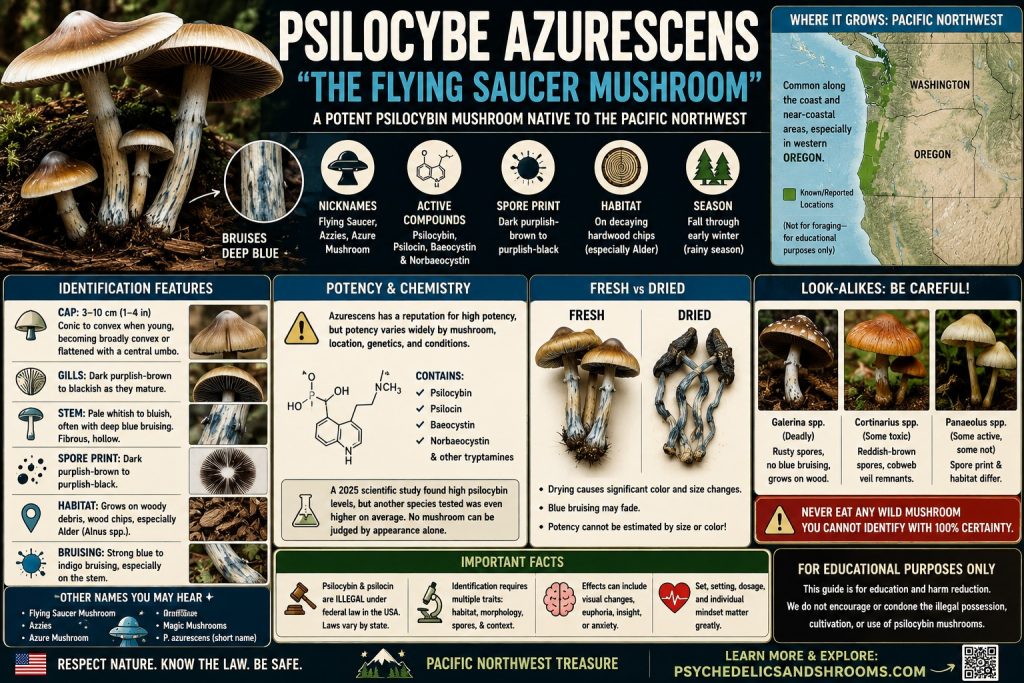
Psilocybe azurescens is a psilocybin-producing mushroom species associated particularly with the Pacific Northwest of North America. The scientific name was formally published by Paul Stamets and Jochen Gartz in 1995, and current taxonomic databases recognize Psilocybe azurescens as a species.
The species is widely known by informal names such as flying saucer mushroom, azure mushroom, “azzies,” and sometimes blue-themed mushroom names.
Its reputation largely comes from three characteristics:
- relatively large fruiting bodies compared with some other Psilocybe species;
- pronounced blue-to-indigo bruising after tissue damage; and
- potentially high concentrations of psychedelic tryptamines.
However, descriptions such as strongest psilocybin mushroom, largest magic mushroom, and biggest psychedelic mushroom need qualification. Modern chemical research demonstrates considerable variability in mushroom chemistry, meaning no species nickname guarantees the potency of an individual specimen.
This guide is for identification, taxonomy, chemistry, safety, and public education. It does not provide instructions for growing, obtaining, preparing, or consuming psilocybin mushrooms.
For additional educational mushroom material, explore psychedelicsandshrooms.com.
Psilocybe Azurescens at a Glance
| Characteristic | Psilocybe azurescens |
|---|---|
| Kingdom | Fungi |
| Genus | Psilocybe |
| Species | P. azurescens |
| Scientific authorship | Stamets & Gartz, 1995 |
| Common nickname | Flying saucer mushroom |
| General U.S. association | Pacific Northwest |
| Substrate association | Woody debris |
| Bruising | Strong blue/indigo discoloration can occur |
| Spore print | Dark purplish-brown to purplish-black described |
| Psychoactive compounds | Psilocybin, psilocin and related tryptamines |
| U.S. federal status | Psilocybin and psilocin are federally controlled |
Its type information is particularly relevant to the Oregon association: Index Fungorum records the type material as occurring on Alnus rubra wood chips in Oregon.
Why Is It Called the Flying Saucer Mushroom?
The nickname flying saucer mushroom or flying saucers mushroom comes from the appearance of mature caps, which can broaden considerably while retaining a central raised area.
The formal species description characterized caps as approximately 30–100 mm across, initially conic-to-convex and becoming broadly convex or flatter with maturity while retaining a pronounced umbo.
That shape helped inspire the memorable “flying saucer” terminology.
It isn’t a separate species.
Flying saucer mushroom = a common nickname associated with Psilocybe azurescens.
P. Azurescens and PS Azurescens Mean the Same Thing
Searches for P azurescens and PS azurescens are generally abbreviations for Psilocybe azurescens.
Scientific writing normally abbreviates the genus after it has first been written in full:
Psilocybe azurescens → P. azurescens
Using the full scientific name at least once is particularly useful because common mushroom names are frequently ambiguous.
Identifying Psilocybe Azurescens
Wild mushroom identification should never depend on a single feature.
The original species description included a combination of macroscopic and microscopic characteristics.
Cap
The cap can develop from conic or convex toward broadly convex or relatively flattened with maturity.
Caramel, chestnut and ochraceous-brown coloration has been described, with color changing as moisture conditions change.
Central Umbo
A conspicuous raised central portion of the cap is an important feature commonly associated with the species.
Stem
The stem is generally pale to white when relatively young, with additional discoloration developing with age or injury.
Blue Bruising
Damage can produce substantial blue coloration, eventually becoming deeper blue or indigo-black.
But this point is critical:
Blue bruising alone does not prove that a mushroom is Psilocybe azurescens.
Gills
The gills mature toward brownish coloration and can darken substantially where damaged.
Spores
The species has dark spores. The original description reports a spore print that is dark purplish-brown to purplish-black.
Correct identification involves the combination of morphology, microscopy, ecology and, where necessary, molecular methods.
Mushrooms With Black Spores Aren’t Automatically Azurescens
Keywords such as black gilled mushrooms, black mushroom identification, and mushrooms with black spores shouldn’t be used as shortcuts to P. azurescens identification.
Numerous unrelated mushrooms develop dark gills or dark spore deposits.
Furthermore, what appears “black” to an observer can actually be dark brown, purple-brown, purple-black or another very dark shade.
Spore color is one taxonomic characteristic—not an edibility or psychoactivity test.
Why Does Psilocybe Azurescens Bruise Blue?
Blue bruising is associated with chemical reactions occurring after tissues of certain psilocybin-containing mushrooms are damaged.
The blue color shouldn’t be imagined as simply “blue psilocybin” sitting inside the mushroom. Injury initiates chemical reactions involving psilocybin-related compounds and oxidation products.
This same general bluing phenomenon occurs among several Psilocybe species.
It is scientifically interesting, but bluing is not a reliable stand-alone field test for safety, identity, or potency.
Is Psilocybe Azurescens the Strongest Psilocybin Mushroom?
You’ll frequently encounter P. azurescens described as the strongest psilocybin mushroom.
Historically, the species earned a reputation for unusually high concentrations of psilocybin-related alkaloids. Its original description specifically noted unusually high concentrations of psilocybin, psilocin and baeocystin.
But declaring any one species the permanent “strongest mushroom in the world” oversimplifies the evidence.
A particularly useful modern study published in 2025 chemically profiled several Psilocybe species under controlled research conditions. In that experiment, P. zapotecorum had the highest measured psilocybin concentration among the species tested—not P. azurescens. Researchers also found that species, storage, mushroom development and other factors affected chemical composition.
Older research on Pacific Northwest mushrooms likewise found substantial variation in psilocybin and psilocin concentrations between collections—even within species.
The scientifically responsible conclusion is therefore:
Psilocybe azurescens is recognized as a potentially high-potency psilocybin-producing species, but appearance or species name cannot predict the chemical concentration of an individual mushroom.
Strong Psychedelic Mushrooms Aren’t Necessarily Predictable
The phrase strong psychedelic mushrooms can create the false impression that potency is a fixed species characteristic.
Actual chemistry is more complicated.
Variables can include:
genetics, developmental stage, environmental conditions, mushroom tissue, storage conditions and specimen-to-specimen variation.
A genetic and chemical survey has confirmed multiple tryptamines across Psilocybe species, including P. azurescens.
Laboratory analysis is substantially more informative than judging strength by cap size, blue bruising, nickname or online reputation.
Is Psilocybe Azurescens the Biggest Magic Mushroom?
Not in any scientifically meaningful universal sense.
P. azurescens can produce relatively substantial fruiting bodies, and the formal description reported caps reaching around 10 cm and stems potentially approaching 20 cm.
That’s large compared with some small Psilocybe species.
But biggest magic mushroom and largest magic mushroom aren’t formal taxonomic categories.
Other psilocybin-producing species can also develop substantial fruiting bodies.
More importantly:
Physical size doesn’t reliably predict psilocybin concentration.
A large mushroom isn’t automatically stronger than a small one.
Psilocybe Azurescens and Oregon
The association between azurescens and Oregon is well established.
Index Fungorum’s record for the species lists the type locality/substrate as wood chips of red alder (Alnus rubra) in Oregon.
The original description characterized it as a Pacific Northwest species associated with deciduous woody debris in coastal environments.
This geographic history explains search terms such as:
Oregon blue mushrooms
azurescens Oregon
Psilocybe azurescens map USA
But “Oregon blue mushroom” isn’t a reliable scientific name.
Many fungi can appear blue or bruise blue.
Psilocybe Azurescens Map USA
People searching for a Psilocybe azurescens map generally want to understand the species’ geographic distribution.
Its best-known natural association is the Pacific Northwest, particularly the coastal region around northern Oregon and adjacent areas. Herbarium-based information also reports collections or introductions beyond that core area.
However, internet mushroom maps have important limitations.
A pin on a map may represent:
- a professionally verified herbarium specimen;
- a citizen-science observation;
- an old historical record;
- an introduced population;
- a misidentification; or
- a cultivated occurrence rather than a naturally established population.
A Psilocybe azurescens map USA should therefore be interpreted as distribution information, not as a guide for obtaining psychoactive mushrooms.
Habitat and Ecology
P. azurescens is saprotrophic, meaning it obtains nutrients by decomposing organic material.
The species has a particularly strong association with woody debris.
Its original description characterized it as lignicolous—wood-associated—and occurring in soil enriched with deciduous wood debris in coastal Pacific Northwest environments.
That ecology is scientifically important because fungi are major decomposers.
They participate in nutrient cycling by breaking down complex organic materials that would otherwise accumulate in ecosystems.
This ecological role exists independently of the mushroom’s psychoactive chemistry.
Growing Azurescens: Why This Article Doesn’t Provide Instructions
Search phrases such as:
growing azurescens
growing Psilocybe azurescens
azurescens mushroom growing
Psilocybe azurescens grow
are common online.
Cultivation is scientifically relevant. Researchers cultivate fungi under controlled laboratory conditions to establish authenticated reference materials and investigate their chemistry.
For example, the 2025 reference-material study successfully cultivated P. azurescens and other Psilocybe species under controlled research conditions, verifying species through anatomical, microscopic and DNA methods before chemical analysis.
That doesn’t make home cultivation legally equivalent to laboratory research.
Because P. azurescens produces federally controlled psychedelic substances in the United States, this educational article does not provide substrate recipes, environmental parameters, inoculation procedures, cultivation schedules, harvesting instructions or other actionable growing guidance.
Readers interested in mushroom cultivation can instead study legal culinary species such as oyster, shiitake and lion’s mane mushrooms.
Dried Psilocybe Azurescens
Searches for dried Psilocybe azurescens, azurescens dried, and dried azurescens often appear alongside potency questions.
Drying changes the physical appearance of mushrooms dramatically.
Colors can fade or darken, tissue shrinks, diagnostic characteristics become less obvious, and bruising can become difficult to interpret.
Consequently, identifying an unknown dried mushroom from appearance is substantially less reliable than examining a complete fresh specimen with ecological and microscopic information.
Chemical composition can also change with handling and storage.
The 2025 reference-material research found that storage conditions affected measured psilocybin and psilocin composition.
This is another reason dried appearance cannot reveal potency.
Psilocybe Azurescens Street Name
There is no single standardized Psilocybe azurescens street name.
Common informal terms include:
- flying saucers;
- azzies;
- azure mushrooms; and
- flying saucer mushrooms.
Common names aren’t regulated scientific terminology.
A substance or mushroom sold under one of these names cannot be assumed to have been authenticated as P. azurescens.
Psilocybe Azurescens vs. Other Magic Mushroom Varieties
The phrase magic mushroom varieties encompasses multiple species, not simply different “strains” of one mushroom.
| Mushroom | Scientific status | General distinction |
|---|---|---|
| Psilocybe azurescens | Species | Pacific Northwest wood-associated species |
| Psilocybe cubensis | Species | Widely discussed tropical/subtropical species |
| Psilocybe cyanescens | Species | Wood-associated species with characteristically wavy mature caps |
| Psilocybe semilanceata | Species | Small grassland-associated species |
| Panaeolus cyanescens | Different genus/species | Psilocybin-producing Panaeolus |
Calling all of these “strains” is scientifically inaccurate.
They represent distinct fungal taxa.
Psilocybe Azurescens vs. Psilocybe Cyanescens
The names are easy to confuse.
Both are blue-bruising, wood-associated Psilocybe species discussed in connection with the Pacific Northwest.
But they aren’t simply two names for the same mushroom under conventional taxonomic treatment.
P. azurescens was described as having characteristics distinguishing it from P. cyanescens, including its pronounced umbo and microscopic differences.
Correct differentiation may require more than casual photographs.
Black Mushroom Identification and Look-Alike Risk
Black mushroom identification is particularly unsuitable as a shortcut.
Mushrooms change appearance with moisture, age, injury and decomposition. Gills can darken as spores mature, while bruising or decay can introduce additional colors.
A dark-gilled mushroom found in Oregon isn’t automatically P. azurescens.
Wild fungi include toxic species.
Therefore:
Never use blue bruising, dark spores, geographic location, or cap shape alone to determine that an unknown mushroom is safe to consume.
Professional identification considers multiple independent characteristics.
Potential Effects and Risks
Psilocybin is metabolized to psilocin, which produces psychedelic effects largely through serotonin-receptor activity.
Effects can involve significant changes in:
- visual perception;
- sensory processing;
- emotions;
- thought;
- time perception;
- self-perception; and
- interpretation of the surrounding environment.
Unwanted reactions can include fear, panic, confusion, nausea, impaired judgment and psychologically overwhelming experiences.
Potency variability adds uncertainty when whole mushrooms are involved.
This is fundamentally different from modern clinical trials using characterized compounds, defined protocols, participant screening and professional supervision.
Legal Status in the United States
Psilocybin and psilocin remain controlled substances under U.S. federal law.
At the same time, some states and municipalities have adopted reforms involving decriminalization, regulated psychedelic services, enforcement priorities, or research.
Those concepts are not interchangeable.
Decriminalization ≠ federal legalization.
Regulated therapeutic access ≠ unrestricted recreational sale.
Clinical research authorization ≠ permission for general cultivation.
Readers should consult current state and local government sources because psychedelic policy continues to evolve.
Frequently Asked Que stions
1. What is Psilocybe azurescens?
Psilocybe azurescens is a psilocybin-producing mushroom species formally described by Stamets and Gartz in 1995 and strongly associated with the Pacific Northwest.
2. Why is Psilocybe azurescens called a flying saucer mushroom?
The nickname relates to the broad shape mature caps can develop, often with a conspicuous central umbo.
3. Is Psilocybe azurescens the strongest psychedelic mushroom?
It has a long-standing reputation as a high-potency species, but “strongest” is too absolute. Modern research demonstrates substantial chemical variability, and a 2025 controlled study found another tested species with a higher measured psilocybin concentration.
4. Where is Psilocybe azurescens found in the USA?
Its best-established natural association is with the Pacific Northwest, particularly coastal northern Oregon and surrounding areas. Distribution records should not be interpreted as foraging or procurement directions.
5. Does Psilocybe azurescens have black spores?
Descriptions generally characterize its spore print as very dark purplish-brown to purplish-black. Dark spores alone cannot identify the species.
6. Can you identify Psilocybe azurescens from blue bruising?
No. Blue bruising is one characteristic but isn’t sufficient to establish species, safety, edibility or potency.
Educational Resources
For broader educational reading about fungi, psilocybin research, mushroom identification and the difference between mushroom species and informal strain names, explore psychedelicsandshrooms.com.
The NCBI Taxonomy record for Psilocybe azurescens provides scientific taxonomic information, while a recent PubMed study on Psilocybe reference materials and chemical profiles provides useful modern evidence about species identification and chemical variability.
