mushroom and shrooms
Cordyceps Supplement: Benefits, Uses, Energy, Safety & Side Effects
Aug
What Is a Cordyceps Supplement?
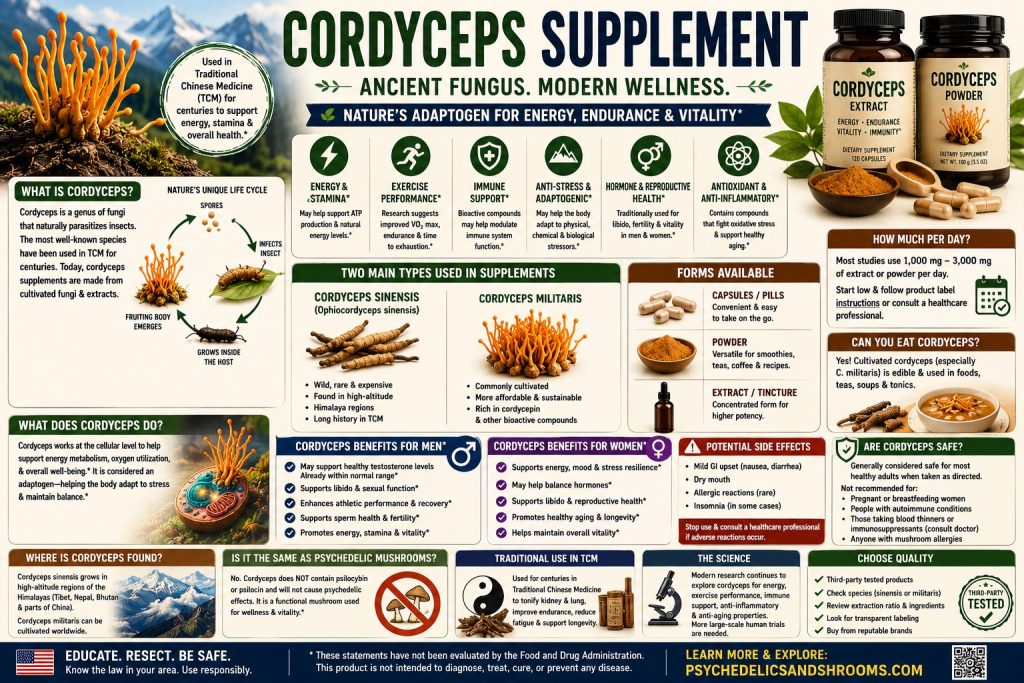
A cordyceps supplement is a dietary supplement containing material or extracts derived from fungi associated with the Cordyceps group. These products have become increasingly visible in the United States as functional-mushroom supplements marketed around energy, exercise, endurance and general wellness.
Cordyceps has a much longer history than today’s capsules and powders. Certain cordyceps fungi have been used within traditional Chinese medicine (TCM), while modern researchers have investigated their chemistry and possible biological effects.
One complication is that the word cordyceps can describe several different things.
Traditional Ophiocordyceps sinensis—historically called Cordyceps sinensis—is not necessarily the same fungal material found in a modern American supplement. Many commercial products instead use cultivated fungi such as Cordyceps militaris or cultured mycelial preparations.
That distinction matters when interpreting research.
A study involving one species or extract cannot automatically establish that every cordyceps mushroom supplement produces the same effects.
For more educational material about functional fungi and mushroom supplements, readers can explore psychedelicsandshrooms.com.
What Are Cordyceps?
Cordyceps are fungi, not plants.
The group is famous for its unusual ecology. Many cordyceps-related fungi are parasites of insects or other arthropods.
A fungal infection can develop inside an insect host before eventually producing a fruiting structure.
This extraordinary lifecycle helped make cordyceps famous well beyond mycology.


6
Popular culture sometimes portrays cordyceps as though it could turn humans into fungus-controlled “zombies.” That’s fiction.
The biology of insect-parasitic fungi does not mean consuming an ordinary cordyceps dietary supplement causes a comparable infection in humans.
Cordyceps Sinensis: Understanding the Name
Cordyceps sinensis is an older scientific name still heavily used in supplement searches and traditional-medicine literature.
The currently accepted name is Ophiocordyceps sinensis.
The fungus has a remarkable natural lifecycle associated with caterpillars in high-altitude regions of the Tibetan Plateau and surrounding areas.
Natural material can be scarce and expensive.
Consequently, the modern supplement market includes cultivated fungal preparations designed to provide more scalable alternatives.
Consumers shouldn’t assume that a bottle labeled “cordyceps” contains wild-harvested O. sinensis.
Cordyceps Sinensis vs. Cordyceps Militaris
These names are often confused.
| Characteristic | Ophiocordyceps sinensis | Cordyceps militaris |
|---|---|---|
| Older/common terminology | Cordyceps sinensis | Cordyceps militaris |
| Natural ecology | Caterpillar-associated fungus | Insect-associated fungus |
| Traditional use | Long TCM history | Also used/studied |
| Cultivation | Natural form is difficult to reproduce commercially | Can be cultivated |
| Supplement use | Cultured preparations may be used | Common modern supplement source |
| Notable research compound | Various fungal metabolites | Often studied for cordycepin |
Therefore, research on C. militaris shouldn’t automatically be presented as evidence about wild O. sinensis.
Cordyceps Benefits: What Does the Research Actually Suggest?
The phrase cordyceps benefits produces an enormous range of online claims.
Some are substantially better supported than others.
Researchers have investigated cordyceps preparations in areas including:
- exercise performance;
- fatigue;
- oxygen utilization;
- immune signaling;
- inflammation;
- metabolic health;
- cardiovascular physiology; and
- aging-related biological pathways.
But investigation doesn’t equal proven clinical benefit.
Many studies involve animals, isolated cells, small human samples or specific extracts that may differ considerably from retail supplements.
A recent systematic review and meta-analysis examining Cordyceps sinensis supplementation and aerobic performance found evidence suggesting improvements in some endurance-related measures, while also emphasizing heterogeneity among studies.
That makes exercise performance one of the more interesting areas of cordyceps research—but not a reason to describe the fungus as a guaranteed performance enhancer.
Do Cordyceps Give You Energy?
The question “does cordyceps give you energy?” needs clarification.
Cordyceps isn’t comparable to caffeine.
A cup of coffee can produce relatively rapid central nervous system stimulation because caffeine blocks adenosine receptors.
Cordyceps is different.
Research interest in “energy” generally concerns exercise physiology, cellular energy metabolism, oxygen utilization and fatigue rather than an immediate stimulant effect.
Therefore:
Cordyceps supplements shouldn’t automatically be expected to produce a caffeine-like buzz.
Someone may perceive improved energy or endurance, but subjective testimonials don’t prove that cordyceps caused the change.
What Does Cordyceps Do?
At the laboratory level, cordyceps-derived compounds interact with numerous biological pathways.
One compound receiving considerable scientific attention is cordycepin, also called 3′-deoxyadenosine.
Cordycepin has been investigated for biological activity involving cellular signaling, inflammation and metabolism.
Much of that research remains preclinical.
A compound demonstrating an interesting effect in cultured cells does not mean consuming a mushroom powder will reproduce the same effect in a person.
This is one of the most important distinctions in functional-mushroom science.
Cordyceps and Exercise Performance
Exercise is among the most commonly marketed applications for cordyceps.
Human studies have examined outcomes such as:
VO₂ max — the body’s maximum capacity to use oxygen during intense exercise.
Time to exhaustion — how long someone can sustain a particular workload.
Aerobic capacity — the ability to perform exercise using oxygen-dependent energy systems.
Fatigue — a more complicated outcome influenced by numerous physiological and psychological factors.
Research results aren’t perfectly consistent.
Different studies have used different species, preparations, quantities, populations and durations.
Cordyceps should therefore be viewed as an area of active research rather than an established substitute for training, adequate nutrition, sleep or medical treatment.
Cordyceps Benefits for Males
Searches for cordyceps benefits for male commonly involve testosterone, fertility, libido, athletic performance and energy.
Animal and laboratory research has investigated reproductive biology and steroidogenesis in relation to cordyceps-derived compounds.
However, these findings are frequently exaggerated when translated into supplement advertising.
There isn’t strong enough evidence to tell healthy men that ordinary cordyceps supplements reliably:
- raise testosterone;
- treat erectile dysfunction;
- increase fertility;
- increase sperm count; or
- build muscle.
Men should be especially skeptical of products promising hormone enhancement without robust human clinical evidence.
Cordyceps may have interesting biological properties, but “male vitality” is primarily a marketing category rather than a precise medical outcome.
Cordyceps Benefits for Females
Similarly, cordyceps benefits for female is a broad search phrase rather than a specific clinical indication.
Cordyceps is sometimes marketed to women for:
- energy;
- exercise performance;
- stress;
- immune support;
- libido;
- hormonal balance; and
- healthy aging.
Evidence for these outcomes varies substantially.
There is not strong evidence that a typical cordyceps supplement can “balance female hormones,” treat infertility, correct menstrual disorders or replace evidence-based treatment for menopause.
Women may participate in general cordyceps research concerning exercise or wellness, but female-specific medical claims require much stronger evidence.
What Is Cordyceps Good For?
A more evidence-conscious interpretation of what is cordyceps good for is:
Cordyceps is a functional fungus with a history of traditional use and growing scientific interest, particularly around exercise physiology and bioactive fungal compounds.
That’s different from saying it cures diseases.
Consumers should be cautious when supplements promise treatment for cancer, diabetes, kidney disease, heart disease, infertility or other serious conditions.
In the United States, dietary supplements aren’t approved by FDA as medicines before being marketed in the same manner as prescription drugs. FDA explains that manufacturers—not FDA—are generally responsible for ensuring supplement products are safe and properly labeled before marketing.
Cordyceps TCM and Chinese Medicine
Cordyceps TCM refers to its history within traditional Chinese medicine.
Traditional applications have included concepts associated with fatigue, respiratory function, vitality and kidney-related TCM theory.
However, traditional Chinese medical terminology shouldn’t be translated literally into modern biomedical diagnoses.
For example, a traditional concept involving “kidney” function may encompass a broader framework than the anatomical kidneys recognized in Western medicine.
Historical use is valuable cultural and medical information.
It isn’t, by itself, proof of modern clinical effectiveness.
Cordyceps Extract
A cordyceps extract is a concentrated preparation in which compounds have been extracted from fungal material.
This can differ substantially from simply grinding dried fungus into powder.
Extract characteristics may depend on:
- fungal species;
- fruiting body versus mycelium;
- extraction method;
- concentration;
- growing substrate;
- processing; and
- standardization.
Therefore, two bottles labeled “cordyceps extract” can be chemically different products.
Cordyceps Mushroom Extract vs. Powder
Consumers frequently encounter both cordyceps mushroom extract and cordyceps powder.
They aren’t necessarily equivalent.
Cordyceps Powder
Powder may consist of dried fungal material that has been ground.
Cordyceps Extract
Extracts involve processing designed to concentrate or isolate soluble components from the fungal material.
Neither format is automatically superior.
Quality depends on identity, processing, contamination testing, ingredient transparency and whether the manufacturer accurately describes what is inside the product.
Cordyceps Pills and Capsules
Cordyceps pills provide a convenient format for standardized serving sizes.
Capsules may contain:
- fruiting-body powder;
- mycelium;
- extracts;
- blends of mushroom ingredients; or
- cordyceps combined with other supplements.
The word “capsule” says nothing about quality.
Consumers should examine the Supplement Facts panel and identify exactly what fungal species and preparation the manufacturer lists.
How Much Cordyceps Per Day?
There is no single scientifically established cordyceps dose per day appropriate for every adult, every product and every health objective.
Research studies have used different species, preparations and quantities.
That makes it misleading to convert one study’s protocol into universal dosing advice.
For commercial supplements, consumers should follow the specific product label and discuss use with a qualified healthcare professional when they have medical conditions, take medications, are pregnant or breastfeeding, or are considering unusually concentrated preparations.
More isn’t automatically better.
Can You Eat Cordyceps?
Yes—certain cultivated cordyceps products, particularly Cordyceps militaris, are used as foods or ingredients.
But “can you eat cordyceps mushrooms?” shouldn’t be interpreted as permission to eat unidentified wild fungi.
Commercially cultivated food-grade cordyceps and an unidentified orange fungus found outdoors aren’t equivalent.
Only consume fungal products positively identified and intended for food use.
Cordyceps Side Effects
Cordyceps supplements are often well tolerated in research settings, but side effects can occur.
Reported or plausible concerns can include:
- gastrointestinal discomfort;
- nausea;
- diarrhea;
- dry mouth;
- allergic reactions; and
- intolerance to other ingredients in multi-ingredient supplements.
Long-term safety data for every commercial preparation aren’t available.
Safety also depends on the individual.
Are Cordyceps Safe?
For many healthy adults, commercial cordyceps supplements may be tolerated, but “are cordyceps safe?” cannot be answered universally.
Extra caution is appropriate for people who:
Take prescription medications. Supplements can potentially interact with medicines.
Have autoimmune disorders. Mushroom products marketed for immune effects warrant discussion with a clinician.
Use medications affecting blood clotting. Potential interactions should be considered.
Are pregnant or breastfeeding. Safety data are limited.
Have mushroom allergies. Allergic reactions are possible.
Are preparing for surgery. Healthcare professionals should know about supplements being used.
Supplements also vary in quality, making manufacturing and testing important.
How to Evaluate a Cordyceps Supplement
Rather than looking for the bottle making the biggest promises, examine what the manufacturer actually discloses.
A stronger product label should make it reasonably easy to determine:
- The fungal species — such as Cordyceps militaris.
- What part is used — fruiting body, mycelium or another preparation.
- Whether it’s an extract or powder.
- The amount per serving.
- Additional ingredients.
- Allergen information.
- Quality/testing information.
- Manufacturer identity and contact information.
Be skeptical of claims such as “guaranteed testosterone boost,” “cures fatigue,” or “reverses disease.”
Those go well beyond what functional-mushroom evidence currently establishes.
Where Is Cordyceps Found?
Cordyceps-related fungi occur in multiple parts of the world.
Ophiocordyceps sinensis is famously associated with high-altitude environments across the Tibetan Plateau and Himalayan regions.
Other cordyceps-related species have different geographic distributions and insect hosts.
Modern commercial Cordyceps militaris, however, can be cultivated under controlled conditions.
That means the cordyceps in a U.S. supplement doesn’t necessarily originate from a wild Himalayan collection.
Cordyceps vs. Psychedelic Mushrooms
Cordyceps is sometimes grouped with mushrooms such as lion’s mane, reishi and psychedelic mushrooms simply because they’re all fungi.
Pharmacologically, they’re very different.
| Feature | Cordyceps | Psilocybin mushrooms |
|---|---|---|
| Functional supplement | Commonly | No |
| Psilocybin | Not characteristic | Present |
| Psychedelic effects | No | Yes |
| Common wellness marketing | Energy/exercise | Not conventional supplement use |
| U.S. dietary supplements | Widely available | Psilocybin remains federally controlled |
A cordyceps mushroom supplement does not cause a psychedelic trip.
For broader education about functional versus psychedelic mushrooms, visit psychedelicsandshrooms.com.
Frequently Asked Questions
1. What are cordyceps?
Cordyceps are fungi, many of which naturally parasitize insects or other arthropods. Ophiocordyceps sinensis and cultivated Cordyceps militaris are particularly prominent in supplements and research.
2. What does cordyceps do to humans?
Research has investigated exercise performance, fatigue, metabolism and other biological effects, but outcomes depend on the preparation and evidence remains mixed for many marketed benefits.
3. Does cordyceps give you energy?
Cordyceps isn’t a conventional stimulant like caffeine. Some research suggests certain preparations may influence exercise-related outcomes, but people shouldn’t expect a guaranteed caffeine-like energy boost.
4. What are cordyceps benefits for males and females?
Research relevant to general exercise and wellness can apply to both sexes, but claims that cordyceps reliably increases testosterone, fertility, libido or “balances hormones” aren’t supported strongly enough to be treated as established medical benefits.
5. Are cordyceps supplements safe?
They may be tolerated by many healthy adults, but side effects and interactions are possible. People taking medications, pregnant or breastfeeding individuals, and those with significant medical conditions should discuss supplements with an appropriate healthcare professional.
6. How much cordyceps should you take per day?
There is no universal evidence-based amount suitable for every cordyceps species, extract and person. Research preparations differ substantially. Follow the particular product’s labeling and seek professional advice when medical circumstances make supplement use uncertain.
Educational Resources
For further educational reading about functional mushrooms, mushroom supplements and the differences between medicinally researched fungi and psychedelic species, explore psychedelicsandshrooms.com.
For scientific research, PubMed’s Cordyceps research database provides access to peer-reviewed studies. U.S. consumers can also consult FDA information about dietary supplements to understand how supplements differ from FDA-approved medicines.
