mushroom and shrooms
Poisonous Mushrooms: Deadly Species, Identification, Pictures & Safety
Aug
What Are Poisonous Mushrooms?
Poisonous mushrooms are fungi containing substances capable of causing harmful effects when consumed. Mushroom poisoning ranges from relatively short-lived gastrointestinal illness to neurological effects, seizures, liver failure, kidney damage and death.
The particularly dangerous part of wild-mushroom poisoning is that a deadly mushroom can resemble an edible species.
There is no universal visual characteristic that separates poisonous mushrooms from edible ones.
A mushroom isn’t safe merely because:
- animals have eaten it;
- insects are crawling on it;
- it smells pleasant;
- its cap is brightly colored—or completely plain;
- it doesn’t bruise;
- it grows near edible mushrooms;
- cooking changes its appearance; or
- an identification app suggests an edible species.
Some of the world’s deadliest mushrooms look surprisingly ordinary.
For broader educational reading about mushroom biology and identification, explore psychedelicsandshrooms.com.
Deadliest Mushrooms at a Glance
Several mushroom groups are particularly important in poisoning education.
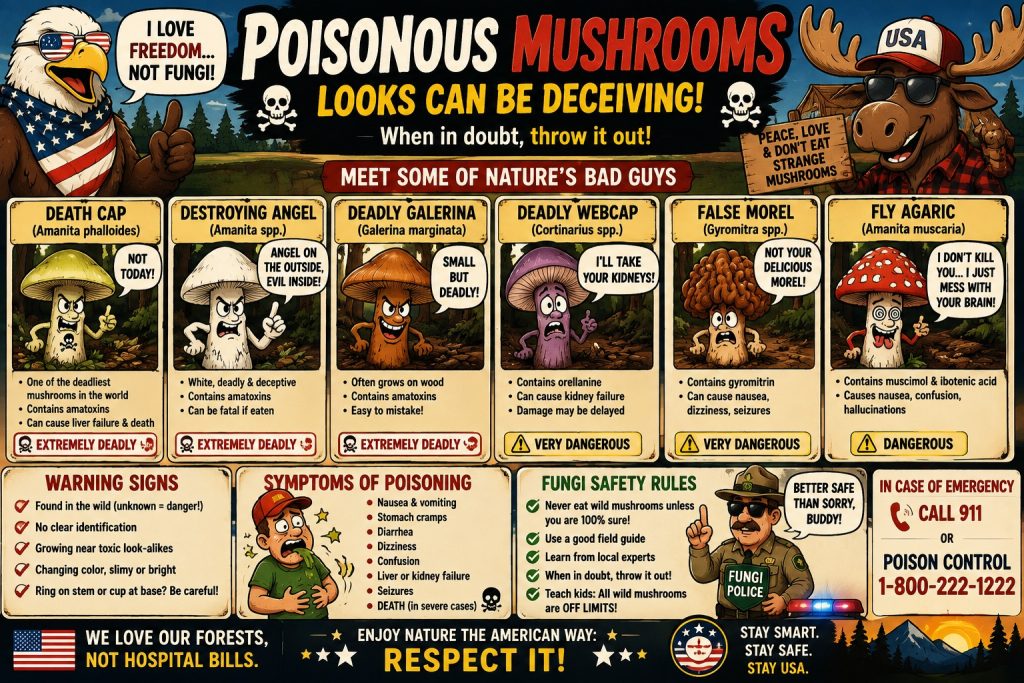
| Mushroom | Scientific name/group | Major toxic concern | Potential outcome |
|---|---|---|---|
| Death cap | Amanita phalloides | Amatoxins | Severe liver failure, death |
| Destroying angels | Several Amanita spp. | Amatoxins | Severe liver failure, death |
| Deadly galerina | Galerina marginata | Amatoxins | Severe liver injury, death |
| Deadly webcaps | Cortinarius spp. | Orellanine | Delayed kidney failure |
| False morels | Gyromitra spp. | Gyromitrin-related toxins | Neurological/GI toxicity |
| Certain Lepiota | Several small species | Amatoxins | Potentially fatal liver injury |
| Certain Clitocybe/Inocybe | Various species | Muscarine | Cholinergic poisoning |
| Fly agaric | Amanita muscaria | Ibotenic acid/muscimol | Neurological toxicity |
This isn’t a complete list of toxic fungi.
Thousands of mushroom species exist, and toxicity information is incomplete for many of them.
What Is the Deadliest Mushroom?
The death cap (Amanita phalloides) is one of the most notorious poisonous mushrooms worldwide.


8
Its danger comes largely from amatoxins, a family of toxins that inhibit RNA polymerase II and disrupt essential cellular processes.
The liver is especially vulnerable.
A particularly dangerous feature of amatoxin poisoning is its delayed course. Someone can develop gastrointestinal symptoms, apparently improve, and subsequently develop serious liver injury.
Therefore, feeling better after an initial episode does not necessarily mean the danger has passed.
Death Cap: Amanita Phalloides
The death cap is a useful example of why mushroom safety cannot depend on stereotypes.
It isn’t necessarily dramatically colored.
Typical characteristics can include:
Cap: commonly greenish, olive, yellowish or brownish, although coloration varies.
Gills: generally white.
Stem: pale, often with a ring.
Base: typically has a sac-like volva surrounding the stem base.
Spore print: white.
But these characteristics should be used for education—not as a guarantee that an amateur can safely distinguish every specimen.
Young Amanita mushrooms can look different from mature examples, and important structures can remain underground or be damaged.
What Are Destroying Angel Mushrooms?
“Destroying angel” isn’t one single mushroom species.
The name is applied to several white, highly poisonous Amanita species.
In North America, different species occur in different regions.
Their mostly white appearance creates a dangerous identification problem because numerous harmless mushrooms are also white.
Destroying angels can contain amatoxins capable of producing catastrophic liver injury.
This makes the assumption that “plain white mushrooms are probably safe” particularly dangerous.
Deadly Galerina
Galerina marginata is another important deadly mushroom.
It is typically much smaller and less visually dramatic than the death cap.
The species can grow on decaying wood and contains amatoxins.
This demonstrates an important principle:
Size doesn’t predict mushroom toxicity.
A small brown mushroom can contain medically serious toxins.
Mycologists sometimes use the informal expression LBM—little brown mushroom because numerous small brown species can be difficult for inexperienced observers to distinguish.
Unknown LBMs shouldn’t be eaten.
Deadly Webcaps and Kidney Damage
Some Cortinarius mushrooms contain orellanine, a toxin particularly associated with kidney injury.
The frightening feature of orellanine poisoning is the potential delay between consumption and serious symptoms.
Kidney toxicity may become apparent only after considerable time has passed.
This means a person may initially believe nothing is wrong.
Delayed toxicity is one reason mushroom poisoning requires professional medical evaluation rather than waiting for symptoms to become severe.
False Morels
Morels are highly valued edible mushrooms.
Unfortunately, several fungi loosely called false morels, particularly species of Gyromitra, can be toxic.
Some contain compounds associated with gyromitrin, which can ultimately generate monomethylhydrazine-related toxicity.
Potential effects include:
- nausea;
- vomiting;
- abdominal symptoms;
- dizziness;
- neurological effects;
- seizures; and
- severe poisoning in some circumstances.
Processing practices historically used with some false morels shouldn’t be interpreted as proof that these mushrooms can always be made safe.
Fly Agaric: Poisonous but Different
Amanita muscaria—the famous red mushroom with white spots—is probably the world’s most recognizable toadstool.
Its toxicology differs substantially from death caps.
Rather than amatoxins, A. muscaria contains compounds including muscimol and ibotenic acid.
Poisoning can cause neurological effects such as confusion, altered perception, agitation, sedation and impaired coordination.
It shouldn’t be confused with psilocybin mushrooms.
Muscimol and psilocybin act through substantially different pharmacological systems.
Poisonous Mushroom Species Aren’t All Poisonous in the Same Way
One reason types of poisonous mushrooms is such a complicated subject is that fungal toxins belong to different chemical families.
| Toxin/group | Example mushrooms | Major concern |
|---|---|---|
| Amatoxins | Death cap, destroying angels, deadly galerina | Liver toxicity |
| Orellanine | Certain Cortinarius | Kidney toxicity |
| Muscarine | Certain Inocybe/Clitocybe | Cholinergic syndrome |
| Muscimol/ibotenic acid | Amanita muscaria | Neurological effects |
| Gyromitrin-related compounds | Some Gyromitra | GI/neurological toxicity |
| GI irritants | Numerous species | Vomiting, diarrhea, abdominal pain |
Consequently, “mushroom poisoning” isn’t one single medical condition.
The mushroom involved can substantially change the clinical picture.
Poisonous Mushroom Names
Some commonly discussed poisonous mushroom names include:
- death cap;
- destroying angel;
- deadly galerina;
- deadly webcap;
- fool’s webcap;
- false morel;
- fly agaric;
- panther cap;
- jack-o’-lantern mushroom; and
- various toxic Lepiota, Inocybe and Clitocybe species.
Common names can vary geographically.
Scientific names are more useful when communicating about a suspected poisoning.
Are Toadstools Poisonous?
The word toadstool doesn’t represent a scientific taxonomic group.
Historically, people often used “toadstool” for mushrooms they considered unattractive or poisonous.
Biologically, however, there isn’t a clear mushroom-versus-toadstool division.
Both terms refer to fungal fruiting bodies in ordinary usage.
Therefore, searches for pictures of poisonous toadstools shouldn’t lead to the conclusion that something called a “mushroom” is edible while something called a “toadstool” is toxic.
Nature doesn’t follow that linguistic distinction.
Poisonous Mushroom Pictures and Names: Why Photos Aren’t Enough
People understandably search for:
images of poisonous mushrooms
deadly mushrooms pictures
pictures of poison mushrooms
photos of poisonous mushrooms
poisonous mushroom pictures and names
Photographs are excellent educational tools.
They aren’t definitive edibility tests.
The same mushroom can look substantially different depending on:
- age;
- moisture;
- sunlight;
- genetics;
- geographic location;
- camera exposure;
- environmental damage; and
- developmental stage.
Important diagnostic features may also be underneath the cap, at the stem base, or microscopic.
An image showing only the top of a mushroom may omit exactly the characteristic needed for identification.
Don’t Identify Mushrooms From Cap Color Alone
Color is particularly unreliable.
A mushroom can fade dramatically as it dries.
Rain can wash cap surfaces.
Young and old specimens may have different coloration.
Different species can share almost identical colors.
This is why categories such as “red mushroom,” “white mushroom,” “brown mushroom” or “black mushroom” aren’t sufficient for determining edibility.
Important Identification Characteristics
Professional mushroom identification can consider multiple characteristics together, including:
Cap
Shape, texture, color, surface structures and changes with age.
Gills, Pores or Teeth
What structure produces spores beneath the cap?
Gill Attachment
Do the gills attach to the stem, stop before it, or run down it?
Stem
Color, texture, hollowness, fibers and other structures.
Ring
Some mushrooms have remnants of a partial veil around the stem.
Stem Base
The underground base can be crucial.
Removing a mushroom incorrectly may leave diagnostic structures such as a volva behind.
Spore Print
Spore color can narrow possibilities.
It does not prove edibility.
Microscopy
Spore dimensions and other microscopic structures can distinguish visually similar species.
Ecology
Does the fungus grow from soil, grass, buried wood, living trees, dead logs or another substrate?
Geography and Season
Distribution and fruiting period provide additional evidence.
Identification is strongest when multiple independent features agree.
Non-Edible Mushroom Doesn’t Always Mean Poisonous
The phrase non edible mushroom encompasses more than toxic fungi.
A mushroom might be considered non-edible because it is:
- poisonous;
- too tough;
- extremely bitter;
- too small to be useful as food;
- poorly studied;
- known to cause inconsistent reactions; or
- simply not traditionally regarded as food.
Therefore:
non-edible ≠ necessarily deadly
and
not known to be poisonous ≠ confirmed safe to eat.
That distinction is important when researching unfamiliar fungi.
Can Cooking Destroy Mushroom Poisons?
There is no universal rule.
Some mushroom toxins are relatively heat-stable.
Amatoxins, for example, shouldn’t be assumed to become harmless through ordinary cooking.
Cooking a death cap doesn’t turn it into food.
Drying, freezing, frying, boiling or microwaving shouldn’t be treated as universal detoxification techniques.
The safest approach is not to consume mushrooms whose identity and edibility aren’t firmly established.
Can Animals Tell You Whether Mushrooms Are Safe?
No.
Different species have different physiology.
A mushroom eaten by insects, squirrels, deer or another animal isn’t necessarily safe for humans.
Similarly, folklore tests involving silver spoons, onions, garlic, milk or other household materials don’t reliably distinguish poisonous mushrooms.
There is no universal kitchen test for mushroom toxicity.
Mushroom Poisoning Symptoms
Symptoms vary according to the toxin.
Possible signs include:
- nausea;
- vomiting;
- abdominal pain;
- diarrhea;
- sweating;
- excessive salivation;
- dizziness;
- confusion;
- hallucinations;
- agitation;
- severe drowsiness;
- seizures;
- jaundice;
- reduced urination; and
- evidence of liver or kidney injury.
The timing of symptoms can also be diagnostically important.
Some toxic mushrooms cause rapid gastrointestinal effects.
Others produce delayed organ damage.
Delayed Symptoms Can Be Especially Dangerous
A common misconception is:
“I ate the mushroom several hours ago and feel fine, so it must have been safe.”
That’s false.
Certain dangerous mushroom poisonings have delayed symptom onset.
Some amatoxin poisonings, for example, can initially produce severe gastrointestinal illness followed by an apparent improvement before serious hepatic injury becomes evident.
Never use absence of immediate symptoms as proof of safety.
What to Do After Suspected Mushroom Poisoning
Suspected ingestion of an unidentified or poisonous wild mushroom should be treated seriously.
In the United States, contact Poison Control at 1-800-222-1222 or use Poison Control. Call 911 for collapse, seizures, severe breathing difficulty, loss of consciousness, or another immediate emergency.
When possible, preserve:
- remaining mushroom specimens;
- uneaten portions;
- photographs showing the mushroom from multiple angles; and
- information about when it was eaten and when symptoms began.
These materials can sometimes help poison specialists and mycologists identify the fungus.
Do not deliberately induce vomiting unless a medical professional specifically instructs you to do so.
Wild Mushroom Safety in the United States
Foraging can be educational and rewarding, but edible identification requires considerably more expertise than matching photographs.
A conservative approach includes:
Never consume an unidentified wild mushroom.
Don’t rely on AI or phone apps alone.
Learn complete genera and their dangerous look-alikes.
Collect the whole mushroom for identification.
Use current regional field guides.
Learn from experienced local mycologists.
Keep unknown mushrooms away from young children and pets.
Seek professional advice quickly after a suspected toxic ingestion.
Regional expertise matters because North American mushroom communities differ considerably by climate and habitat.
For further educational mushroom information, visit psychedelicsandshrooms.com.
Poisonous Mushrooms vs. Psychedelic Mushrooms
“Poisonous” and “psychedelic” aren’t interchangeable categories.
Some mushrooms contain psilocybin and alter perception.
Other mushrooms contain amatoxins capable of destroying liver cells.
Still others contain muscimol, muscarine, orellanine or gastrointestinal irritants.
The consequences and mechanisms are very different.
An unknown mushroom should never be consumed simply because someone thinks it might be psychedelic.
Mistaking a toxic mushroom for another species can become a medical emergency.
Frequently Asked Questions
1. What is the deadliest mushroom?
The death cap, Amanita phalloides, is among the world’s most medically important deadly mushrooms because it contains amatoxins capable of causing severe liver failure.
2. Can you identify poisonous mushrooms by looking at them?
Some species have recognizable characteristics, but there is no universal visual test for toxicity. Identification should consider multiple morphological, ecological and sometimes microscopic characteristics.
3. Are brightly colored mushrooms poisonous?
Not necessarily. Some toxic mushrooms are colorful, while some deadly species are relatively plain. Color isn’t a reliable toxicity test.
4. Does cooking make poisonous mushrooms safe?
Not universally. Some important toxins survive ordinary cooking. Never rely on cooking as a method for making an unidentified mushroom edible.
5. Are all non-edible mushrooms poisonous?
No. Some are classified as non-edible because they’re tough, bitter, tiny, poorly studied or otherwise unsuitable as food. But an unknown mushroom should not be assumed safe merely because toxicity hasn’t been established.
6. What should I do if someone eats an unidentified mushroom?
In the United States, contact Poison Control promptly at 1-800-222-1222. For severe or life-threatening symptoms, call 911. Preserve specimens and photographs when possible to assist identification.
Educational Resources
For further mushroom education, identification concepts and comparisons between culinary, poisonous and psychoactive fungi, explore psychedelicsandshrooms.com.
For poisoning guidance, use Poison Control. Scientific literature concerning mushroom poisoning, amatoxins and clinical management can also be explored through PubMed mushroom poisoning research.
