
mushroom and shrooms
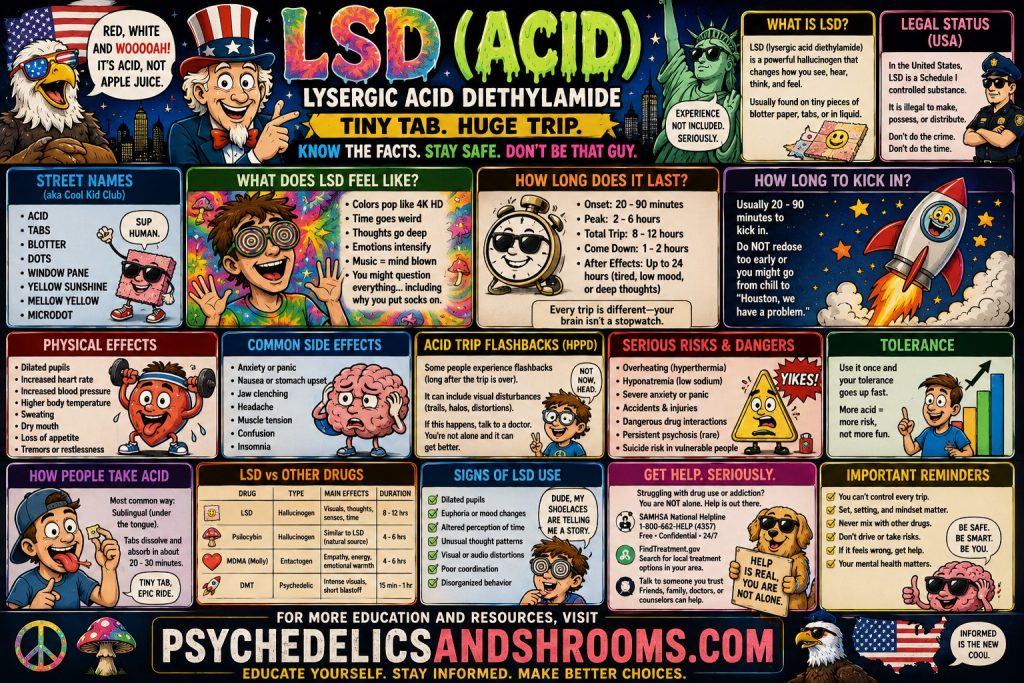
LSD Meaning: Acid, Effects, Duration, Risks, Flashbacks & U.S. Legal Status
Aug
What Does LSD Mean?
LSD stands for lysergic acid diethylamide, a powerful psychoactive drug classified as a classic hallucinogen or psychedelic.
The term comes from the compound’s chemical name. LSD became widely known during the twentieth century because extraordinarily small quantities can produce substantial alterations in perception, thought, mood, and the experience of time.
In the United States, LSD is federally classified as a Schedule I controlled substance.
Common street names include:
- acid;
- blotter acid;
- dots;
- window pane; and
- mellow yellow.
For broader educational material about psychedelics and psychoactive substances, readers can explore psychedelicsandshrooms.com.
LSD vs. Acid: What’s the Difference?
In common drug terminology, LSD and acid usually refer to the same drug.
LSD is the chemical abbreviation.
Acid is a street name.
However, something sold as “acid” isn’t automatically confirmed to contain LSD. An unregulated product can be misrepresented or contain another psychoactive compound.
Appearance alone cannot establish chemical identity.
Is LSD a Hallucinogen?
Yes.
LSD is considered a classic hallucinogen. Its perception-altering effects are strongly associated with serotonin signaling in the brain.
Classic hallucinogens can alter how people process:
- vision;
- sound;
- touch;
- time;
- emotions;
- thoughts; and
- their sense of themselves and their surroundings.
NIDA describes classic hallucinogens as acting on serotonin-related neural circuits, with important effects involving regions associated with mood, cognition and perception.
Is LSD a Stimulant or Depressant?
LSD doesn’t fit neatly into either category.
It is primarily classified as a hallucinogen/psychedelic, rather than a conventional stimulant such as amphetamine or a depressant such as alcohol.
However, LSD can produce some physical changes that resemble stimulation.
DEA lists effects including increased heart rate, increased blood pressure, higher body temperature, sweating and sleeplessness.
That doesn’t make LSD pharmacologically equivalent to cocaine or amphetamine.
Where Does LSD Come From?
LSD is a semi-synthetic compound.
Its history is connected to lysergic acid chemistry and ergot alkaloids, which are associated with the fungus Claviceps purpurea. LSD itself isn’t simply a naturally occurring mushroom or fungus that people harvest.
Modern illicit LSD is manufactured chemically.
The DEA reports that illicit LSD is produced in clandestine laboratories.
This distinction matters when people describe LSD as a “natural psychedelic.” It isn’t natural in the same sense as psilocybin-containing mushrooms.
What Does LSD Feel Like?
An LSD experience is commonly called an acid trip or simply a trip.
Reported psychological and perceptual effects can include:
- intensified colors;
- altered shapes and patterns;
- unusual visual experiences;
- altered perception of time;
- intensified emotions;
- changes in thought patterns;
- altered sense of self;
- unusual associations between ideas; and
- changes in the perception of sounds.
NIDA notes that hallucinogens can produce distorted sensory experiences and changes in time perception. Experiences can range from subjectively pleasant to frightening.
Importantly, there isn’t one universal LSD experience.
What Is an Acid Trip Like?
Someone saying they “tripped on acid” generally means they experienced LSD’s psychoactive effects.
A trip can involve profound perceptual and emotional changes.
Some people describe experiences as interesting or meaningful.
Others experience a bad trip, which can involve:
- intense fear;
- panic;
- paranoia;
- confusion;
- frightening perceptual distortions;
- fear of dying;
- feeling trapped in the experience; or
- loss of confidence about what’s real.
DEA warns that serious psychological effects can include fear, anxiety, depression and paranoia.
A person’s reaction can be difficult to predict.
How Long Does an Acid Trip Last?
LSD is notable for its relatively long psychoactive duration.
NIDA’s hallucinogen educational material reports that effects can begin within roughly 20–90 minutes after ingestion and can persist for as long as approximately 12 hours.
These figures are descriptive, not instructions for use.
Timing varies according to individual biology, substance identity and other circumstances.
Residual problems such as insomnia, anxiety or emotional exhaustion can continue after the primary psychedelic effects diminish.
How Long Does Acid Take to Kick In?
Searches such as how long for acid to kick in or how long can it take for acid to kick in are common.
Published educational information describes onset as variable rather than instantaneous.
That variability creates a safety concern: someone may mistakenly assume that a substance “isn’t working” and take additional drugs.
This article therefore doesn’t provide redosing instructions or a schedule for recreational LSD use.
How to Take Acid
Keywords such as how to take acid, how to take acid tabs, how to do acid, and taking acid frequently accompany LSD searches.
This guide won’t provide step-by-step administration instructions or recreational dosing guidance.
There is no risk-free way to use an unregulated illicit drug.
Additionally, a product represented as LSD may have uncertain:
- identity;
- concentration;
- purity; and
- contamination.
Clinical or laboratory information about known LSD therefore cannot establish the contents or strength of an unknown illicit product.
What Are LSD Symptoms?
Observable LSD symptoms can include psychological, sensory and physical changes.
Perceptual symptoms
People may experience:
- visual distortions;
- intensified colors;
- unusual patterns;
- altered depth perception;
- distorted time perception; and
- altered sensory experiences.
Emotional symptoms
Possible changes include:
- euphoria;
- anxiety;
- rapidly changing emotions;
- fear;
- panic; and
- paranoia.
Physical symptoms
DEA identifies effects including dilated pupils, increased body temperature, increased heart rate and blood pressure, sweating, appetite loss, sleeplessness, dry mouth and tremors.
These symptoms aren’t diagnostic by themselves.
LSD and Judgment
One significant risk isn’t simply what someone sees.
It’s what they believe and do while perception and judgment are altered.
DEA notes that LSD can impair depth and time perception and the ability to recognize ordinary dangers, increasing vulnerability to injury.
Accidents, unsafe environments and dangerous decisions can therefore become major components of LSD-related harm.
Can Acid Kill You?
Fatal poisoning attributed exclusively to LSD is considered uncommon compared with many other illicit drugs.
But “rarely fatal from direct toxicity” doesn’t mean safe.
DEA states that death following LSD use is rare while also noting potentially serious and lasting psychological effects. Hallucinogen-related deaths can also occur through accidents, dangerous behavior, suicide, polysubstance exposure or other indirect circumstances.
Medical emergencies can therefore still occur during or after suspected LSD exposure.
LSD Tolerance
LSD tolerance can develop rapidly.
NIDA reports that repeated LSD exposure can produce substantial tolerance, meaning the drug’s effects become reduced with repeated use. NIDA also notes cross-tolerance with certain other classic hallucinogens, including psilocybin and mescaline.
This shouldn’t be interpreted as a reason to increase quantities.
Escalating exposure can increase unpredictability and psychological risk.
Tolerance also isn’t the same thing as immunity to harm.
Is LSD Addictive?
LSD doesn’t typically produce the same compulsive reinforcement pattern associated with drugs such as nicotine, cocaine or opioids.
Physical withdrawal is also not generally considered characteristic of classic LSD use.
However, this doesn’t mean repeated use is harmless.
People can still develop problematic behavioral patterns involving psychedelics, experience psychiatric consequences, or continue using them despite adverse effects.
Acid Trip Flashbacks
The phrase acid trip flashback is commonly used to describe a recurrence of aspects of a previous psychedelic experience after the acute drug effects have ended.
A more clinically relevant concept is Hallucinogen Persisting Perception Disorder (HPPD).
Possible persistent or recurring visual disturbances can include:
- trails behind moving objects;
- halos;
- visual distortions; or
- other perception abnormalities.
DEA reports that such experiences have occurred days or even months after LSD exposure. NIDA also identifies HPPD and persistent psychosis as uncommon but potentially serious long-term consequences associated with classic hallucinogens.
A persistent visual disturbance deserves medical assessment rather than being casually dismissed as a flashback.
LSD and Mental Health
Psychedelic experiences can involve dramatic changes in emotion and cognition.
Some individuals experience severe:
- anxiety;
- paranoia;
- panic;
- disorganization;
- depressive symptoms; or
- prolonged perceptual disturbances.
People with underlying psychiatric vulnerabilities may face additional concerns.
Research into psychedelics doesn’t establish unsupervised LSD use as mental-health treatment.
Controlled scientific research and illicit recreational use involve very different circumstances.
Is Acid Illegal?
Under current U.S. federal law, yes.
LSD remains a Schedule I controlled substance under the Controlled Substances Act. DEA describes Schedule I substances as having no currently accepted medical use in treatment in the United States and a high potential for abuse under the federal scheduling framework.
State and local policies can evolve, but they don’t automatically change federal law.
Lysergic Acid Diethylamide Street Names
Common LSD nicknames and street names include:
- acid;
- blotter;
- blotter acid;
- dots;
- mellow yellow; and
- window pane.
Street terminology is culturally variable and changes over time.
A street name also doesn’t verify chemical composition.
LSD vs. Psilocybin Mushrooms
LSD and psilocybin are both classic psychedelics but aren’t the same substance.
| Feature | LSD | Psilocybin mushrooms |
|---|---|---|
| Origin | Semi-synthetic compound | Naturally occurring fungal compounds |
| Main active drug | LSD | Psilocybin → psilocin |
| Drug class | Classic psychedelic | Classic psychedelic |
| Main receptor system | Strong 5-HT2A involvement | Strong 5-HT2A involvement |
| Typical duration | Relatively long | Generally shorter than LSD |
| U.S. federal status | Schedule I | Schedule I |
Research findings concerning one psychedelic shouldn’t automatically be applied to another.
For broader comparisons between LSD, psilocybin and other psychedelics, explore psychedelicsandshrooms.com.
LSD vs. MDMA
LSD and MDMA are also frequently confused.
MDMA is commonly described as an entactogen with stimulant-like properties, whereas LSD is a classic psychedelic.
Although both strongly involve serotonin biology, their pharmacological mechanisms and characteristic effects differ substantially.
The term “party drug” isn’t a scientifically useful classification.
What to Do During a Suspected LSD Emergency
A severely distressed or confused person should be kept away from obvious environmental dangers while professional help is obtained.
Seek emergency assistance for:
- loss of consciousness;
- seizure;
- serious injury;
- chest pain;
- dangerous behavior;
- severe agitation that cannot be safely managed;
- suicidal behavior;
- breathing problems; or
- another rapidly worsening medical emergency.
In the United States, call 911 for an immediate emergency.
Poison-exposure guidance is also available through America’s Poison Centers at 1-800-222-1222.
Frequently Asked Questions
1. What does LSD stand for?
LSD stands for lysergic acid diethylamide, a potent classic hallucinogen commonly called acid.
2. Are LSD and acid the same thing?
“Acid” is a common street name for LSD. However, an illicit substance sold as acid isn’t chemically verified simply because someone calls it LSD.
3. Is LSD a stimulant or depressant?
Neither classification adequately describes it. LSD is primarily classified as a classic hallucinogen or psychedelic, although it can produce physical effects such as increased heart rate and blood pressure.
4. How long does an acid trip last?
LSD’s principal effects can persist for many hours, with NIDA educational material reporting effects lasting as long as about 12 hours in some circumstances. Individual experiences vary.
5. Can LSD cause flashbacks?
Recurring perceptual disturbances have been reported after LSD exposure. HPPD is a recognized condition involving persistent or recurring perception changes.
6. Is LSD legal in the United States?
LSD remains federally classified as a Schedule I controlled substance.
Educational Resources
For broader educational material about LSD, psilocybin, psychedelic research and psychoactive-substance safety, explore psychedelicsandshrooms.com.
Current U.S. legal and drug-information material is available from the DEA LSD Fact Sheet. Scientific and public-health information about hallucinogens is also available through NIDA’s hallucinogen research material.
