
mushroom and shrooms
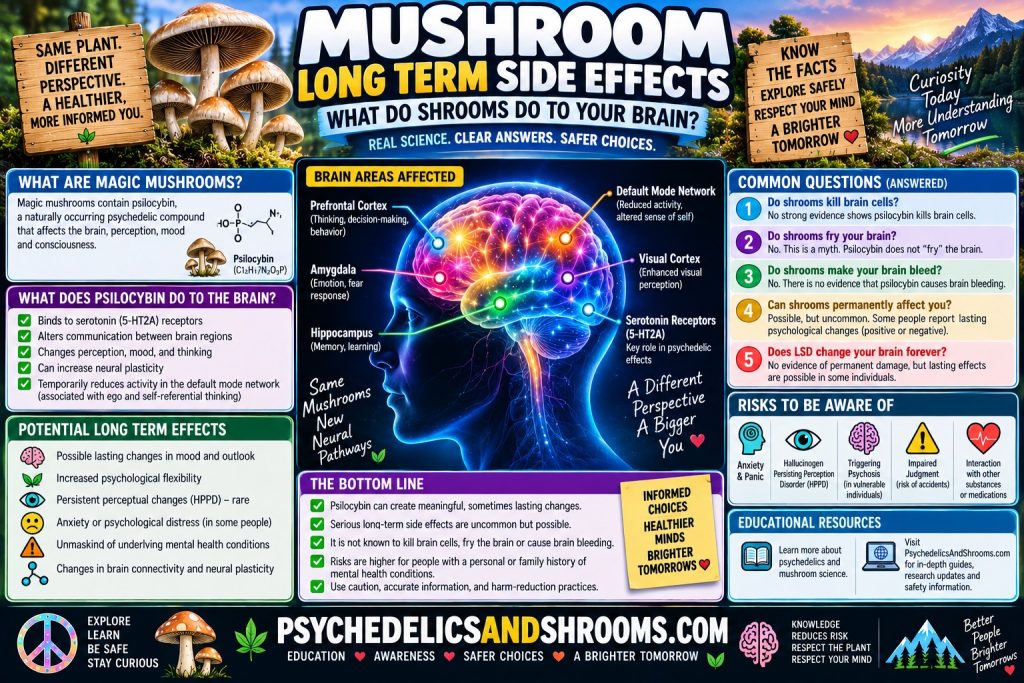
Mushroom Long-Term Side Effects: What Do Shrooms Do to Your Brain?
Sep
What Are the Long-Term Side Effects of Magic Mushrooms?
Questions about mushroom long-term side effects have become increasingly common as scientific interest in psilocybin grows.
People want to know whether psychedelic mushrooms permanently change the brain, kill brain cells, cause brain damage, or produce lasting psychological effects.
The scientific picture is more complicated than either “shrooms destroy your brain” or “psilocybin is completely harmless.”
Psilocybin produces substantial temporary changes in perception, cognition, emotion, and brain-network activity. Researchers are also investigating whether some changes in psychological functioning or neural plasticity can persist beyond the acute psychedelic experience.
At the same time, adverse psychological effects can occasionally persist.
The available evidence does not support popular myths that ordinary psilocybin effects involve the brain physically bleeding or being “fried.”
However, absence of those particular effects doesn’t mean psychedelic mushrooms are risk-free.
For additional educational information about mushrooms and psychedelic science, explore PsychedelicsAndShrooms.com.
What Does Psilocybin Do to the Brain?
Psilocybin itself is converted in the body into psilocin.
Psilocin interacts with several serotonin receptors, with the 5-HT2A receptor playing a particularly important role in classic psychedelic effects.
Serotonin signaling contributes to numerous functions involving:
- mood;
- perception;
- cognition;
- sensory processing; and
- behavior.
Psilocybin doesn’t simply “switch the brain on” or “turn it off.”
Instead, researchers observe temporary changes in how different brain regions and networks communicate.
These altered communication patterns may help explain why colors, thoughts, emotions, memories, time, and a person’s sense of self can feel dramatically different during a psychedelic experience.
Brain on Psilocybin: What Happens During the Acute Effects?
Modern brain-imaging research has given scientists a much more detailed picture of the brain on psilocybin.
During acute psychedelic effects, studies have observed changes involving large-scale brain networks.
Researchers have reported alterations in:
- functional connectivity;
- communication between brain regions;
- sensory processing;
- self-referential processing;
- network organization; and
- brain activity associated with perception.
One particularly important area of research concerns the default mode network, a collection of interacting brain regions associated with self-referential thinking and other cognitive functions.
Psilocybin can temporarily alter ordinary patterns of organization within and between brain networks.
This doesn’t mean the brain becomes damaged or stops functioning.
It means its normal communication architecture temporarily changes.
Does Psilocybin “Rewire” the Brain?
The phrase how does psilocybin rewire the brain appears frequently in popular media.
“Rewire” is a useful metaphor, but it can exaggerate what scientists have established.
Researchers are interested in neuroplasticity—the nervous system’s ability to change its structure, function, or connections.
Preclinical research has reported changes involving neuronal growth and plasticity-related processes following psychedelic exposure.
Human research has also found changes in brain connectivity associated with psilocybin.
However:
Psilocybin isn’t literally rewiring the brain like someone replacing electrical cables.
Scientists are still investigating:
- which neural changes persist;
- how long they persist;
- whether they cause therapeutic outcomes;
- which changes are beneficial;
- whether outcomes differ among individuals; and
- how psychological support interacts with biological effects.
“Promotes neuroplasticity” is therefore more scientifically useful than claiming that psilocybin permanently rewires everyone’s brain.
What Do Shrooms Do to Your Brain Long Term?
The answer depends partly on what we mean by “long term.”
Researchers have documented psychological and behavioral changes that can continue after acute psilocybin effects end, particularly in controlled clinical research.
Studies have investigated possible lasting changes involving:
- mood;
- psychological flexibility;
- personality-related measures;
- emotional processing;
- well-being;
- behavior; and
- symptoms of certain psychiatric disorders.
But clinical research shouldn’t be equated with recreational mushroom consumption.
Clinical studies may involve:
- carefully screened participants;
- known substances;
- standardized protocols;
- trained monitors;
- psychological preparation;
- controlled environments; and
- structured follow-up.
Those protections may be absent during unsupervised use.
Psilocybin Mushrooms Long-Term Effects
Potential long-term outcomes can be divided into several categories.
| Potential outcome | What the evidence suggests |
|---|---|
| Permanent brain-cell destruction | Not established as a typical psilocybin effect |
| Brain bleeding | Not a recognized normal mechanism of psilocybin |
| Persistent perceptual symptoms | Possible but uncommon |
| Lasting psychological changes | Reported and actively studied |
| Persistent anxiety or distress | Can occur |
| Psychotic symptoms | Serious concern, particularly in susceptible people |
| Physical dependence | Not typical in the way seen with opioids |
| Rapid tolerance | Can develop with repeated psychedelic exposure |
| Therapeutic effects | Promising in controlled research, but not guaranteed |
The key word is variability.
A lasting change isn’t automatically beneficial or harmful.
Do Shrooms Kill Brain Cells?
There is no good evidence supporting the common claim that typical psilocybin exposure simply kills brain cells.
Psilocybin’s primary known psychedelic mechanism involves serotonin receptor signaling rather than indiscriminate destruction of neurons.
This is very different from saying that psilocybin can never cause harm.
People can still experience:
- psychological distress;
- dangerous behavior while intoxicated;
- accidents;
- psychiatric complications; or
- poisoning from incorrectly identified mushrooms.
But “shrooms kill your brain cells” isn’t an accurate explanation of psilocybin pharmacology.
Do Shrooms Fry Your Brain?
“Frying your brain” isn’t a medical diagnosis.
The phrase is commonly used to describe fears that psychedelics permanently destroy intelligence or physically burn out the brain.
Current neuroscience doesn’t describe psilocybin’s mechanism this way.
During intoxication, thinking and perception can become profoundly altered.
Someone may experience:
- distorted sensory information;
- unusual associations;
- impaired judgment;
- confusion;
- intense emotions; or
- altered beliefs about themselves and reality.
These dramatic subjective changes can feel as though the brain has fundamentally changed.
That isn’t equivalent to neurons being physically “fried.”
Do Shrooms Make Your Brain Bleed?
No established mechanism of ordinary psilocybin intoxication involves mushrooms making the brain bleed.
The idea that mushrooms make your brain bleed is an internet myth.
A brain hemorrhage is a medical emergency involving bleeding within or around the brain and has recognized medical causes.
Psilocybin’s psychedelic effects primarily involve serotonin-receptor activity, not bleeding brain tissue.
However, sudden severe neurological symptoms should never be dismissed because someone used mushrooms.
If a person develops:
- sudden extreme headache;
- one-sided weakness;
- facial drooping;
- difficulty speaking;
- seizure;
- collapse; or
- loss of consciousness,
seek emergency medical care immediately.
Don’t assume those symptoms are simply a psychedelic experience.
Do Shrooms Cause Brain Damage?
The question do shrooms cause brain damage requires nuance.
Current evidence doesn’t support describing psilocybin as routinely causing structural brain destruction.
But “brain damage” is an extremely broad phrase.
A psychoactive substance can cause harm without directly killing neurons.
For example, psychedelic intoxication can impair judgment sufficiently to contribute to:
- falls;
- traffic injuries;
- drowning;
- dangerous wandering;
- traumatic accidents; or
- other secondary injuries.
An unknown mushroom creates another danger: misidentification.
Some poisonous mushrooms can cause severe organ injury or neurological illness completely unrelated to psilocybin.
Are Mushrooms Bad for Your Brain?
“Mushrooms” includes thousands of species, so the question is too broad.
Culinary mushrooms such as oyster, shiitake, button, and portobello mushrooms aren’t equivalent to psilocybin-containing mushrooms.
Likewise, poisonous mushrooms aren’t equivalent to either group.
For psychedelic mushrooms specifically, brain effects depend on:
- psilocybin exposure;
- individual susceptibility;
- psychiatric history;
- other substances;
- medications;
- environmental circumstances; and
- product/species identity.
A more useful question is therefore:
What neurological and psychological risks are associated with psilocybin?
Persistent Perceptual Changes and HPPD
One long-term concern associated with hallucinogens is Hallucinogen Persisting Perception Disorder (HPPD).
HPPD involves persistent or recurring perceptual disturbances after the acute effects of a hallucinogen have ended.
Symptoms can include phenomena such as:
- visual trails;
- afterimages;
- halos;
- flashes;
- altered perception of movement; or
- other visual disturbances.
Not every unusual visual experience after psychedelic use represents HPPD.
Persistent symptoms require professional evaluation because migraine, neurological disorders, medications, anxiety, eye disorders, and other conditions can also produce visual disturbances.
Can Shrooms Permanently Affect You?
They potentially can—but “permanent” needs careful interpretation.
Some people report enduring positive changes after psychedelic experiences.
Others report persistent anxiety, perceptual changes, emotional difficulties, or other unwanted effects.
Clinical research has also documented psychological changes that persist for months after carefully controlled psilocybin administration.
None of this means everyone who uses psilocybin experiences permanent changes.
Individual responses vary considerably.
Psilocybin and Psychosis
One of the more serious concerns involves psychotic symptoms.
Psilocybin can temporarily produce dramatic alterations in perception and thinking.
Persistent psychosis appears uncommon, but people with vulnerability to schizophrenia-spectrum disorders or other serious psychiatric conditions deserve particular caution.
This is one reason many clinical psychedelic studies exclude participants with certain personal or family histories of psychotic disorders.
A recreational psychedelic experience shouldn’t be assumed equivalent to a clinical research session.
Psilocybin and Anxiety
Psilocybin can produce intensely positive emotions in some people.
It can also produce:
- panic;
- overwhelming fear;
- paranoia;
- confusion; and
- severe anxiety.
Most acute psychedelic effects eventually resolve, but some individuals may remain psychologically distressed afterward.
Persistent anxiety, sleep disruption, derealization, or difficulty functioning deserves professional attention.
Depersonalization and Derealization
Some people describe persistent feelings that:
- they aren’t fully real;
- their surroundings seem unreal;
- they’re observing themselves from outside;
- reality feels dreamlike; or
- their sense of identity has changed.
These experiences can occur in depersonalization or derealization.
They aren’t unique to psychedelics and can also occur with anxiety disorders, trauma, panic, sleep deprivation, and other psychiatric conditions.
When symptoms persist or interfere with daily life, professional evaluation is appropriate.
What About Memory and Intelligence?
There isn’t strong evidence that ordinary psilocybin exposure inevitably causes progressive intellectual decline.
During intoxication, however, attention, working memory, judgment, and cognitive processing can change substantially.
Long-term cognitive effects remain an area requiring careful study, particularly because recreational-use patterns differ considerably from controlled clinical exposure.
Statements that psilocybin either “destroys intelligence” or universally “makes the brain smarter” go beyond available evidence.
Effects of Psychedelics on the Brain
Not all psychedelics are identical.
LSD, psilocybin, mescaline, and DMT are generally categorized as classic psychedelics because they share important serotonin-related pharmacology.
However, their:
- duration;
- metabolism;
- receptor interactions;
- potency;
- subjective effects; and
- research histories
aren’t identical.
Therefore, findings from one psychedelic shouldn’t automatically be attributed to another.
Does LSD Change Your Brain Forever?
Like psilocybin, LSD can produce dramatic temporary alterations in perception and cognition.
Research also investigates longer-lasting psychological and neural changes.
But the claim that LSD inevitably changes everyone’s brain forever isn’t supported.
Persistent perceptual disturbances and psychiatric complications can occur in some individuals, while many people don’t develop those problems.
The scientifically appropriate conclusion is therefore neither “LSD permanently destroys the brain” nor “LSD can never cause lasting problems.”
Psilocybin vs. LSD and Long-Term Brain Effects
| Feature | Psilocybin | LSD |
|---|---|---|
| Classic psychedelic | Yes | Yes |
| Strong 5-HT2A involvement | Yes | Yes |
| Alters perception | Yes | Yes |
| Changes brain-network activity | Yes | Yes |
| Evidence of routine brain-cell destruction | No | No |
| Persistent perceptual effects possible | Yes | Yes |
| Psychological complications possible | Yes | Yes |
| Guaranteed permanent brain changes | No | No |
Research continues to refine these conclusions.
Clinical Research Doesn’t Mean Risk-Free Recreational Use
Promising psilocybin research has produced enormous public interest.
Researchers have investigated psilocybin in controlled settings for conditions including depression, psychological distress, and substance-use disorders.
But clinical trials aren’t simply “people taking shrooms.”
Research protocols can involve medical screening, psychological assessment, controlled substances of known composition, trained facilitators, monitoring, and follow-up.
Consequently, positive findings from clinical studies shouldn’t be converted into the claim:
“Magic mushrooms are proven safe for everyone.”
They aren’t.
Unknown Mushroom Products Add Another Layer of Risk
Chocolate bars, gummies, capsules, powders, and other products marketed with psychedelic mushroom imagery may not contain what consumers expect.
Potential concerns include:
- inaccurate labeling;
- unknown concentrations;
- undeclared substances;
- contamination;
- counterfeit packaging; and
- unexpected pharmacology.
A product saying “mushroom” on its wrapper isn’t equivalent to a characterized psilocybin preparation used in research.
Wild Mushrooms Create a Different Danger
Wild mushroom poisoning can be much more medically dangerous than the expected pharmacological effects of psilocybin.
Some toxic mushrooms can cause:
- liver failure;
- kidney failure;
- seizures;
- severe gastrointestinal illness;
- neurological effects; and
- death.
Never use brain effects, bruising, photographs, or online descriptions as a method of deciding whether an unidentified mushroom is safe.
When Should Someone Seek Medical Help?
Seek urgent medical care for:
- seizure;
- unconsciousness;
- severe confusion;
- suicidal behavior;
- dangerous agitation;
- serious breathing problems;
- sudden neurological symptoms;
- suspected poisonous-mushroom ingestion; or
- behavior creating immediate danger.
In the United States, call 911 for an immediate emergency.
For suspected poisoning, America’s Poison Centers can be reached at 1-800-222-1222.
Persistent hallucinations, anxiety, paranoia, derealization, perceptual disturbances, or major changes in functioning also deserve professional assessment even when they aren’t an immediate emergency.
Frequently Asked Questions
1. What do shrooms do to your brain?
Psilocybin is converted to psilocin, which affects serotonin receptors and temporarily changes perception, cognition, emotions, and communication among brain networks.
2. Do shrooms kill brain cells?
Current evidence doesn’t support the common claim that psilocybin’s normal psychedelic mechanism involves indiscriminately killing brain cells.
3. Do mushrooms make your brain bleed?
Brain bleeding isn’t a recognized mechanism responsible for psilocybin’s psychedelic effects. Sudden neurological symptoms such as severe headache, weakness, seizure, or unconsciousness are medical emergencies regardless of recent drug use.
4. Can shrooms permanently affect you?
Persistent psychological or perceptual effects can occur, although they aren’t inevitable. Researchers are also studying longer-lasting psychological and neuroplastic changes following controlled psilocybin administration.
5. Do shrooms cause permanent brain damage?
Evidence doesn’t show routine structural brain destruction from psilocybin. However, psychological complications, accidents, persistent perceptual symptoms, and risks from misidentified mushrooms remain important.
6. How does psilocybin rewire the brain?
“Rewiring” is an oversimplification. Research suggests psychedelics can influence neural plasticity and temporarily alter brain-network connectivity, but scientists are still determining which changes persist and what they mean clinically.
Educational Resources
For additional educational information about psilocybin, mushrooms, psychedelic neuroscience, and safety, explore PsychedelicsAndShrooms.com.
Published biomedical research on psilocybin and the brain can be explored through PubMed. Information about psychedelic and hallucinogen research is also available from the National Institute on Drug Abuse (NIDA).
The evidence-based takeaway is straightforward: psilocybin substantially changes brain activity while its effects are active, and researchers are studying longer-lasting neural and psychological changes. But claims that shrooms normally “fry the brain,” kill brain cells, or make the brain bleed aren’t supported explanations of psilocybin’s known pharmacology.
