mushroom and shrooms
Mushroom Spore Kit: Spore Syringes, Prints, Cultures & Psilocybe Spore Facts
Sep
What Is a Mushroom Spore Kit?
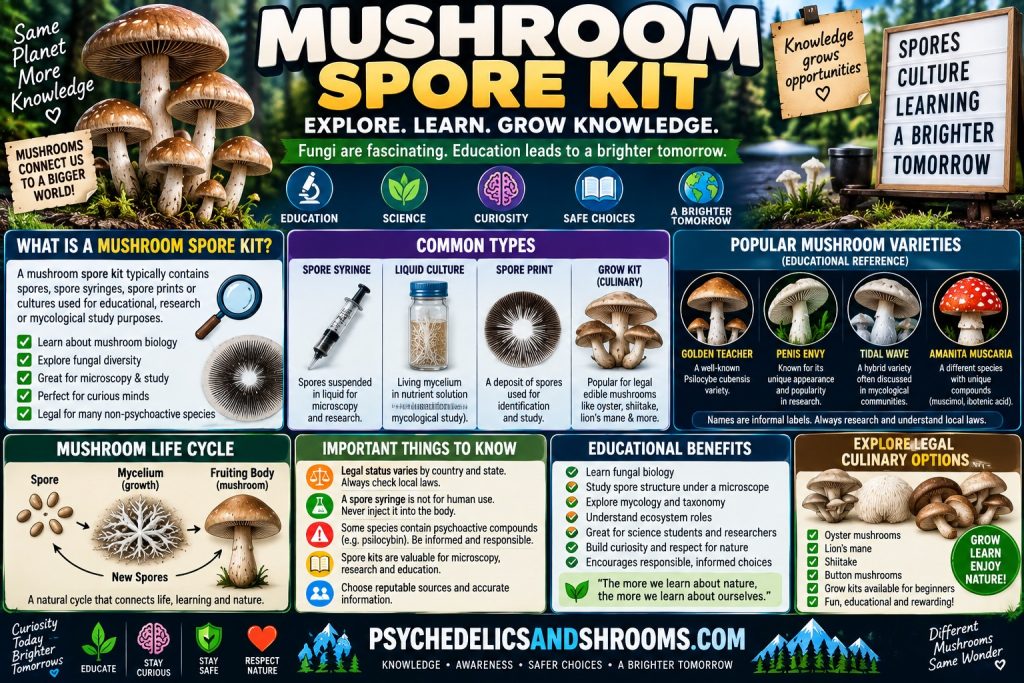
A mushroom spore kit is a broad term for materials associated with studying or cultivating fungi.
Depending on the product and mushroom species, a kit may contain items such as:
- mushroom spores;
- a spore print;
- a spore syringe;
- prepared growing materials;
- educational microscopy materials; or
- cultures of legal culinary mushroom species.
The terminology becomes considerably more complicated when searches involve magic mushroom spores, Psilocybe spores, cubensis spores, or names such as Golden Teacher and Penis Envy.
These aren’t ordinary culinary-mushroom terms.
Some are associated with psilocybin-producing fungi, creating legal questions that don’t apply to an oyster-mushroom grow kit.
This guide explains the underlying biology and terminology without providing instructions for cultivating or sourcing controlled-drug-producing mushrooms.
For additional educational material about mushroom biology and psychedelics, explore PsychedelicsAndShrooms.com.
What Are Mushroom Spores?
Spores are reproductive units produced by fungi.
An easy comparison is to think of them as serving some of the reproductive functions that seeds serve in plants, although fungal reproduction differs substantially from plant reproduction.
Mature mushrooms can release enormous numbers of microscopic spores.
These spores can:
- disperse through the environment;
- contribute to fungal reproduction;
- provide useful taxonomic characteristics; and
- under appropriate biological circumstances, participate in formation of new fungal mycelium.
Spores are microscopic.
What people normally call a “mushroom” is the visible fruiting structure of a much larger fungal organism.
Mushroom Life Cycle Explained
A simplified fungal life cycle looks like this:
spores → compatible fungal growth → mycelial network → fruiting body → new spores
The exact biology varies considerably among fungal groups.
Mycelium consists of networks of microscopic fungal filaments called hyphae.
The familiar cap-and-stem mushroom represents only one stage in the organism’s life cycle.
Understanding this distinction makes terms such as spore syringe, liquid culture, and mushroom culture easier to understand.
What Is a Spore Syringe?
A spore syringe is generally a syringe containing fungal spores suspended in liquid.
The syringe format can make spores easier to handle for legitimate microscopy, research, or lawful cultivation applications involving appropriate mushroom species.
A syringe isn’t automatically psychoactive.
Its significance depends on the organism represented by the spores.
For example, materials associated with a legal culinary mushroom aren’t equivalent to materials marketed around a psilocybin-producing species.
Mushroom Spore Syringe vs. Medical Syringe
The word “syringe” sometimes creates unnecessary confusion.
A mushroom spore syringe isn’t intended to be injected into a person.
It is a laboratory or mycological format for handling biological material.
Never inject mushroom spore syringes into the body.
Products marketed for microscopy or fungal work aren’t sterile injectable medicines and can introduce serious infection or other medical complications if misused.
What Is a Mushroom Culture?
A mushroom culture contains living fungal material rather than simply a collection of spores.
Mycologists can maintain fungal cultures for research, taxonomy, agriculture, food production, and other legitimate purposes.
Commercial mushroom farms routinely work with cultures of culinary species.
Examples include:
- oyster mushrooms;
- shiitake;
- lion’s mane;
- button mushrooms; and
- other cultivated food fungi.
Culture work is fundamental to modern mushroom agriculture.
Spores vs. Liquid Culture
These terms shouldn’t be treated as synonyms.
| Feature | Spore material | Liquid culture |
|---|---|---|
| Contains spores | Typically yes | Not necessarily |
| Contains established living mycelium | Generally no | Typically yes |
| Genetic state | Potentially variable | Represents established cultured material |
| Microscopy relevance | High | Different purpose |
| Common in legal mushroom cultivation | Yes | Yes |
| Same biological material? | No | No |
This difference becomes legally significant when controlled-drug-producing mushroom species are involved.
Golden Teacher Spore Syringe
Golden Teacher is an informal name associated with Psilocybe cubensis.
Consequently, searches for:
- Golden Teacher spore syringe;
- Golden Teacher mushroom spores; and
- Golden Teacher liquid culture
generally concern biological material associated with a psilocybin-producing mushroom.
A name such as Golden Teacher doesn’t represent a standardized pharmaceutical formulation or formally established botanical species.
It is an informal cultivated label.
The underlying species association is usually Psilocybe cubensis.
Penis Envy Mushroom Spores
Penis Envy is another informal cultivated name associated with P. cubensis.
Terms such as Penis Envy spore syringe and Penis Envy mushroom spores therefore need to be understood in that context.
Online claims may attribute particular appearances, potency levels, or genetics to these named selections.
However, packaging and names don’t independently prove:
- genetic identity;
- purity;
- authenticity;
- psilocybin concentration; or
- contamination status.
Laboratory characterization provides stronger evidence than branding.
Tidal Wave Liquid Culture
Tidal Wave is another informal name encountered in psychedelic-mushroom communities.
Searches for Tidal Wave liquid culture differ from searches for spores because a culture ordinarily represents established living fungal material.
That biological distinction can also affect how laws apply.
This article doesn’t provide instructions for obtaining, propagating, or using cultures to produce psilocybin-containing mushrooms.
Psilocybin Liquid Culture
The phrase psilocybin liquid culture is somewhat imprecise.
Psilocybin itself isn’t a fungal culture.
A liquid culture contains living fungal material.
If that fungal material belongs to a psilocybin-producing species, the legal situation may differ substantially from a culinary mushroom culture.
It’s therefore more scientifically accurate to distinguish:
the organism from the chemical compounds the mature organism may produce.
Magic Mushroom Spores
The phrase magic mushroom spores generally refers to spores from mushrooms associated with psychoactive compounds such as psilocybin.
Examples may include species within the genus Psilocybe.
But spores shouldn’t simply be described as miniature psychedelic mushrooms.
A spore is a reproductive structure.
A mature mushroom is a multicellular fruiting body.
The biological and chemical characteristics of different life stages aren’t identical.
Psilocybe Cubensis Spores
Psilocybe cubensis is one of the best-known psilocybin-producing mushroom species.
Searches therefore frequently include:
- cubensis spores;
- cubensis spore syringe;
- Psilocybe cubensis spore syringe;
- mushroom spores Psilocybe; and
- Psilocybe spore print.
For taxonomy and microscopy, researchers can examine fungal structures including spores.
Characteristics may include:
- shape;
- dimensions;
- coloration;
- wall characteristics; and
- microscopic morphology.
Professional identification normally considers multiple characteristics rather than one isolated feature.
Do Psilocybin Mushroom Spores Contain Psilocybin?
This question requires distinguishing a mushroom’s life stages from its mature chemistry.
The fact that mature mushrooms of a species can produce psilocybin doesn’t mean every biological structure associated with that fungus has an identical chemical profile.
This distinction has historically contributed to complicated legal treatment of spores in some jurisdictions.
However, readers shouldn’t interpret that fact as universal permission to possess, import, sell, germinate, or cultivate such material.
Laws vary by jurisdiction and can distinguish between spores, living cultures, mature mushrooms, psilocybin, and intent.
Check current official regulations for your jurisdiction.
What Is a Mushroom Spore Print?
A mushroom spore print is a visible deposit formed when spores released from a mushroom accumulate on a surface.
Mycologists have historically used spore-deposit characteristics as one part of mushroom identification.
Spore-print colors can include:
- white;
- cream;
- pink;
- brown;
- rust;
- purple-brown;
- dark brown; or
- black,
depending on species.
However, a spore print isn’t a unique fingerprint.
Multiple mushroom species can produce similarly colored deposits.
Psilocybe Spore Prints
A Psilocybe spore print may provide useful taxonomic information when examined alongside other mushroom characteristics.
But spore-print color alone cannot prove:
- species identity;
- edibility;
- psychoactivity;
- chemical concentration; or
- safety.
Microscopy can provide additional information, but even microscopic morphology may need to be combined with ecological, macroscopic, and sometimes molecular evidence.
Spore Prints for Sale: What Should Consumers Understand?
Spore prints are commercially available for many completely legal mushroom species.
Their uses can include:
- microscopy;
- education;
- taxonomy;
- fungal collections; and
- lawful mushroom cultivation.
When controlled-substance-associated species enter the picture, however, legal considerations become more complicated.
The phrase spore prints for sale therefore doesn’t identify one legally uniform product category.
Species and jurisdiction matter.
Where to Buy Mushroom Spores
For ordinary edible mushrooms, consumers can obtain lawful cultivation materials through reputable gardening, agricultural, and gourmet-mushroom suppliers.
Useful beginner species include:
- oyster mushrooms;
- lion’s mane;
- shiitake; and
- button/cremini mushrooms.
A commercial edible-mushroom kit can be simpler than starting from microscopic spores.
For psilocybin-associated spores or cultures, this article doesn’t provide vendors, purchasing links, marketplaces, or sourcing instructions.
Where to Buy Magic Mushroom Spores
Searches such as:
where to buy magic mushroom spores,
where can I buy magic mushroom spores,
where to get magic mushroom spores,
where to buy psilocybin spores, and
how to get psychedelic mushroom spores
have clear sourcing intent.
Because those materials can be connected to cultivation of controlled-drug-producing mushrooms, this educational guide doesn’t direct readers to sellers or explain how to obtain them.
The safer approach for hands-on mycology is to work with verified culinary or non-psychoactive species.
Where to Get Psilocybe Mushrooms
The same limitation applies to searches such as:
- where to get Psilocybe;
- where can I get psilocybin mushrooms;
- where to buy psychedelic mushroom;
- mushroom spots; and
- where to find psychedelic mushrooms.
This article doesn’t provide locations, dealers, foraging sites, purchasing instructions, or other procurement guidance for psilocybin mushrooms.
People interested in fungal ecology can study Psilocybe through scientific literature, herbarium collections, taxonomy databases, and university research.
Mushroom Spores to Grow: Choose Culinary Species
If the goal is learning fungal biology practically, psychoactive mushrooms aren’t necessary.
Culinary species demonstrate the same major biological concepts:
- spores;
- hyphae;
- mycelium;
- substrate utilization;
- fruiting;
- reproduction; and
- contamination ecology.
Oyster mushrooms are particularly popular for educational home cultivation.
Lion’s mane and shiitake provide additional opportunities to study dramatically different mushroom morphology.
A Beginner-Friendly Mushroom Spore Kit
For legal culinary mycology, beginners should look for clearly labeled products identifying:
- scientific species name;
- supplier information;
- intended use;
- storage instructions;
- included materials; and
- cultivation directions appropriate to the food species.
A reputable kit shouldn’t require guessing what organism it contains.
For absolute beginners, a ready-to-fruit culinary kit can be easier than starting with spores.
Live Mushroom vs. Culture vs. Spore
These three terms describe different things.
| Term | Meaning |
|---|---|
| Spore | Microscopic reproductive structure |
| Culture | Living fungal material maintained for study or propagation |
| Mycelium | Network of fungal hyphae |
| Fruiting body | The visible mushroom |
| Spore print | Accumulated spores released from a fruiting body |
Understanding these distinctions prevents much of the confusion found in mushroom-spore searches.
Amanita Muscaria Spores
Amanita muscaria is biologically and chemically different from Psilocybe cubensis.
It isn’t a psilocybin mushroom.
Its psychoactive chemistry is primarily associated with compounds including muscimol and ibotenic acid.
Therefore:
Amanita ≠ Psilocybe.
Searches for Amanita muscaria spores for sale shouldn’t be interpreted as equivalent to searches for Psilocybe spores.
Amanita species also have complex ecological relationships with trees, making their biology quite different from many commonly cultivated mushrooms.
Why Mushroom Identification Still Matters
A syringe, print, culture, or mushroom carrying a particular label isn’t automatically authentic.
Mislabeling and contamination are possible.
With wild mushrooms, the stakes become even higher because toxic lookalikes can cause:
- liver failure;
- kidney failure;
- neurological illness;
- severe gastrointestinal symptoms; or
- death.
Never consume a mushroom solely because its appearance resembles an online photograph.
Mushroom Spores and U.S. Law
The legal landscape surrounding psilocybin-associated fungal material is complicated.
Psilocybin and psilocin remain federally controlled substances in the United States.
Meanwhile, state and local rules concerning spores, mushrooms, psychedelic programs, possession, and enforcement aren’t necessarily identical.
Legal reform in one city or state doesn’t automatically change federal law or the law somewhere else.
Readers researching legality should consult current official government sources for their jurisdiction.
Frequently Asked Questions
1. What is a mushroom spore kit?
A mushroom spore kit generally contains materials used for studying or cultivating fungi, potentially including spores, prints, syringes, or other mycological materials. Contents vary substantially between products.
2. What is a mushroom spore syringe?
A spore syringe contains fungal spores suspended in liquid for mycological applications. It isn’t a medical injection and should never be injected into a person.
3. Is liquid culture the same as a spore syringe?
No. A spore syringe generally contains spores, while a liquid culture ordinarily contains established living fungal material.
4. What is a mushroom spore print?
A spore print is a deposit of spores released by a mushroom. Mycologists can use its characteristics as one component of identification, although a print alone doesn’t prove species identity.
5. Where can I buy mushroom spores?
For legal culinary species, reputable gardening and gourmet-mushroom suppliers sell cultivation materials and kits. This article doesn’t provide sourcing directions for psilocybin-associated spores or cultures.
6. Can I use a mushroom kit to learn mycology without psychedelic mushrooms?
Absolutely. Oyster, shiitake, lion’s mane, and other culinary species allow beginners to study mycelium, fruiting, spores, fungal ecology, and contamination without needing a psilocybin-producing species.
Educational Resources
For additional educational information about mushroom biology, psilocybin research, fungal identification, and psychedelic science, explore PsychedelicsAndShrooms.com.
Scientific literature about Psilocybe and fungal biology can be explored through PubMed. For general fungal taxonomy and species information, the USDA National Fungus Collections provides a scientific resource.
The essential distinction is simple: a spore, spore print, liquid culture, mycelium, and mature mushroom represent different biological materials. Understanding those differences is fundamental to responsible mycology.
