mushroom and shrooms
Silly Farms Mushrooms: Chocolate Ingredients, Gummies, Reviews & Safety
Sep
What Are Silly Farms Mushrooms?
Silly Farms mushrooms is a search phrase commonly associated with Silly Farms chocolate bars, gummies, tablets, and mushroom-based edible products.
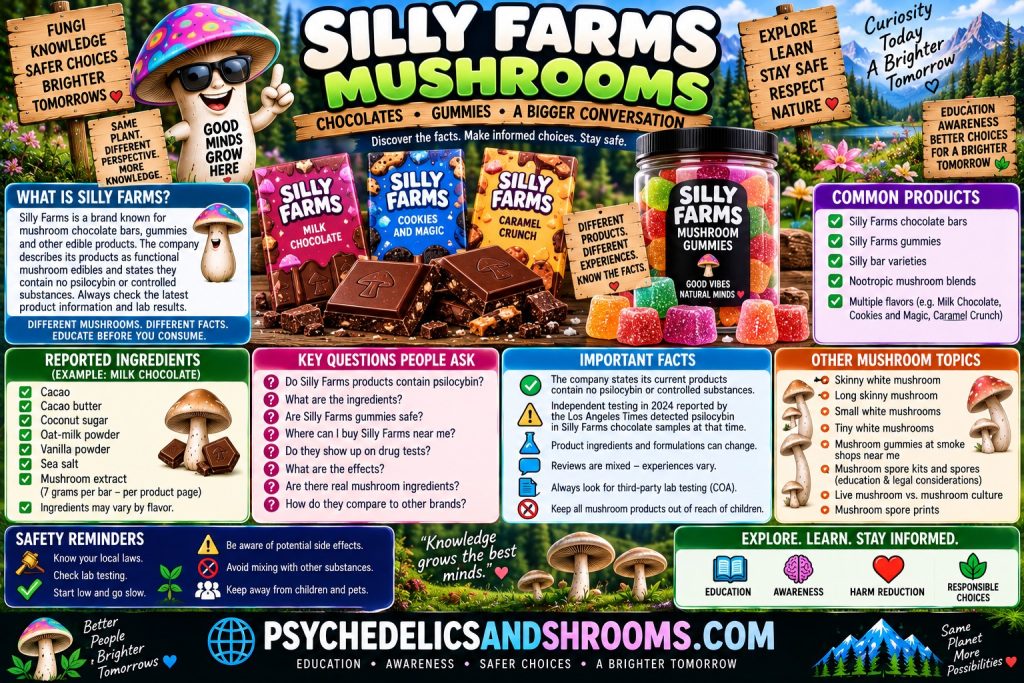
The company currently describes itself as a functional or nootropic mushroom-edibles brand rather than a psilocybin mushroom company. Its website states that its current products contain zero psilocybin or controlled substances and says products undergo laboratory testing.
That distinction matters.
Consumers shouldn’t automatically assume that every product marketed with psychedelic-looking mushroom imagery contains psilocybin. Likewise, they shouldn’t assume that packaging or marketing claims alone establish exactly what’s inside an edible.
Independent testing can provide important additional information.
Silly Farms Mushroom Chocolate Ingredients
According to the current Silly Farms Milk Chocolate product listing, its listed ingredients include:
- pure cacao;
- cacao butter;
- coconut sugar;
- dry oat-milk powder;
- vanilla powder;
- sea salt; and
- mushroom extract.
The product page describes the bar as containing 7 grams of mushroom extract.
Other flavors can contain additional ingredients.
For example, the company’s Dubai Chocolate listing currently describes a product containing cacao, cacao butter, coconut sugar, oat-milk powder, vanilla, sea salt, pistachio paste, and a mushroom extract/blend.
Therefore, someone researching Silly Farms mushroom chocolate ingredients should check the exact product rather than assuming every flavor has an identical formula.
What Exactly Is the Mushroom Extract?
This is where careful reading becomes particularly important.
Current Silly Farms marketing describes its products using phrases such as nootropic mushroom blend, mushroom extract, and functional mushroom edibles. The company also says its current products don’t contain psilocybin or controlled substances.
However, consumers should distinguish three different things:
Manufacturer claims tell us what a company says a product contains.
Certificates of analysis provide laboratory information about a particular tested sample or batch.
Independent investigative testing can provide another source of evidence.
These sources don’t always agree.
The Important Silly Farms Testing Controversy
Independent reporting provides essential context for any serious Silly Farms review.
In August 2024, the Los Angeles Times reported that laboratory testing of Silly Farms-branded chocolate samples detected psilocybin, even though the tested product’s labeling didn’t disclose psilocybin.
That historical finding conflicts with the company’s current statements that its products contain no psilocybin or controlled substances.
It would be inappropriate to assume that a sample tested in 2024 establishes the composition of every Silly Farms product manufactured in 2026.
But it would also be inappropriate to ignore the finding.
The safest conclusion is:
Product formulation, batches, packaging and marketplace authenticity can change. Current batch-specific independent testing is more informative than assumptions based solely on a brand name.
Silly Farms Chocolate Bars
Silly Farms currently lists numerous chocolate flavors.
Its collection includes products such as Milk Chocolate, Caramel Crunch, Buttercup, Cookies and Magic, Fruity Tunes, Wavy Wafer, S’mores, Strawberry Milkshake, Cinnamagic and Matcha Heaven.
The company describes the bars as chocolate combined with its proprietary mushroom blend.
Flavor variety doesn’t tell consumers what psychoactive compounds, if any, are present.
That requires chemical evidence.
Silly Bar: What Does the Name Mean?
A Silly Bar generally refers to one of the company’s mushroom chocolate products.
Consumers shouldn’t interpret “mushroom chocolate” as a scientifically precise ingredient category.
Mushroom products can potentially involve very different organisms or compounds, including:
- culinary mushrooms;
- functional mushroom extracts;
- Amanita ingredients;
- psilocybin-containing fungi; or
- other compounds in poorly characterized products.
These categories aren’t pharmacologically interchangeable.
Silly Farms Gummies
Silly Farms gummies are another part of the brand’s edible-product range.
The company’s own 2026 review describes gummies as one of its major product categories alongside chocolate and tablets. It characterizes them as nootropic mushroom products and again states that the current lineup contains no psilocybin or controlled substances.
Consumers should remember that a gummy format doesn’t establish what’s inside.
The same principles apply:
label + batch information + credible laboratory testing > packaging appearance.
Silly Farms Mushroom Gummies Review
Online Silly Farms mushroom gummies reviews vary considerably.
Some consumers report noticeable psychoactive-like effects, while others describe little or inconsistent effect. Community reports also contain speculation about what compounds might be responsible. Such anecdotes shouldn’t be treated as chemical analysis.
The company’s own reviews are also inherently promotional.
That doesn’t make every company statement false; it means readers should distinguish advertising, customer anecdotes, and independently generated evidence.
A useful review should examine:
| Question | Why it matters |
|---|---|
| Exact ingredients listed? | Establishes manufacturer’s claim |
| Batch number available? | Helps connect testing to product |
| COA available? | Provides analytical information |
| Laboratory identified? | Helps assess testing credibility |
| Date of analysis? | Old tests may not represent current batches |
| Psychoactive compounds tested? | Determines what the analysis actually covers |
| Contaminants tested? | Relevant to product safety |
| Independent evidence available? | Helps verify marketing claims |
A five-star customer review cannot answer these questions.
Are Silly Farms Reviews Reliable?
Reviews can help assess things such as:
- flavor;
- texture;
- packaging;
- customer service; and
- general consumer experience.
They are much less reliable for establishing:
- chemical composition;
- pharmacology;
- safety;
- exact potency; or
- presence or absence of psilocybin.
Someone saying a product “felt exactly like mushrooms” doesn’t prove that it contained psilocybin.
Likewise, someone reporting no psychedelic effect doesn’t prove that a product contains no psychoactive compound.
Chemical identification requires appropriate analysis.
What About “Mushroom Fitness Talk Chocolate Bars”?
Searches such as farms mushroom fitness talk chocolate bars may represent variations, autocorrections, social-media terminology, or attempts to locate discussions surrounding mushroom chocolates.
Consumers should be careful when unfamiliar product names appear in search results.
Look-alike packaging, outdated product pages and third-party listings can create confusion about which product is actually being discussed.
When researching a commercial mushroom edible, identify the exact:
- manufacturer;
- product name;
- package;
- batch;
- ingredient list; and
- relevant laboratory report.
Silly Mushrooms: Does the Phrase Mean Psilocybin?
Not necessarily.
“Silly mushrooms” isn’t a scientific species name.
Nor does the phrase establish that a product contains psilocybin.
Scientific names such as Psilocybe cubensis, Amanita muscaria, Hericium erinaceus and Ganoderma refer to very different fungi.
Marketing terms don’t have the same taxonomic precision.
For broader mushroom and psychedelic education, visit PsychedelicsAndShrooms.com.
Functional Mushrooms vs. Psilocybin Mushrooms
These categories shouldn’t be confused.
| Category | Examples | Psilocybin expected? |
|---|---|---|
| Culinary mushrooms | Oyster, shiitake, button | No |
| Functional-mushroom products | Lion’s mane, reishi, chaga products | No |
| Psilocybin mushrooms | Certain Psilocybe species | Yes |
| Amanita muscaria | Fly agaric | No—different psychoactive chemistry |
| Unverified mushroom edible | Unknown | Cannot assume |
A package covered in colorful mushroom artwork cannot resolve this distinction.
Why Independent Testing Matters
Mushroom chocolates and gummies occupy a confusing consumer marketplace.
Laboratory testing can potentially investigate:
- declared active ingredients;
- undeclared psychoactive compounds;
- heavy metals;
- microorganisms;
- pesticides;
- residual solvents; and
- other contaminants.
But even the words lab tested deserve scrutiny.
Consumers should ask:
What was tested?
Which batch was tested?
When?
By which laboratory?
Which analytes were included?
A certificate testing only heavy metals, for example, doesn’t prove the absence of every possible psychoactive compound.
What Are Mushroom Gummies?
Outside any specific brand, mushroom gummies are edible products containing mushroom-derived ingredients or ingredients marketed in connection with mushrooms.
Some are conventional supplements.
Others are marketed using psychedelic imagery.
The term alone doesn’t tell consumers whether a gummy is:
- non-psychoactive;
- intoxicating;
- a dietary supplement;
- a conventional food;
- an Amanita product; or
- something else.
The ingredient panel remains important.
Mushroom Gummies at Smoke Shops
The keyword mushroom gummies smoke shop near me suggests consumers frequently encounter these products at smoke shops and similar retailers.
Retail availability doesn’t independently establish:
- FDA approval;
- ingredient accuracy;
- safety;
- legality in every jurisdiction; or
- chemical identity.
This article therefore doesn’t provide nearby smoke shops or purchasing directions for potentially intoxicating mushroom products.
If a product’s contents are uncertain, the safer choice is not to consume it until reliable information is available.
Small White Mushrooms: Completely Different Search Intent
The supporting keywords skinny white mushroom, long skinny mushroom, small white mushrooms, and tiny white mushrooms represent a separate mushroom-identification topic.
Appearance alone isn’t sufficient to identify a wild mushroom.
A mushroom being:
- white;
- small;
- skinny;
- tall; or
- thin-stemmed
doesn’t establish its species.
Many unrelated fungi can share those characteristics.
Skinny White Mushroom Identification
Professional mushroom identification can involve examination of:
- cap morphology;
- gills or pores;
- stem;
- base;
- veil structures;
- spore characteristics;
- substrate;
- ecology;
- geographic distribution; and
- microscopic structures.
Some small white mushrooms are harmless.
Others can be poisonous.
Consequently, don’t consume an unknown mushroom because it resembles a photograph online.
Long Skinny Mushrooms
A long skinny mushroom could belong to numerous genera.
Stem length changes with:
- species;
- developmental stage;
- environmental conditions;
- competition;
- moisture;
- light; and
- substrate.
Stem shape therefore isn’t a reliable edibility test.
The same warning applies to tiny white mushrooms appearing in lawns, houseplants, mulch or forests.
Can Small White Mushrooms Be Poisonous?
Yes.
Color and size don’t determine toxicity.
Some highly toxic mushrooms can be pale or white.
Likewise, some edible mushrooms can be white.
There is no universal rule such as:
“White mushrooms are safe.”
Nor is the opposite statement true.
Species-level identification matters.
Mushroom Product vs. Wild Mushroom
Consumers should also distinguish packaged mushroom products from wild specimens.
A commercial gummy raises questions about:
- manufacturing;
- ingredients;
- labeling; and
- chemical testing.
A wild mushroom raises different questions about:
- taxonomy;
- poisonous lookalikes;
- habitat;
- specimen condition; and
- identification.
Both situations require evidence, but the evidence isn’t the same.
What If Someone Has a Bad Reaction?
Seek urgent medical help for serious symptoms such as:
- seizure;
- unconsciousness;
- serious breathing difficulty;
- chest pain;
- extreme agitation;
- severe confusion;
- suicidal or dangerous behavior; or
- rapidly worsening illness.
In the United States, call 911 for an immediate emergency.
For suspected poisoning or uncertain ingestion, America’s Poison Centers can provide guidance at 1-800-222-1222.
Keep the package when possible.
Packaging, ingredient information and batch numbers can help healthcare professionals investigate what someone may have consumed.
Frequently Asked Questions
1. What are Silly Farms mushrooms?
The phrase generally refers to mushroom-related chocolate, gummies and other products sold under the Silly Farms brand. The company currently describes its products as nootropic mushroom edibles rather than psilocybin products.
2. What are Silly Farms mushroom chocolate ingredients?
The current Milk Chocolate listing identifies cacao, cacao butter, coconut sugar, oat-milk powder, vanilla, sea salt and mushroom extract, and describes the product as containing 7 grams of mushroom extract. Formulas vary by flavor.
3. Do Silly Farms chocolate bars contain psilocybin?
Silly Farms currently states that its products contain no psilocybin or controlled substances. However, independent testing reported by the Los Angeles Times in 2024 detected psilocybin in Silly Farms-branded chocolate samples tested at that time. Those historical results don’t establish the composition of every current batch, making current batch-specific testing important.
4. Are Silly Farms reviews enough to know what’s in a product?
No. Reviews can describe consumer experiences, but they cannot reliably determine chemical composition. Appropriate laboratory analysis provides stronger evidence.
5. Can I identify a small white mushroom from its color?
No. Numerous species can be small and white. Accurate wild-mushroom identification requires multiple characteristics, and unidentified mushrooms shouldn’t be consumed.
6. Where can I buy Silly Farms gummies near me?
This guide focuses on product education rather than directing readers to smoke shops or sellers of potentially intoxicating mushroom products. Check current local regulations and verify a product’s ingredients and testing before making decisions about it.
Educational Resources
For additional educational information about mushrooms, psychedelic science, mushroom products and safety, explore PsychedelicsAndShrooms.com.
The key consumer lesson is simple: don’t infer chemistry from a mushroom logo, product name, customer review or smoke-shop shelf placement. Look for current, batch-specific evidence about what a mushroom edible actually contains.
