
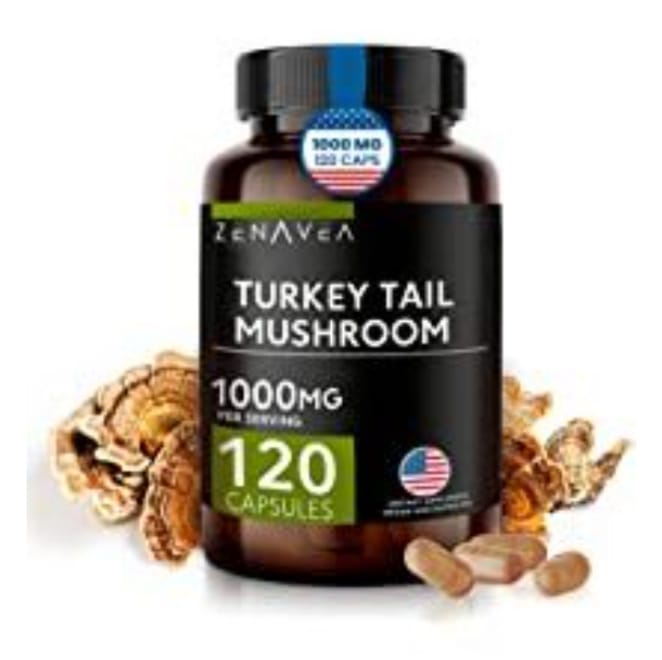
Turkey Tail Mushroom Capsules: Benefits, Cancer Research, Extracts & Safety
What Are Turkey Tail Mushroom Capsules?
Turkey Tail Mushroom Capsules provide turkey tail mushroom material or concentrated extracts in a convenient supplement form. Turkey tail, scientifically known as Trametes versicolor, grows naturally on dead wood in forests around the world.
The fungus gets its common name from its appearance. Specifically, colorful concentric bands spread across its thin, fan-shaped fruiting body and resemble a turkey’s tail.
Researchers have studied turkey tail because it contains several biologically interesting compounds. In particular, polysaccharides have attracted considerable scientific attention.
Two preparations appear frequently in research: PSK (polysaccharide-K) and PSP (polysaccharopeptide).
Because researchers have studied these compounds in oncology, many people now search for information about turkey tail mushroom and cancer. However, the research requires careful interpretation.
Turkey tail doesn’t replace established cancer treatment. Instead, researchers have investigated certain standardized preparations as complementary or adjunctive approaches alongside conventional care.
Therefore, people shouldn’t substitute turkey tail capsules for surgery, chemotherapy, radiation therapy, immunotherapy, hormonal treatment, or other therapies recommended by an oncology team.
For more educational mushroom information, explore PsychedelicsAndShrooms.com.
What Does Turkey Tail Mushroom Do?
Turkey tail contains complex polysaccharides, including compounds associated with beta-glucans.
Researchers continue to investigate how these substances interact with biological systems. For example, studies have explored immune signaling, gut microorganisms, antioxidant activity, and complementary cancer applications.
Moreover, scientists have examined how specific turkey-tail-derived preparations interact with immune cells.
However, biological activity doesn’t automatically equal a proven medical benefit.
A laboratory experiment may identify an interesting mechanism. Nevertheless, researchers still need well-designed human trials to determine whether that mechanism produces a meaningful clinical benefit.
Consequently, people should view turkey tail as an actively researched medicinal mushroom rather than a proven treatment for every condition associated with it online.
Turkey Tail Mushroom Benefits
Discussions about turkey tail mushroom benefits usually focus on immune and digestive health.
Researchers have taken particular interest in the mushroom’s polysaccharides. In addition, scientists increasingly study relationships between fungi, immune signaling, and the intestinal microbiome.
Still, supplement advertising can move much faster than clinical evidence.
For example, phrases such as “boosts immunity,” “eliminates tumors,” “detoxifies the body,” or “prevents cancer” can imply far more certainty than research supports.
Instead, a more accurate description recognizes turkey tail as a medicinal fungus containing scientifically interesting compounds.
Researchers continue to explore those compounds. Meanwhile, consumers should distinguish promising research from established treatment.
Turkey Tail Mushroom and Cancer
The relationship between turkey tail mushroom and cancer deserves special attention.
Scientists have studied turkey-tail-derived preparations in several oncology settings. Much of the historical clinical interest has centered on standardized preparations used alongside conventional treatment.
For example, researchers have extensively investigated PSK in Japan.
However, the word adjunct matters.
An adjunct complements standard treatment. It doesn’t replace it.
Furthermore, research involving a standardized medicinal preparation doesn’t prove that every turkey tail capsule, tea, powder, gummy, or tincture produces identical effects.
Therefore, consumers need to identify exactly which preparation researchers studied before applying a study’s conclusions to a commercial supplement.
Turkey Tail Cancer Studies
A turkey tail cancer study may examine several different questions.
For instance, researchers may investigate immune responses. Other studies may examine outcomes when a standardized preparation accompanies conventional cancer treatment.
Scientists have also explored:
- immune-cell activity;
- recovery of immune function;
- treatment-related outcomes;
- quality-of-life measures; and
- biological mechanisms involving fungal polysaccharides.
Nevertheless, cancer research varies enormously in quality.
A cell-culture experiment cannot answer the same questions as a randomized human clinical trial. Similarly, an animal study doesn’t prove that humans will experience identical effects.
For that reason, the statement “researchers have studied turkey tail in cancer” remains accurate.
By contrast, “turkey tail cures cancer” goes beyond the evidence.
Turkey Tail Breast Cancer Study
Researchers have also investigated turkey tail breast cancer applications.
Some early human research has explored immune function in women following conventional breast cancer treatment. Scientists wanted to understand whether turkey-tail preparations could influence immune recovery.
Those investigations provide useful preliminary information.
However, improved immune markers don’t automatically prove that a supplement destroys breast cancer cells, prevents recurrence, or improves survival.
Moreover, breast cancer includes several biologically different diseases.
Tumors may differ according to:
- hormone-receptor status;
- HER2 status;
- genetic characteristics;
- stage;
- metastatic behavior; and
- treatment response.
Therefore, no single mushroom supplement should be presented as a universal breast cancer therapy.
Turkey Tail Mushroom for Breast Cancer
People searching turkey tail mushroom for breast cancer may be looking for complementary treatment options.
Understandably, a cancer diagnosis can encourage patients and families to investigate every possible avenue. Nevertheless, complementary care and replacement therapy remain fundamentally different.
A patient might discuss a supplement with an oncology team while continuing evidence-based treatment.
Conversely, abandoning established therapy for an unproven mushroom product can create serious risks.
Therefore, anyone considering turkey tail during breast cancer treatment should discuss the exact supplement with their healthcare team.
Turkey Tail Mushroom Breast Cancer Research
When reviewing turkey tail mushroom breast cancer research, readers should consider the type of evidence.
| Research type | What it can tell us |
|---|---|
| Laboratory research | Identifies possible biological mechanisms |
| Animal research | Tests effects in experimental models |
| Small human studies | Provides preliminary clinical evidence |
| Controlled clinical trials | Offer stronger evidence about human outcomes |
| Replicated studies | Increase confidence in a finding |
| Standardized extract research | Applies most directly to that preparation |
This hierarchy prevents a common mistake.
Specifically, consumers sometimes see a promising laboratory study and assume an ordinary capsule will produce the same result in humans.
Science doesn’t work that way.
Instead, researchers build evidence gradually.
Turkey Tail Mushroom Prostate Cancer Study
Scientists have also explored medicinal mushroom compounds in prostate cancer research.
However, a turkey tail mushroom prostate cancer study may focus on biological mechanisms rather than demonstrating a successful human treatment.
For instance, researchers might examine immune responses or cellular activity.
Those findings can justify additional research. Still, they don’t prove that ordinary turkey tail capsules shrink prostate tumors.
Therefore, men undergoing prostate cancer treatment should discuss supplements with their oncology or urology team.
What Is PSK?
PSK stands for polysaccharide-K, also called Krestin.
Researchers have studied this turkey-tail-derived preparation extensively, particularly in Japan.
Importantly, PSK isn’t simply another name for turkey tail mushroom powder.
Instead, researchers use a standardized preparation. Standardization improves consistency and allows scientists to study a more clearly characterized substance.
That difference affects:
- concentration;
- composition;
- reproducibility; and
- interpretation of clinical results.
Consequently, consumers shouldn’t assume that an ordinary turkey tail supplement provides the same preparation used in PSK research.
What Is PSP?
PSP stands for polysaccharopeptide.
Like PSK, PSP comes from turkey-tail-related fungal material and has attracted scientific interest.
Researchers have investigated its biological and immune-related properties.
Even so, consumers should avoid using “PSP,” “PSK,” and “turkey tail powder” interchangeably.
Each term describes something different.
Therefore, when reading a study, ask one crucial question:
What exact turkey tail preparation did the researchers test?
That simple question prevents many misleading comparisons.
Turkey Tail Mushroom Supplements
Consumers can find turkey tail mushroom supplements in several forms.
Common options include capsules, pills, powders, extracts, teas, and gummies. In addition, manufacturers often include turkey tail in multi-mushroom blends.
However, format doesn’t determine effectiveness.
Instead, quality depends on factors such as fungal identity, processing, extraction, manufacturing standards, and testing.
For example, one capsule may contain whole mushroom powder. Another may contain a concentrated extract.
A third product could combine turkey tail with several other fungi.
Therefore, always read beyond the front label.
Turkey Tail Mushroom Capsules
Many consumers prefer turkey tail mushroom capsules because they offer convenience.
Manufacturers can place either mushroom powder or extract inside capsules. Some products may also combine different fungal materials.
When comparing products, check for:
- the scientific species name;
- clearly stated quantities;
- powder versus extract;
- fungal material used;
- manufacturer information;
- batch identification; and
- credible quality testing.
Furthermore, don’t assume that a larger milligram number guarantees a better product.
Concentration and composition matter more than a dramatic number printed on the bottle.
Best Turkey Tail Mushroom Capsules
No single product qualifies as the best turkey tail mushroom capsules for everyone.
Instead, consumers can compare products using transparent criteria.
First, look for the scientific name Trametes versicolor.
Next, examine whether the manufacturer clearly identifies the mushroom material. For example, does the label describe fruiting-body material, mycelium, an extract, or a combination?
Then, look for meaningful quality testing.
Finally, avoid products that promise to cure cancer or other serious diseases.
Reliable supplement companies should communicate limitations rather than relying on exaggerated medical claims.
Best Turkey Tail Mushroom Supplement
Choosing the best turkey tail mushroom supplement also depends on the intended purpose.
A healthy adult interested in general mushroom supplementation has different considerations from someone undergoing cancer treatment.
For cancer patients, medical context matters far more than star ratings or influencer recommendations.
Therefore, patients should show the exact ingredient label to their healthcare team before adding a supplement.
This step becomes especially important during chemotherapy, immunotherapy, radiation treatment, or complex medication regimens.
Turkey Tail Mushroom Powder
Turkey tail mushroom powder generally contains dried fungal material that manufacturers grind into a fine powder.
However, powder differs from concentrated extract.
Whole mushroom powder can contain a broad range of fungal components. By comparison, extraction processes aim to concentrate particular soluble constituents.
Several factors influence the final product, including:
- fungal material;
- cultivation;
- processing;
- drying;
- storage; and
- quality control.
As a result, two turkey tail powders can differ considerably.
Turkey Tail Extract
A turkey tail extract concentrates selected components from fungal material.
Manufacturers often use hot water because many mushroom polysaccharides dissolve in water. Some companies also use additional extraction techniques.
However, the word “extract” alone doesn’t tell consumers everything.
For instance, two extracts may differ in concentration, source material, extraction ratio, or chemical profile.
Therefore, consumers should look for detailed labeling rather than assuming every extract provides equivalent composition.
Turkey Tail Mushroom Gummies
Turkey tail mushroom gummies offer a sweeter and more convenient supplement format.
Manufacturers typically combine mushroom ingredients with other components needed to create a gummy.
These may include:
- sweeteners;
- flavorings;
- gelling agents; and
- stabilizers.
Consequently, someone comparing turkey tail gummies with capsules should examine more than taste.
The actual mushroom ingredient remains the most important consideration.
Turkey Tail Gummies vs. Capsules
| Feature | Capsules | Gummies |
|---|---|---|
| Convenient | Yes | Yes |
| Added sweeteners | Less common | Common |
| Can contain extracts | Yes | Yes |
| Automatically more effective | No | No |
| Quality varies | Yes | Yes |
| Transparent labeling matters | Yes | Yes |
Ultimately, delivery format doesn’t establish supplement quality.
Instead, consumers should focus on composition, testing, and transparent labeling.
Turkey Tail Pills
People often use turkey tail pills and turkey tail mushroom pills as general terms for tablets and capsules.
These products can contain powder, extracts, or blended ingredients.
Again, consumers should read the complete label.
Mushroom illustrations, words such as “premium,” and large milligram numbers don’t independently establish potency or clinical effectiveness.
Organic Turkey Tail Mushroom
An organic turkey tail mushroom product may appeal to consumers who value certified production practices.
However, organic certification answers a production question—not a medical one.
An organic supplement isn’t automatically:
- more clinically effective;
- more concentrated;
- safer for every person;
- free from side effects; or
- capable of treating disease.
Therefore, consumers should consider organic certification alongside, rather than instead of, evidence and quality testing.
Turkey Tail Mushroom Tea
Turkey tail mushroom tea represents a traditional-style way to prepare the fungus.
Unlike button or oyster mushrooms, turkey tail develops a thin but tough and leathery fruiting body.
Consequently, people don’t usually sauté it as a conventional vegetable.
Instead, hot-water preparations make more practical culinary sense.
Still, homemade tea doesn’t equal the standardized extracts used in specific scientific studies.
That distinction becomes especially important when discussing cancer research.
How to Prepare Turkey Tail Mushroom
When using commercially sourced, correctly identified food-grade turkey tail, people commonly prepare it as a hot-water beverage.
Because the fruiting body remains tough, the preparation generally involves heating it in water and straining out the solids.
Consumers should follow the instructions supplied with a reputable food-grade product.
Meanwhile, anyone undergoing cancer treatment or taking multiple medications should discuss regular medicinal-mushroom use with a healthcare professional.
Turkey Tail Mushroom Recipe
A basic turkey tail mushroom recipe can remain simple.
Start with a commercially sourced food-grade product and follow its preparation directions. Afterward, strain the tough fungal material from the liquid.
Some people add ordinary culinary ingredients such as ginger or lemon for flavor.
Importantly, treat the resulting drink as a food or herbal-style beverage—not as a substitute for cancer therapy.
How to Cook Turkey Tail Mushrooms
Turkey tail doesn’t cook like common grocery-store mushrooms.
Its leathery texture usually remains firm even after heating. Therefore, people more commonly use it in strained hot-water preparations.
Furthermore, cooking doesn’t make an unidentified wild mushroom safe.
Some mushroom toxins resist ordinary cooking temperatures.
For that reason, never use boiling, frying, or drying as a substitute for accurate mushroom identification.
Are Turkey Tail Mushrooms Edible?
Properly identified turkey tail isn’t generally known as a conventional poisonous mushroom.
However, the word edible can create the wrong expectation.
Its texture makes it unsuitable for eating like a portobello, oyster, or shiitake mushroom.
Instead, people commonly use processed forms such as teas, powders, and extracts.
Correct identification remains essential for wild specimens.
Can You Eat Turkey Tail Mushrooms?
People can use correctly identified turkey tail in food-style preparations, but the fruiting body remains very tough.
Therefore, most people don’t eat it directly.
Additionally, several bracket fungi can resemble turkey tail.
A photograph or identification app alone shouldn’t determine whether a wild specimen is safe to consume.
When uncertainty exists, don’t eat it.
Dried Turkey Tail Mushroom
Dried turkey tail mushroom stores more easily than fresh material.
Consumers often purchase dried material for tea or further food preparation.
Even so, drying doesn’t confirm species identity or eliminate every possible contamination problem.
Commercial products should ideally provide clear information about species, source, manufacturer, and batch.
Moreover, discard material that develops unexpected moisture, mold, or signs of spoilage.
Turkey Tail Benefits for Females
Searches for turkey tail benefits for female frequently overlap with interest in breast cancer, immunity, and digestive health.
However, research doesn’t establish a universal female-specific turkey tail benefit.
Women have participated in research involving breast cancer and immune function. Nevertheless, those findings shouldn’t become generic claims that turkey tail “balances female hormones” or produces unique benefits for every woman.
Pregnancy and breastfeeding also require additional caution because researchers haven’t established comprehensive safety data for every concentrated medicinal mushroom preparation.
Is Turkey Tail Mushroom Hard on the Liver?
Current evidence doesn’t establish routine liver injury as an expected effect of turkey tail.
Nevertheless, supplement-related liver concerns can arise for several reasons.
A contaminated product may create problems. Likewise, another ingredient in a multi-supplement formulation could cause an adverse reaction.
Underlying liver disease also changes the risk calculation.
Therefore, people with liver conditions should discuss supplements with a healthcare professional.
Seek medical care for concerning symptoms such as jaundice, dark urine, persistent vomiting, or severe abdominal pain.
Turkey Tail Mushroom Side Effects
Many studies describe turkey-tail preparations as relatively well tolerated. Even so, turkey tail mushroom side effects can occur.
Reported concerns can include:
- digestive discomfort;
- nausea;
- changes in bowel movements;
- darkened stools;
- individual sensitivity; and
- allergic reactions.
Moreover, a finished supplement may contain ingredients beyond turkey tail.
As a result, consumers should consider the complete formulation when investigating a reaction.
Turkey Tail and Medication Interactions
Natural origin doesn’t guarantee freedom from interactions.
This point becomes particularly important for cancer patients.
People receiving chemotherapy, immunotherapy, immunosuppressive treatment, or complex prescription regimens should discuss turkey tail supplements with their healthcare team.
Similarly, patients taking anticoagulants or medications with narrow therapeutic ranges should avoid assuming that a mushroom supplement cannot affect treatment.
Healthcare professionals can evaluate the supplement in the context of the complete medication list.
Turkey Tail Isn’t a Psychedelic Mushroom
Turkey tail is not a psilocybin mushroom.
It doesn’t produce the classic psychedelic effects associated with psilocybin-containing species.
Instead, scientists primarily study turkey tail for its polysaccharides, immune-related biology, nutritional characteristics, and potential medicinal applications.
Therefore, readers shouldn’t place all mushroom products into one category.
Functional, medicinal, culinary, poisonous, and psychedelic mushrooms can have completely different chemistry.
Frequently Asked Questions
1. What are turkey tail mushroom capsules good for?
Manufacturers commonly market turkey tail supplements for immune and general wellness support. Researchers have also studied specific turkey-tail-derived compounds in several medical contexts, including adjunctive oncology. However, ordinary capsules don’t qualify as cancer treatments.
2. Does turkey tail mushroom cure cancer?
No. Researchers have investigated standardized preparations such as PSK alongside conventional cancer treatment. That research doesn’t establish turkey tail supplements as stand-alone cancer cures.
3. Has turkey tail been studied for breast cancer?
Yes. Researchers have explored immune responses involving turkey-tail preparations in breast cancer contexts. However, these studies don’t show that an ordinary supplement can replace established breast cancer therapy.
4. Is turkey tail mushroom hard on the liver?
Researchers haven’t established routine liver injury as an expected turkey tail effect. Still, underlying liver disease, contamination, interactions, and other supplement ingredients can influence risk.
5. Can you eat turkey tail mushrooms?
People can use correctly identified food-grade turkey tail in culinary-style preparations. However, its leathery texture makes tea, powder, and extract forms more practical than eating the fruiting body like an ordinary mushroom.
6. What should I look for in turkey tail mushroom capsules?
Choose products that clearly identify Trametes versicolor, disclose ingredient quantities and mushroom material, explain whether the product contains powder or extract, provide batch traceability, and use credible quality testing.
Educational Resources
For more educational material about medicinal mushrooms, supplements, fungal biology, and mushroom research, explore PsychedelicsAndShrooms.com.
People researching turkey tail mushroom and cancer should prioritize peer-reviewed medical evidence and established cancer organizations over supplement advertising. Furthermore, readers should always identify the exact preparation used in a study before applying its results to a commercial product.
Ultimately, turkey tail deserves scientific interest because researchers have studied its immune-active polysaccharides and standardized derivatives. However, responsible health information must distinguish promising adjunctive research from the unsupported claim that turkey tail mushroom capsules cure cancer.
| Quantity | 4 bottles, 6 bottles, 8 bottles, 10 bottles |
|---|
Be the first to review “Turkey Tail Mushroom Capsules”
Related products
Mushroom Capsule
Mushroom Capsule
Mushroom Capsule
Mushroom Capsule
Mushroom Capsule
Mushroom Capsule
Mushroom Capsule
Mushroom Capsule
Reviews
There are no reviews yet.