mushroom and shrooms
Albino Penis Envy Mushroom: Characteristics, Scientific Research, and Safety
Jul
The Albino Penis Envy mushroom, often abbreviated as APE, is one of the most recognized varieties within the Psilocybe cubensis species. It has attracted attention from mycologists, researchers, and those interested in fungal biology because of its distinctive appearance and the ongoing scientific interest in the naturally occurring compounds found in Psilocybe mushrooms. Although discussions about this variety are common online, separating scientific evidence from anecdotal claims is essential for anyone seeking reliable information.
Unlike edible mushrooms such as Shiitake, Oyster, or Portobello mushrooms, the Albino Penis Envy mushroom belongs to a group of mushrooms that naturally contain psilocybin and psilocin. These compounds are currently being studied in carefully regulated clinical research to better understand their effects on the brain and their potential therapeutic applications. Educational resources available at https://psychedelicsandshrooms.com/ provide readers with evidence-based information about mushroom science, psychedelic research, and fungal biology while clearly distinguishing scientific findings from recreational use.
What Is the Albino Penis Envy Mushroom?
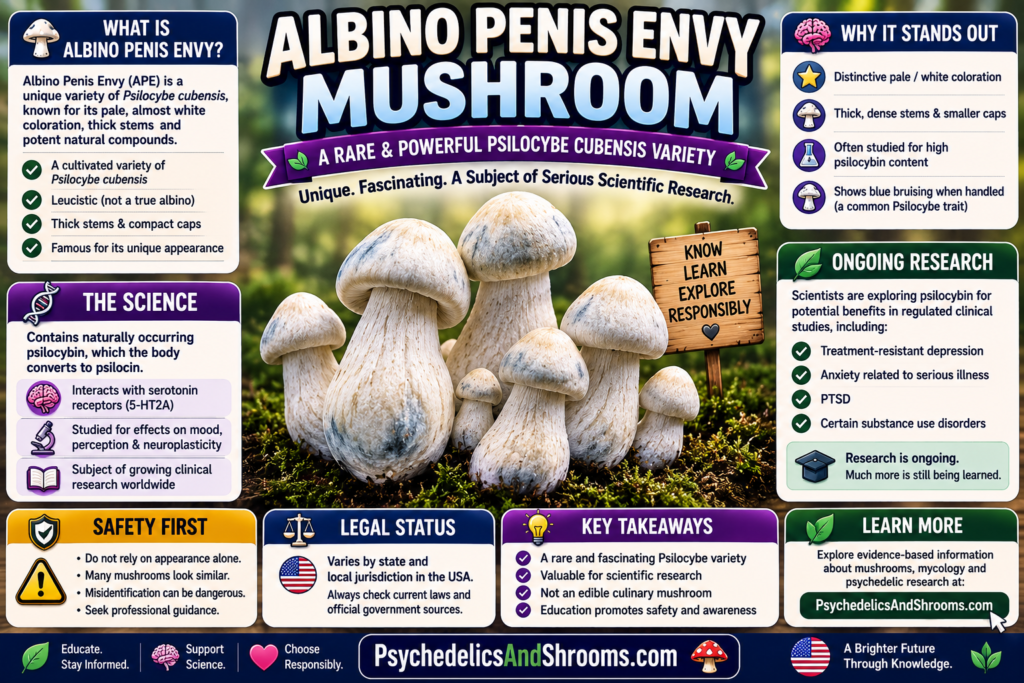
The Albino Penis Envy mushroom is a cultivated variety of Psilocybe cubensis. Despite its common name, it is not a true albino. Instead, it is considered leucistic, meaning it has reduced pigmentation while retaining some natural coloration. This gives the mushroom its characteristic pale white to cream-colored appearance.
It is widely recognized for several visual characteristics:
- Thick, dense stems
- Compact caps
- Pale or nearly white coloration
- Blue bruising when handled, a common characteristic among many psilocybin-containing mushrooms
These features help distinguish it from many other Psilocybe cubensis varieties, although accurate identification always requires expert knowledge because many mushroom species can appear similar.
Why Is It Called Albino Penis Envy?
The name combines two descriptive characteristics.
“Albino” refers to its light coloration, although, scientifically, most specimens are better described as leucistic rather than completely albino.
“Penis Envy” refers to the variety’s distinctive shape, which differs from many traditional Psilocybe cubensis mushrooms by producing thicker stems and relatively smaller caps.
The name has become widely recognized within mycology and mushroom research communities.
Scientific Interest
Researchers continue studying psilocybin-containing mushrooms because they contain naturally occurring compounds that interact with serotonin receptors in the brain.
Scientific interest focuses on understanding:
- Brain function
- Neuroplasticity
- Emotional processing
- Learning and memory
- Consciousness
- Mental health research
Universities and medical institutions around the world continue conducting carefully controlled studies to better understand these biological processes.
Psilocybin and Psilocin
Albino Penis Envy mushrooms naturally contain psilocybin, which the body converts into psilocin after ingestion.
Psilocin primarily interacts with serotonin receptors, particularly the 5-HT2A receptor, influencing communication between regions of the brain involved in perception, mood, and cognition.
Modern brain imaging research continues investigating how these temporary neurological changes may contribute to therapeutic outcomes under professionally supervised clinical conditions.
Current Clinical Research
Research involving psilocybin has expanded considerably over the past decade.
Clinical studies continue investigating its potential role in treating:
- Treatment-resistant depression
- Anxiety associated with serious illness
- Post-traumatic stress disorder (PTSD)
- Certain substance use disorders
These studies occur under strict ethical oversight with medical screening, trained clinicians, and psychological support.
Researchers emphasize that clinical investigations should not be confused with unsupervised or recreational use.
Habitat and Cultivation Background
Wild Psilocybe cubensis mushrooms naturally grow in tropical and subtropical environments with warm temperatures and high humidity.
Albino Penis Envy is primarily known as a cultivated variety rather than a naturally occurring wild population.
Because environmental conditions, genetics, and cultivation methods influence mushroom development, physical appearance can vary from one specimen to another.
Understanding fungal biology helps researchers better appreciate the remarkable diversity found within mushroom species.
Safety Considerations
Scientific education should always prioritize safety.
Many mushroom species resemble one another, including some that are toxic or potentially dangerous.
For this reason:
- Visual appearance alone is not sufficient for reliable identification.
- Misidentification can have serious health consequences.
- Scientific discussions should never replace expert identification or medical advice.
Researchers also emphasize that psilocybin-containing mushrooms should only be studied or administered within approved clinical research or legally authorized settings where appropriate.
Anyone experiencing depression, anxiety, or other mental health concerns should seek guidance from a qualified healthcare professional.
Legal Status
The legal status of psilocybin-containing mushrooms varies by country, state, and local jurisdiction.
Some regions allow regulated clinical research or supervised therapeutic programs, while others continue to prohibit possession or use outside authorized settings.
Because laws can change, readers should consult official government resources for current legal information.
Educational articles should not be interpreted as legal advice.
The Importance of Accurate Mushroom Education
Public interest in mushrooms continues to expand, making reliable education more valuable than ever.
Understanding the differences between:
- Edible mushrooms
- Functional mushrooms
- Medicinal fungi
- Psilocybin-containing mushrooms
helps reduce misinformation while encouraging evidence-based discussions.
Readers interested in mushroom biology, mycology, and psychedelic science can explore additional educational resources at https://psychedelicsandshrooms.com/guides/.
Final Thoughts
The Albino Penis Envy mushroom remains one of the most recognizable Psilocybe cubensis varieties because of its unique appearance and the growing body of scientific research surrounding psilocybin-containing mushrooms. While researchers continue exploring potential therapeutic applications in carefully supervised clinical settings, much remains under investigation.
Learning about fungal biology, neuroscience, and current scientific research allows readers to better understand this fascinating mushroom while appreciating the importance of evidence-based education and responsible public discussion.
For more educational articles about mushrooms, mycology, neuroscience, and psychedelic research, visit https://psychedelicsandshrooms.com/.
FAQs
What is the Albino Penis Envy mushroom?
The Albino Penis Envy mushroom is a cultivated variety of Psilocybe cubensis recognized for its pale coloration, thick stems, and compact caps.
Is the Albino Penis Envy mushroom truly albino?
Most experts describe it as leucistic, meaning it has reduced pigmentation rather than complete albinism.
Why is this mushroom studied by researchers?
Scientists investigate naturally occurring compounds such as psilocybin to better understand brain function, neuroplasticity, and potential therapeutic applications in regulated clinical research.
Does the Albino Penis Envy mushroom naturally grow in the wild?
It is primarily recognized as a cultivated variety, while wild Psilocybe cubensis populations occur in warm tropical and subtropical environments.
Can mushrooms be identified by appearance alone?
No. Many mushroom species resemble one another, making expert identification essential.
Where can I learn more about mushroom science?
Visit https://psychedelicsandshrooms.com/ and https://psychedelicsandshrooms.com/guides/ for educational resources about mushrooms, mycology, and current scientific research.
