mushroom and shrooms
Mushroom Liquid Culture: A Complete Guide to Mycology and Fungal Research
Jul
Mushroom liquid culture is an important concept in mycology and fungal research. It refers to a nutrient-rich liquid solution that supports the growth of mushroom mycelium under sterile laboratory conditions. Researchers, educators, and mushroom enthusiasts use liquid culture to study fungal biology, preserve mushroom genetics, and better understand how fungi develop. As interest in mushroom science continues to grow in the United States, many people are searching for reliable information about mushroom liquid culture and its role in modern mycology.
Unlike mushroom spores, which are reproductive cells, liquid culture contains actively growing mycelium suspended in a sterile nutrient solution. Scientists value this approach because it allows them to observe fungal growth and maintain cultures for educational and research purposes.
Educational resources available at https://psychedelicsandshrooms.com/ help readers understand mushroom biology, fungal ecology, mycology, and the differences between edible, functional, medicinal, and psychedelic mushrooms through evidence-based information.
What Is Mushroom Liquid Culture?
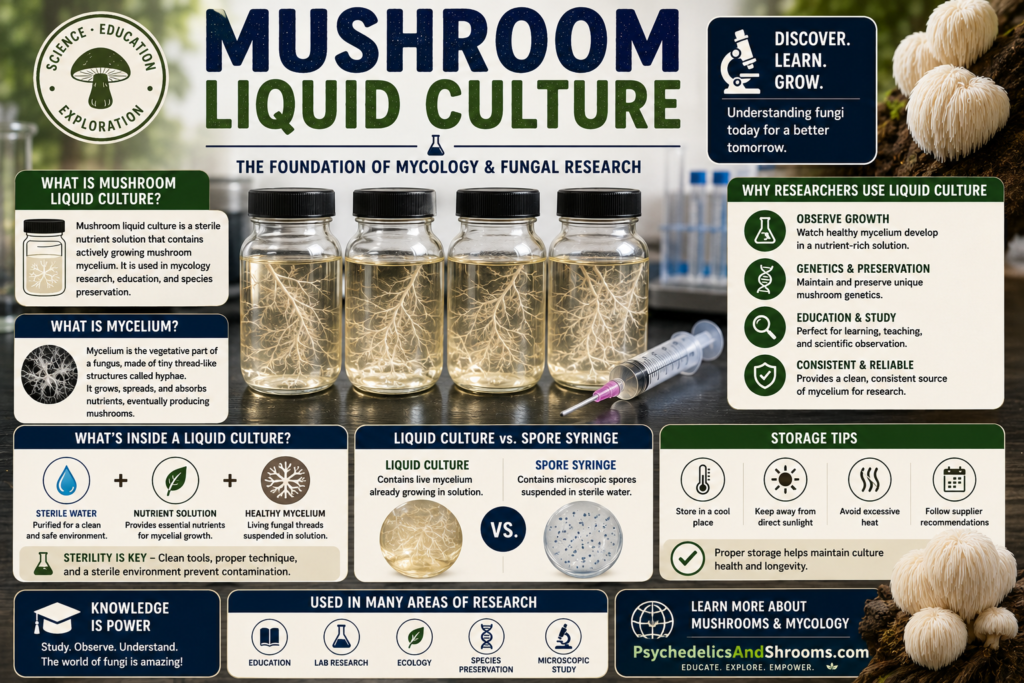
Mushroom liquid culture is a sterile solution containing nutrients that support the growth of mushroom mycelium. The liquid environment allows researchers to observe healthy fungal development while maintaining cultures under carefully controlled conditions.
In educational and laboratory settings, liquid cultures are commonly used to study fungal biology, genetics, and species characteristics.
Understanding Mushroom Mycelium
Mycelium is the living network of microscopic fungal threads that forms the main body of a fungus.
Before a mushroom produces a visible fruiting body, the mycelium grows through its environment, absorbing nutrients and expanding its network.
Studying mycelium helps scientists better understand:
- Fungal growth
- Reproduction
- Ecology
- Biodiversity
- Species identification
- Cellular development
What Is Inside a Liquid Culture?
A typical laboratory liquid culture contains:
- Sterile water
- Nutrient solution
- Healthy mushroom mycelium
The nutrient solution provides the resources needed for mycelial growth while sterile preparation helps reduce contamination.
Why Researchers Use Liquid Culture
Liquid culture offers several advantages in scientific and educational work.
Researchers use it for:
- Mycology education
- Laboratory research
- Fungal genetics
- Species preservation
- Microscopic observation
- Demonstrating fungal growth
These applications contribute to a better understanding of fungal biology without relying solely on mature mushrooms.
Importance of Sterile Techniques
Maintaining sterility is one of the most important aspects of handling fungal cultures.
Contaminants such as bacteria, molds, and unwanted fungi can interfere with observations and affect research quality.
Laboratories use sterile equipment and controlled procedures to help maintain healthy cultures.
Storage Considerations
Proper storage helps preserve culture quality.
General recommendations include:
- Keeping cultures in a cool environment.
- Protecting them from direct sunlight.
- Avoiding excessive heat.
- Following laboratory or supplier storage recommendations.
Storage requirements may vary depending on the culture and research purpose.
Liquid Culture vs. Spore Syringes
Although both are used in mycology, they serve different educational purposes.
Liquid culture contains actively growing mycelium suspended in a nutrient solution.
Spore syringes contain microscopic spores suspended in sterile water for observation and research.
Understanding this distinction helps students and researchers appreciate different stages of the fungal life cycle.
Why Mushroom Education Matters
Learning about mushroom liquid culture helps explain how fungi grow, reproduce, and interact with their environment. It also introduces important concepts such as sterile laboratory practices, fungal diversity, and the biology of mycelium.
Reliable educational information encourages responsible scientific learning while reducing confusion about fungal terminology.
Readers interested in learning more about mushroom biology and mycology can explore additional educational resources at https://psychedelicsandshrooms.com/guides/.
Mushroom Liquid Culture and Modern Research
Liquid culture continues to play an important role in mycology laboratories around the world. Scientists use it to study fungal physiology, preserve research samples, and improve understanding of mushroom biology.
As research advances, liquid culture remains an essential tool for education, taxonomy, and fungal science.
Final Thoughts
Mushroom liquid culture is a valuable resource in mycology, providing researchers and educators with a reliable way to study living mycelium under controlled conditions. By supporting scientific observation, fungal preservation, and education, liquid culture contributes to a deeper understanding of mushrooms and their remarkable life cycle.
For more educational articles about mushrooms, mycology, fungal biology, and mushroom science, visit https://psychedelicsandshrooms.com/.
FAQs
What is mushroom liquid culture?
Mushroom liquid culture is a sterile nutrient solution containing actively growing mushroom mycelium used in mycology research and education.
How is liquid culture different from a spore syringe?
Liquid culture contains living mycelium, while a spore syringe contains microscopic spores suspended in sterile water.
Why is sterility important?
Sterile handling helps prevent contamination from bacteria, molds, and other microorganisms that could interfere with scientific work.
What is mycelium?
Mycelium is the network of microscopic fungal threads that forms the main body of a fungus before mushrooms develop.
Is mushroom liquid culture used in scientific research?
Yes. It is commonly used in mycology laboratories for education, fungal biology, species preservation, and microscopy.
Where can I learn more about mushroom science?
Visit https://psychedelicsandshrooms.com/ and https://psychedelicsandshrooms.com/guides/ for educational resources about mushrooms, mycology, and fungal biology.
