mushroom and shrooms
What Is Microdosing? Effects, Benefits, Risks, Safety and U.S. Legal Status
Aug
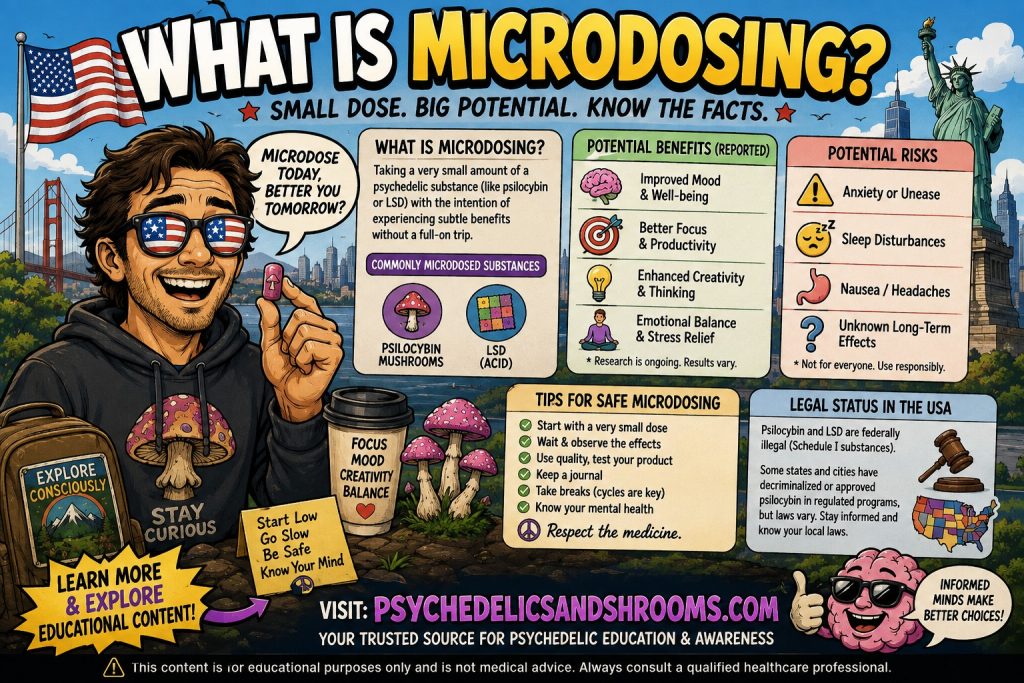
What is microdosing? In psychedelic discussions, microdosing generally means taking a small amount of a psychedelic substance intended to produce little or no obvious perceptual alteration. The term is most commonly associated with psilocybin-containing mushrooms and LSD, although it is sometimes applied more broadly.
A simple microdose definition is therefore: a small amount of a substance taken with the intention of producing subtle rather than fully psychedelic effects.
That definition needs an important qualification. There is no universally accepted medical definition establishing one standardized psychedelic “microdose,” and microdosing is not an FDA-approved treatment protocol for anxiety, depression, or another mental-health condition.
Online discussions sometimes present microdosing as an established wellness practice. Scientific research paints a more complicated picture. Some participants report improvements in mood, creativity, focus, or well-being, while controlled research has raised questions about how much of these reported improvements comes from pharmacological effects versus expectations and placebo effects.
Readers interested in broader psychedelic terminology and educational material can explore psychedelicsandshrooms.com for additional informational resources.
Define Microdose: Microdosing vs. a Full Psychedelic Experience
To define microdose accurately, it helps to distinguish microdosing from a conventional psychedelic experience.
A full psychedelic experience can involve substantial changes in perception, emotion, thought, sensory processing, and sense of self. Microdosing is generally intended to remain below the level at which these pronounced effects occur.
However, individual responses are unpredictable.
Psychedelic potency can vary, particularly with biological materials such as mushrooms. Individual sensitivity, medications, health conditions, product composition, and other factors can also affect the response.
This is one reason seemingly precise dosing claims circulating online should not automatically be interpreted as medically validated recommendations.
How Does Microdosing Work?
People searching how does microdosing work are often looking for both a biological explanation and evidence that the practice produces meaningful benefits.
Psilocybin and LSD influence the brain’s serotonin signaling system. Psychedelic effects are particularly associated with activity involving the serotonin 5-HT2A receptor.
Researchers are investigating how psychedelics may influence neural signaling, perception, cognitive flexibility, and brain-network activity.
But understanding a molecular mechanism does not prove that repeated low-level exposure produces a particular therapeutic outcome.
This distinction is fundamental.
A substance can clearly interact with a biological receptor without every health claim surrounding that substance being clinically established.
What Does Microdosing Do?
Reported microdosing effects include subtle changes in mood, attention, energy, creativity, emotional awareness, and perception.
These are reports—not guaranteed outcomes.
Controlled trials are particularly valuable because people who expect microdosing to improve their lives may notice positive changes even when the pharmacological contribution is small.
Blinding psychedelic studies can also be challenging. If participants can determine whether they received an active substance, expectations can influence study results.
Consequently, the scientific question is not simply whether people say they feel better after microdosing. Researchers need to determine whether measurable improvements reliably exceed placebo effects and whether any improvement persists over time.
Benefits of Microdosing: What Is Actually Established?
Searches for the benefits of microdosing or micro dose benefits frequently produce impressive lists claiming improvements in creativity, productivity, mood, relationships, anxiety, and cognitive performance.
These claims should not be presented as settled medical facts.
Observational studies have documented self-reported positive experiences among some people who microdose. Controlled research, however, has produced mixed findings.
The evidence is also substantially different from research involving full-dose psychedelic-assisted therapy.
Clinical studies investigating psilocybin generally involve carefully characterized substances, participant screening, professional supervision, controlled environments, and structured psychological support. Findings from those studies cannot simply be transferred to unsupervised microdosing.
Microdose Mushrooms Effects
The phrase microdose mushrooms effects generally refers to perceived effects from small amounts of psilocybin-containing mushrooms.
Psilocybin is converted in the body to psilocin. Psilocin interacts with serotonin receptors and produces the characteristic effects associated with psychedelic mushrooms.
At low exposure levels, users may report subtle experiences rather than pronounced visual or perceptual changes.
Possible reported experiences include:
- changes in mood;
- increased or decreased energy;
- altered concentration;
- heightened emotional sensitivity;
- physical discomfort;
- anxiety or restlessness; and
- mild perceptual changes.
Natural mushroom material also creates an additional problem: biological potency is not necessarily uniform.
A mushroom is not equivalent to a standardized pharmaceutical tablet.
Microdosing Psychedelic Mushrooms Benefits: Evidence vs. Claims
Claims about microdosing psychedelic mushrooms benefits deserve careful examination.
Researchers have investigated whether microdosing might affect mood, cognition, creativity, and general psychological functioning. Some observational findings appear encouraging, while controlled studies have often found smaller or less consistent differences.
This does not prove that everyone reporting improvements is mistaken.
It means researchers still need to separate several possible contributors:
Pharmacological effects: Changes directly attributable to the substance.
Expectation effects: Changes influenced by believing a treatment will work.
Behavioral changes: Someone beginning a microdosing routine may simultaneously improve sleep, exercise, diet, journaling, or other habits.
Selection effects: People who have positive experiences may be more likely to discuss them publicly.
Good psychedelic science attempts to separate these variables rather than assuming every reported improvement comes directly from the substance.
Microdosing for Anxiety
Microdosing for anxiety, micro dosing for anxiety, and micro dose for anxiety are increasingly common searches.
The important message is that microdosing should not be represented as an established treatment for an anxiety disorder.
Some people report reduced anxiety, while others can experience increased anxiety, nervousness, agitation, or emotional discomfort from psychedelic substances.
Mental-health conditions also differ significantly between individuals.
Research investigating psychedelic-assisted psychotherapy should not be confused with self-directed microdosing. Clinical research typically involves screening, standardized protocols, professional oversight, and follow-up procedures.
People experiencing persistent anxiety should discuss evidence-based options with an appropriately qualified healthcare professional rather than replacing established treatment with an unverified psychedelic regimen.
Microdosing Psychedelics for Mental Health
Interest in microdosing psychedelics for mental health exists within a much larger scientific discussion about psychedelic medicine.
Psilocybin research has examined conditions including depression and other psychiatric indications. The results of certain controlled psychedelic studies have generated considerable scientific interest.
However, three concepts must remain separate:
- clinical psychedelic research;
- psychedelic-assisted treatment within legally authorized frameworks; and
- unsupervised microdosing.
Evidence supporting one does not automatically establish the effectiveness or safety of another.
More educational discussion about psychedelic research terminology can be explored through psychedelicsandshrooms.com.
Is Microdosing Mushrooms Good for You?
There is no scientifically responsible universal “yes” to is microdosing mushrooms good for you?
Risk and potential benefit depend on numerous factors, and research has not established routine psychedelic microdosing as a generally beneficial medical practice for everyone.
Someone’s positive anecdote cannot predict another person’s response.
Health history, psychiatric vulnerability, other medications, unknown product composition, and legal considerations can all matter.
Consumers should be particularly cautious about websites making guaranteed claims such as “microdosing cures anxiety” or “microdosing permanently increases intelligence.” Claims of this type go considerably beyond established evidence.
Is Microdosing Safe?
Is microdosing safe? The most accurate answer is that important uncertainties remain.
The word “micro” can make an activity sound inherently harmless. A small exposure, however, does not automatically mean zero risk—particularly when repeated over long periods or when the substance itself is unverified.
Possible concerns can include psychological discomfort, anxiety, sleep disruption, headache, gastrointestinal symptoms, changes in attention, and interactions with other substances or medications.
Another major issue is product identity.
An unregulated product advertised as containing psychedelic mushrooms may not necessarily contain the expected ingredient or concentration. This creates risks that do not exist to the same degree in controlled research using analytically characterized substances.
Microdosing Side Effects
Reported microdosing side effects vary between studies and individuals.
Potential unwanted experiences can include headaches, gastrointestinal discomfort, restlessness, sleep changes, anxiety, mood changes, difficulty concentrating, and unexpected psychoactive effects.
Individual vulnerability is particularly important when discussing psychedelics.
People with certain psychiatric histories or medications may face considerations that cannot be adequately evaluated through generalized internet advice.
This is another reason educational information should not be treated as individualized medical guidance.
Long-Term Effects of Microdosing
The long term effects of microdosing remain one of the most important unanswered questions.
Psychedelic microdosing became culturally popular faster than researchers could accumulate years or decades of controlled safety data.
Short-term studies cannot automatically answer questions about repeated exposure over several years.
Researchers need better information about:
- sustained psychological effects;
- tolerance;
- cardiovascular considerations;
- interactions with medications;
- frequency of adverse reactions; and
- whether perceived benefits persist.
Absence of evidence showing a particular long-term harm is not the same as evidence that long-term use is harmless.
Pros and Cons of Microdosing Mushrooms
The pros and cons of microdosing mushrooms are best considered by separating reported experiences from scientifically demonstrated outcomes.
| Area | What is currently important to understand |
|---|---|
| Mood | Some users report improvements, but controlled evidence remains mixed |
| Creativity | Frequently reported, but objective improvements are not consistently demonstrated |
| Anxiety | Some report improvement while others experience increased anxiety |
| Productivity | Anecdotal reports are common; strong clinical evidence is limited |
| Safety | Serious questions remain about individual risk and repeated long-term exposure |
| Product consistency | Unregulated mushroom products may vary substantially |
| Legality | Psilocybin remains federally controlled in the United States |
The table demonstrates why microdosing should not be described as either a miracle intervention or something that has no scientific interest. Research is evolving.
Benefits of Microdosing Acid
“Acid” is a common slang term for LSD. Searches concerning the benefits of microdosing acid generally refer to taking low quantities of LSD with the intention of producing subtle effects.
Users have reported changes involving mood, creativity, concentration, and energy.
As with psilocybin microdosing, however, self-reported benefits should not be confused with clinically established therapeutic outcomes.
LSD is also federally controlled in the United States.
How Often Can You Microdose?
How often can you microdose? is a common search query, but providing a universal schedule would incorrectly turn educational information into individualized drug-use instructions.
There is no FDA-approved psychedelic microdosing schedule for treating anxiety, depression, or improving general wellness.
Frequency also directly affects questions about repeated exposure and long-term safety—the areas where evidence remains incomplete.
Rather than relying on schedules promoted through social media or informal communities, readers should understand that these protocols have not become standardized medical treatment simply because they are widely discussed.
Microdosing in a Sentence
For readers looking for microdosing in a sentence:
Microdosing is the practice of taking a small amount of a substance, commonly discussed in relation to psychedelics, with the intention of producing subtle effects rather than a full psychedelic experience.
That definition describes the practice without making unsupported claims about its benefits.
Will Psychedelics Be Legalized?
The question will psychedelics be legalized cannot be answered with one nationwide prediction.
The United States has overlapping federal, state, and local laws.
Psilocybin remains federally controlled, while some states and municipalities have adopted different approaches involving regulated access, decriminalization, reduced enforcement priority, or therapeutic programs.
These terms are not interchangeable.
Decriminalization generally reduces or changes criminal penalties.
Legalization creates lawful activities under defined rules.
Regulated therapeutic access can permit particular uses without establishing unrestricted consumer sales.
Clinical research authorization allows qualifying research but does not legalize general possession.
This distinction is essential when interpreting headlines about psychedelic-law reform.
Has Psilocybin Been Legalized for Consumer Use?
Statements such as “psilocybin has been legalized for consumer use” require geographic and legal context.
Rules vary significantly by jurisdiction, and changes at a state or municipal level do not change federal controlled-substance law.
Regulated psychedelic programs can also impose requirements concerning location, supervision, licensing, age, or administration.
Consumers should therefore consult current government information for their specific jurisdiction instead of relying on generalized claims found in search results or social-media posts.
Is DMT Legal in California?
People searching is DMT legal in California should distinguish legislative proposals, local enforcement changes, state law, and federal law.
DMT remains a federally controlled substance. Psychedelic policy proposals have received considerable attention in California, but discussion of reform should never be interpreted automatically as unrestricted legalization.
Because psychedelic legislation changes, current official state information should be checked when making legal decisions.
Why Real-World Microdosing Data Are Difficult to Interpret
Microdosing presents an unusually difficult research problem.
People frequently begin microdosing because they already expect positive results. Those expectations can affect subjective measures such as mood, productivity, and creativity.
Researchers therefore use randomized and placebo-controlled designs whenever feasible.
Real-world products introduce another variable. A precisely characterized research compound and a mushroom-containing product obtained through an unregulated source are not necessarily chemically equivalent.
This difference makes conclusions from laboratory research difficult to apply directly to informal consumer behavior.
What Consumers Should Take Away From Microdosing Research
The most useful answer to what is microdosing is neither enthusiastic promotion nor automatic dismissal.
Microdosing is a real behavior receiving legitimate scientific attention. People report positive experiences, and researchers continue investigating possible psychological and biological effects.
At the same time, evidence for many popular benefits of microdosing remains incomplete or mixed. Long-term safety requires additional research, and microdosing should not be presented as an FDA-approved treatment for anxiety or other mental-health disorders.
Psychedelic science is moving rapidly. Good public education should move just as carefully.
Readers interested in broader informational material about psychedelic terminology, research, and mushroom-related subjects can explore psychedelicsandshrooms.com as an additional educational resource.
Frequently Asked Questions
What is microdosing?
Microdosing generally describes taking a small amount of a psychedelic with the intention of experiencing subtle rather than fully psychedelic effects. There is no universally standardized medical microdose.
What are the benefits of microdosing?
People report benefits involving mood, creativity, concentration, and well-being, but controlled research has produced mixed results. Many claimed benefits have not been established as medical facts.
Is microdosing mushrooms safe?
Research has not established microdosing as risk-free. Potential concerns include psychological effects, side effects, medication interactions, uncertain product composition, and incomplete long-term safety data.
Can microdosing help anxiety?
Some individuals report improvement, while others experience increased anxiety. Microdosing is not an established FDA-approved treatment for anxiety disorders.
What are the long-term effects of microdosing?
Long-term evidence remains limited. Researchers need additional data concerning repeated psychedelic exposure, psychological outcomes, cardiovascular considerations, tolerance, and other potential effects.
Is microdosing legal in the United States?
Legality depends on the substance and jurisdiction. Psilocybin and LSD remain federally controlled substances even though certain states and local jurisdictions have adopted different psychedelic policies.
