Uncategorized
Bella Mushrooms: Nutrition, Benefits, Baby Bella vs White Mushrooms
Aug
What Are Bella Mushrooms?
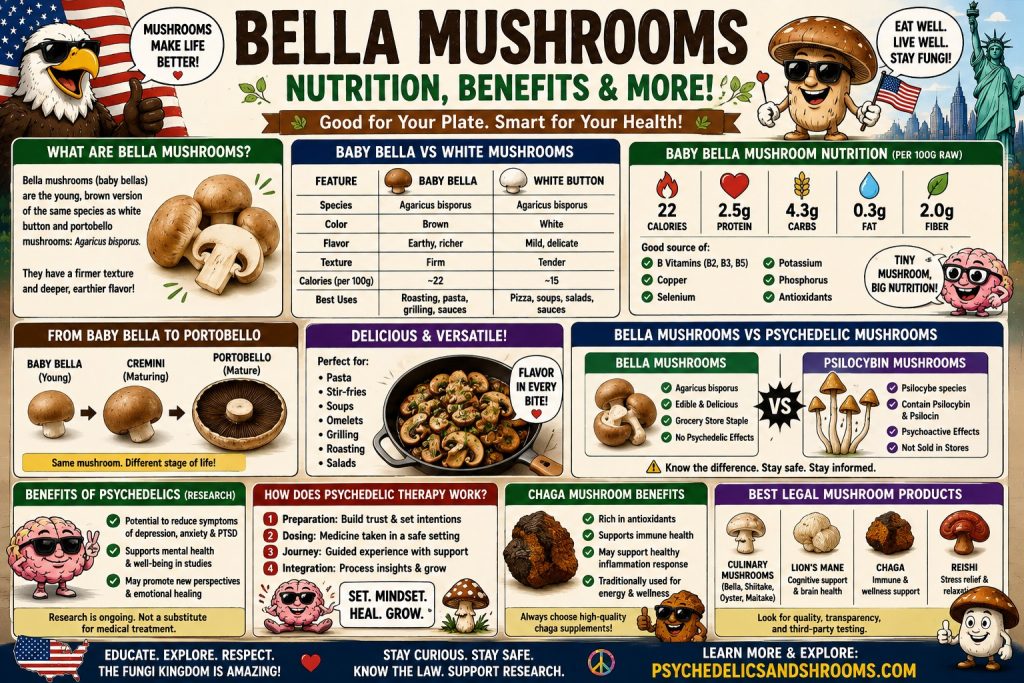
Bella mushrooms, commonly called baby bella mushrooms, are a familiar edible mushroom found in grocery stores throughout the United States. Despite their different appearance and marketing name, baby bellas belong to the same species as ordinary white button mushrooms and full-sized portobello mushrooms: Agaricus bisporus.
The primary differences involve color, maturity, texture, and flavor—not completely different mushroom species.
Baby bellas are typically brown, firm, and slightly more intensely flavored than white buttons. They’re widely used in pasta, pizza, soups, sauces, omelets, stir-fries, and roasted vegetable dishes.
They’re also nutritionally interesting. Mushrooms are generally low in calories while providing nutrients such as B vitamins, minerals, and other biologically active compounds.
Because mushroom searches increasingly overlap with queries concerning psychedelic mushrooms, functional fungi, and plant medicine therapy, this guide also explains the important distinction between an ordinary supermarket baby bella and psychoactive Psilocybe species.
For broader educational material about fungi and psychedelic research, readers can explore psychedelicsandshrooms.com.
What Is a Baby Bella Mushroom?
A baby bella mushroom is the brown, immature form of Agaricus bisporus.
You may also encounter names such as:
- cremini mushroom;
- crimini mushroom;
- baby portabella mushroom;
- baby portobello mushroom; and
- brown button mushroom.
These names commonly describe closely related commercial forms of the same species.
Allowing a brown Agaricus bisporus mushroom to mature produces the large mushroom commonly marketed as a portobello.
This means that baby portabella mushrooms aren’t miniature versions of an unrelated giant mushroom. They represent an earlier developmental stage.
Baby Bella vs. White Mushrooms
One of the most common questions is baby bella vs white mushrooms.
Surprisingly, both are Agaricus bisporus.
| Characteristic | Baby Bella | White Button |
|---|---|---|
| Species | Agaricus bisporus | Agaricus bisporus |
| Typical cap | Brown | White |
| Texture | Relatively firm | Tender |
| Flavor | Deeper, earthier | Mild |
| Calories | Low | Low |
| Common uses | Roasting, sauces, pasta | Pizza, salads, soups, sauces |
| Psychedelic? | No | No |
Because they’re the same species, the nutritional differences are generally much smaller than consumers might assume.
The choice between bella vs white mushrooms is usually more about flavor, texture, appearance, and recipe preference than a dramatic difference in health value.
Baby Bella Mushroom Nutrition
Baby bella mushroom nutrition is one reason these fungi fit easily into many eating patterns.
According to USDA-derived food-composition data, raw brown mushrooms provide roughly 22 calories per 100 grams, with approximately 2.5 grams of protein, 4.3 grams of carbohydrate, and very little fat. Exact values can vary with the specific product and growing conditions.
Baby bellas can also contribute micronutrients including:
Riboflavin (vitamin B2) — involved in cellular energy metabolism.
Niacin (vitamin B3) — contributes to normal metabolic processes.
Pantothenic acid (vitamin B5) — involved in energy metabolism and synthesis of several biologically important compounds.
Copper — contributes to normal connective-tissue, nervous-system, and iron-metabolism functions.
Selenium — an essential trace mineral involved in antioxidant systems and thyroid biology.
Potassium — an electrolyte important for numerous physiological processes.
Their precise nutrient profile varies according to growing conditions, preparation, serving size, and exposure to ultraviolet light.
Calories in Baby Bella Mushrooms
People searching calories in baby bella mushrooms will find that they’re a relatively low-energy food.
A 100-gram raw serving is roughly in the low-20-calorie range.
The important caveat is preparation.
The mushroom itself may be low in calories, but a recipe containing substantial butter, cream, cheese, or oil can have a very different nutritional profile.
This is why comparing the nutrition of raw mushrooms with a restaurant’s cream-filled mushroom dish can be misleading.
Nutritional Value of Bella Mushrooms
The nutritional value of bella mushrooms goes beyond calorie count.
Mushrooms are unusual foods biologically because they are fungi rather than plants. Their nutritional composition also differs from that of most vegetables.
Mushrooms can provide dietary fiber and several micronutrients while remaining relatively low in fat and sodium when prepared without large amounts of added ingredients.
Research has also examined fungal compounds such as beta-glucans, ergothioneine, and various phenolic substances.
That research shouldn’t be converted into claims that eating baby bellas prevents or cures diseases. Nutritional benefit and medical treatment are different concepts.
Are Baby Mushrooms Healthy?
“Baby mushrooms” isn’t a formal species name. In a supermarket context, the phrase may simply describe relatively small mushrooms, including baby bellas.
Baby bella mushrooms can certainly be incorporated into a nutritious diet.
They can add flavor and texture without contributing large amounts of calories, particularly when grilled, roasted, sautéed with modest amounts of oil, or incorporated into soups and vegetable dishes.
No individual food, however, determines whether an entire diet is healthy.
Dietary patterns matter more than treating one mushroom as a “superfood.”
Baby Portobello Mushroom vs. Portobello
A baby portobello mushroom and a full-sized portobello are essentially different developmental stages of brown Agaricus bisporus.
Baby bellas are harvested earlier.
Portobellos are allowed to mature until their caps become substantially larger and more open.
This maturation changes texture and culinary behavior. Large portobello caps are frequently grilled or roasted because their size and texture make them suitable as a substantial component of a meal.
Baby bellas are easier to slice and incorporate into sauces, pasta, soups, and stir-fries.
How Bella Mushrooms Are Commonly Used in Cooking
Baby bellas are popular because they tolerate several cooking methods.
They can be:
- roasted;
- grilled;
- sautéed;
- added to soups;
- incorporated into pasta;
- used in sauces;
- added to omelets; or
- combined with vegetables and grains.
Cooking reduces their water content and can intensify their savory flavor.
Mushrooms absorb moisture readily, so preparation methods can substantially influence their final texture.
Do Bella Mushrooms Contain Psilocybin?
No. Ordinary commercial baby bella mushrooms are not psychedelic mushrooms.
Psilocybe species associated with psilocybin belong to a different group.
This distinction is important because searches for mushroom nutrition increasingly overlap with searches concerning psychedelic therapy, functional mushrooms, and psychoactive fungi.
A supermarket baby bella mushroom should not cause a psychedelic experience.
Its role is culinary and nutritional.
Bella Mushrooms vs. Psychedelic Mushrooms
Bella mushrooms and psilocybin-containing mushrooms differ biologically and pharmacologically.
Baby bellas belong to Agaricus bisporus.
Psilocybin occurs naturally in certain fungi, including numerous species within Psilocybe. Psilocybin is converted to psilocin after administration, and its psychedelic effects are associated strongly with serotonin 5-HT2A receptor signaling.
This produces profound changes in perception and consciousness that ordinary edible bella mushrooms do not cause.
Readers interested in this distinction can explore additional mushroom and psychedelic education at psychedelicsandshrooms.com.
Benefits of Psychedelics: What Does Research Actually Show?
The supporting keyword benefits of psychedelics belongs to a very different scientific discussion from baby bella nutrition.
Clinical researchers have investigated psychedelic compounds such as psilocybin for psychiatric applications.
For example, randomized clinical research has investigated psilocybin-assisted approaches for major depressive disorder, while systematic reviews have evaluated the broader evidence base. Some studies have reported meaningful reductions in depressive symptoms, but researchers continue investigating durability, adverse effects, patient selection, blinding, and the contribution of psychological support.
This should not be interpreted as evidence that all psychedelics are proven treatments or that unsupervised psychedelic consumption provides the same benefits as a clinical trial.
How Does Psychedelic Therapy Work?
How does psychedelic therapy work? depends on what treatment and research protocol is being discussed.
In research settings, psychedelic-assisted therapy may involve several distinct stages:
Screening: Potential participants are evaluated for medical and psychological suitability.
Preparation: Participants learn what to expect and establish a therapeutic framework.
Supervised administration: A controlled psychedelic may be administered within an organized clinical environment.
Monitoring: Trained personnel observe the participant during the acute experience.
Integration or follow-up: Later sessions may explore experiences, behavioral changes, and psychological outcomes.
The psychedelic drug itself is therefore only one component of many research models.
Taking an unidentified psychedelic independently should not be described as equivalent to psychedelic-assisted psychotherapy.
What Is Plant Medicine Therapy?
Plant medicine therapy is not one standardized medical specialty.
The phrase can refer broadly to therapeutic or traditional practices involving plants or naturally occurring substances. In some communities it is also used when discussing psychedelics.
The terminology deserves caution because “plant medicine” can make a psychoactive substance sound automatically safe.
Natural substances can be pharmacologically powerful.
Some are medicinal. While some are toxic. Some interact with medications. Others remain inadequately studied.
Furthermore, some substances commonly grouped under the psychedelic “plant medicine” label aren’t plants at all. Mushrooms, for example, are fungi.
Chaga Is Different Again
Searches for best chaga mushroom supplement and best chaga supplement introduce a third mushroom category.
Chaga (Inonotus obliquus) is a fungus associated particularly with birch trees in northern climates. It has a long history of traditional use and has become common in teas, powders, extracts, and supplements.
Chaga isn’t a baby bella and isn’t a psilocybin mushroom.
Laboratory studies have investigated chaga compounds, but many sweeping health claims made in supplement marketing go beyond high-quality clinical evidence.
Consumers should therefore distinguish between:
- traditional use;
- laboratory findings;
- animal studies; and
- demonstrated human clinical benefits.
These aren’t interchangeable levels of evidence.
How to Evaluate a Chaga Supplement
Rather than declaring one product the universal best chaga mushroom supplement, consumers can evaluate quality indicators.
Look for transparent identification of the fungal material, clear ingredient labeling, contaminant testing, manufacturing information, and independent quality verification where available.
Be cautious about products promising to cure cancer, eliminate disease, or replace medical treatment.
Supplements can also interact with medications or be inappropriate for some health conditions. “Mushroom supplement” does not automatically mean harmless.
What Are the Best Legal Mushroom Products?
The phrase best legal mushroom products can refer to many completely different categories.
Ordinary lawful mushroom products in the United States can include culinary mushrooms such as:
- baby bella;
- white button;
- portobello;
- shiitake;
- oyster;
- maitake; and
- lion’s mane.
The supplement marketplace additionally contains products based on fungi such as lion’s mane, reishi, cordyceps, and chaga.
Legality alone does not establish effectiveness, safety, or product quality.
Consumers should also be cautious when a product is marketed with phrases suggesting psychedelic effects while avoiding clear identification of its active ingredients.
A colorful package is not a laboratory analysis.
Mushroom Products Need Clear Categories
The modern mushroom market can become confusing because very different products share similar branding.
| Category | Example | Primary context |
|---|---|---|
| Culinary mushroom | Baby bella | Food |
| Culinary mushroom | Shiitake | Food |
| Functional/supplement fungus | Chaga | Supplement/wellness |
| Functional mushroom | Lion’s mane | Food/supplement |
| Psychedelic mushroom | Certain Psilocybe species | Psychoactive/research |
| Pharmaceutical research | Purified psilocybin | Controlled clinical research |
Understanding the category should come before evaluating supposed benefits.
Why “Natural” Doesn’t Mean the Same Thing as “Safe”
Bella mushrooms illustrate an interesting point about natural products.
They’re natural fungi and widely consumed as food. Psilocybin mushrooms are also naturally occurring fungi but contain powerful psychoactive compounds. Other mushrooms can contain dangerous toxins.
Chaga is natural but can contain pharmacologically relevant compounds and isn’t automatically appropriate for every person.
“Natural” therefore tells us about origin—not safety, effectiveness, dose, or medical suitability.
Frequently Asked Questions
What are baby bella mushrooms?
Baby bellas are brown immature forms of Agaricus bisporus. They’re also commonly called cremini or baby portobello mushrooms.
Are baby bella and white mushrooms the same?
They belong to the same species, Agaricus bisporus. Their primary differences involve coloration, maturity, texture, and flavor.
How many calories are in baby bella mushrooms?
Raw brown mushrooms contain roughly 22 calories per 100 grams according to USDA-derived nutritional data, although exact values vary.
Are baby bella mushrooms psychedelic?
No. Baby bella mushrooms are ordinary edible Agaricus bisporus. They do not belong to the psilocybin-containing Psilocybe mushroom group.
What are the benefits of psychedelics?
Clinical research suggests potential therapeutic applications for certain psychedelics under controlled conditions, particularly in psychiatric research. This does not establish unsupervised psychedelic use as safe or medically equivalent to clinical treatment.
What is the best legal mushroom product?
There is no universal best product. Culinary mushrooms such as baby bellas, shiitake, oyster, and maitake are ordinary food options, while mushroom supplements require separate evaluation for evidence, quality, ingredients, and safety.
Where to Explore Further
For broader educational material covering mushroom biology, psychedelic science, and emerging research, explore psychedelicsandshrooms.com. The site can also serve as an informational starting point for understanding how culinary, functional, and psychoactive mushrooms differ.
For peer-reviewed research, PubMed’s psilocybin research database provides access to published biomedical literature.
