mushroom and shrooms
Bluing Mushrooms: Why Mushrooms Bruise Blue, Blue Meanies & Psilocybin Science
Aug
What Are Bluing Mushrooms?
Bluing mushrooms are fungi that develop blue, blue-green, or dark bluish discoloration after their tissues are damaged, handled, cut, or otherwise injured.
The phenomenon has become strongly associated online with psilocybin-containing mushrooms. There is a genuine chemical reason for that association: research on Psilocybe cubensis has demonstrated an injury-triggered biochemical cascade involving psilocybin and psilocin that produces blue-colored compounds.
However, one fact needs to be established immediately:
A mushroom bruising blue is not, by itself, sufficient evidence that the mushroom is psychedelic, edible, safe, or even a member of Psilocybe.
Color should never be used as a stand-alone identification test for wild mushrooms.
Terms such as blue cap mushrooms, Blue Meanie mushroom, Blue Yeti mushrooms, and Bluey Vuitton mushroom strain also create confusion because scientific species names, informal cultivar names, and marketing terminology frequently become mixed together.
This guide separates the underlying chemistry from online mushroom terminology.
For more educational material about mushroom biology and psychedelic research, readers can explore psychedelicsandshrooms.com.
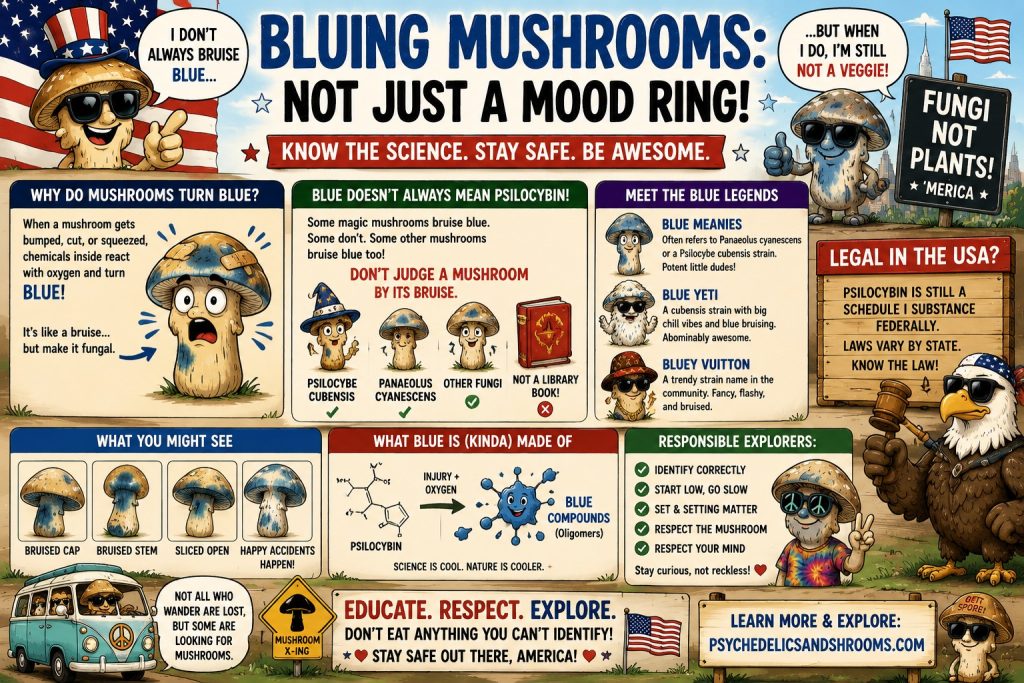
What Does It Mean If a Mushroom Bruises Blue?
When people ask what does it mean if a mushroom bruises blue, they’re usually trying to determine whether discoloration indicates psilocybin.
For certain psilocybin-producing mushrooms, tissue injury triggers biochemical reactions that eventually create blue-colored compounds.
Researchers studying Psilocybe cubensis identified enzymes involved in this process. Following injury, psilocybin is converted toward psilocin, which undergoes oxidation and subsequent coupling reactions that generate colored oligomeric products.
Later structural research helped characterize the chromophores involved in the blue coloration.
In simple terms:
Tissue damage → biochemical reactions → oxidation products → visible blue coloration.
That’s considerably more accurate than saying that the mushroom is simply “turning blue because it contains psilocybin.”
What Causes a Mushroom Bruise?
A mushroom bruise is discoloration resulting from tissue damage.
Handling, cutting, pressure, environmental injury, or aging can cause visible changes in mushroom tissue.
Different mushroom species can react differently.
Color changes may include:
- blue;
- green-blue;
- red;
- yellow;
- brown;
- black; or
- other discoloration.
These reactions can result from different chemical pathways.
Consequently, “it bruised blue” isn’t a complete mushroom identification.
Why Do Some Psilocybin Mushrooms Turn Blue?
The chemistry of bluing Psilocybe is particularly interesting.
Researchers have demonstrated that injury initiates enzymatic reactions involving psilocybin-related chemistry. Oxidized psilocin derivatives can form oligomeric structures responsible for the characteristic blue appearance.
A review of Psilocybe natural products similarly describes heterogeneous blue-colored psilocyl oligomers among the compounds associated with these fungi.
This research replaced much of the older speculation surrounding the famous blue reaction with a clearer biochemical explanation.
Does Blue Bruising Prove a Mushroom Contains Psilocybin?
No.
This is one of the most important points in the entire article.
Blue coloration can provide information as one characteristic among many, but it should not be treated as a definitive field test for psilocybin.
Mushroom identification may require consideration of:
Cap morphology — shape, texture and surface characteristics.
Gills or pores — structure, color and attachment.
Stem — shape, texture and internal characteristics.
Spore characteristics — color and microscopic morphology.
Habitat — soil, wood, grass, dung or other substrate.
Geographic distribution — where the species has actually been documented.
DNA evidence — increasingly important for difficult taxonomic questions.
Research into psychoactive fungi has demonstrated the usefulness of DNA sequencing because morphology alone can be inadequate for distinguishing specimens.
Are Blue Cap Mushrooms Psychedelic?
Not necessarily.
Blue cap mushrooms isn’t a scientific category.
A mushroom can appear blue because of pigmentation, bruising, lighting, aging, environmental conditions, photography, or chemical changes.
Likewise, white and blue mushrooms describes appearance rather than species.
Someone should never eat an unidentified mushroom simply because an online image shows a similar blue cap.
Wild-mushroom identification mistakes can cause poisoning.
What Are Blue Meanie Mushrooms?
Blue Meanie mushroom is a particularly confusing term because it can refer to different things in psychedelic mushroom culture.
Historically, “Blue Meanies” is commonly associated with Panaeolus cyanescens, a psilocybin-producing mushroom.
However, “Blue Meanie” has also been used as an informal cultivar name associated with Psilocybe cubensis.
Those are not the same species.
This is why terms such as Blue Meanies strain or Blue Meanies mushroom strain should always be accompanied by a scientific species name when accuracy matters.
What Is Panaeolus Cyanescens?
Panaeolus cyanescens is a mushroom species within the genus Panaeolus that has been documented as containing psychedelic tryptamines.
Research examining psychoactive fungi has identified P. cyanescens chemically, and a global scientific review has examined the diversity and distribution of psychedelic and non-psychedelic Panaeolus species.
The abbreviated search term pan cyan mushroom generally refers to Panaeolus cyanescens.
“Pan cyan” is convenient community shorthand, but the complete scientific name is preferable in educational material.
Panaeolus Is More Complicated Than One Mushroom
It would be incorrect to assume every Panaeolus mushroom is psychedelic.
A 2023 global review emphasized that the genus includes psychedelic and apparently non-psychedelic species and noted continuing gaps in DNA sequence data and knowledge of species distributions.
More recent phylogenomic research has continued revising the taxonomy of Panaeolus and related groups.
This is another reason casual visual identification is unreliable.
Blue Meanie Mushroom Effects
The phrase Blue Meanie mushroom effects should be interpreted according to the actual species and chemistry rather than the nickname.
Psilocybin is converted in the body to psilocin, the principal compound responsible for classic psychedelic effects through activity involving serotonin receptors, particularly 5-HT2A signaling. Modern pharmacokinetic research continues examining psilocybin and psilocin metabolism.
Possible psychedelic effects can include alterations in:
- visual perception;
- time perception;
- emotional experience;
- thought patterns;
- sense of self;
- spatial perception; and
- sensory processing.
Experiences can also become frightening or psychologically distressing.
This article does not provide dosing, cultivation, procurement, or consumption instructions.
Does More Blue Mean More Psilocybin?
No reliable conclusion like that should be drawn visually.
A darker blue mushroom isn’t automatically more potent.
Bruising can depend on tissue injury, chemical reactions, mushroom condition, oxidation, handling, and other biological variables.
Furthermore, psychedelic alkaloid concentrations can vary between mushroom samples.
A 2024 analytical study used LC-MS/MS to measure psilocybin and psilocin across several P. cubensis cultivars, including a cultivar labeled “Blue Meanie,” illustrating why chemical measurement rather than visual color is needed to quantify compounds.
Blueness is not a potency meter.
What Are Blue Psilocybin Mushrooms?
The phrase blue psilocybin mushrooms usually describes psilocybin-containing mushrooms exhibiting blue bruising.
It does not describe one taxonomic species.
Several psychoactive fungi can display bruising reactions.
Similarly, blue Psilocybe mushrooms describes a characteristic observed in members of a broader genus rather than a single mushroom.
Scientific identification should therefore rely on actual species characteristics rather than color-based nicknames.
Blue Psilocybin Isn’t the Blue Pigment
Another useful distinction concerns the phrase blue psilocybin.
Psilocybin itself shouldn’t simply be imagined as a blue pigment sitting inside the mushroom.
The famous blue color develops through injury-triggered chemistry involving conversion and oxidation processes related to psilocin, ultimately producing colored oligomeric compounds.
The visible color is therefore evidence of a biochemical reaction rather than simply the natural color of psilocybin.
What Are Blue Magic Mushrooms?
Blue magic mushrooms is an informal expression rather than a recognized scientific category.
It may be used for mushrooms exhibiting blue bruising or products carrying blue-themed cultivar names.
Similarly, blue cap magic mushrooms doesn’t identify a particular species.
When evaluating mushroom information, readers should prioritize:
scientific species name → documented chemistry → verified identification
rather than:
color → nickname → assumption.
This simple hierarchy eliminates a surprising amount of online misinformation.
Blue Ghost Mushroom and Ghost Magic Mushroom
Names such as Blue Ghost mushroom and Ghost magic mushroom generally appear within cultivar and community terminology rather than formal species taxonomy.
The same problem occurs throughout online mushroom discussions.
A memorable cultivar name can gradually be treated as though it represents a separate biological species.
It may not.
When encountering names such as Ghost, Blue Ghost, Yeti, or Blue Yeti, readers should ask what scientific species the name supposedly represents and whether that identification has been independently verified.
Blue Yeti Mushrooms
Blue Yeti mushrooms is another informal name encountered in psychedelic mushroom communities.
“Yeti” and similar names are commonly presented as P. cubensis cultivar terminology rather than separate scientifically established mushroom species.
That distinction matters because cultivar names can multiply rapidly through online communities.
They should not be used as substitutes for fungal taxonomy.
Bluey Vuitton Mushroom Strain
Bluey Vuitton mushroom strain is another contemporary cultivar-style name used in psychedelic mushroom discussions.
Searches for a Bluey Vuitton mushroom review frequently lead to subjective descriptions and potency claims.
Such testimonials aren’t controlled scientific evidence.
An online reviewer generally cannot establish exact alkaloid concentration from appearance or subjective experience.
Laboratory analysis is needed to measure compounds such as psilocybin and psilocin accurately.
For educational content, Bluey Vuitton is therefore better discussed as an informal market/community name rather than as a medically characterized psychedelic product.
Blue Meanie Spores
Searches for Blue Meanie spores and Blue Meanie mushroom spores can refer to spores advertised under the Blue Meanie name.
Again, the species ambiguity matters.
A label might refer to Panaeolus cyanescens or use “Blue Meanie” as a P. cubensis cultivar name.
A commercial label alone doesn’t establish genetic identity.
This article does not provide vendors or instructions for using spores to cultivate controlled-substance-producing mushrooms.
Readers interested in the biology of spores can explore educational mushroom resources through psychedelicsandshrooms.com.
What Is a Blue Mini Mushroom?
Blue mini mushroom doesn’t correspond to one widely recognized scientific species.
It can be a descriptive search for a small blue mushroom, a product name, or a mistaken version of “Blue Meanie.”
Size and color aren’t sufficient for identifying fungi.
Small mushrooms can be particularly difficult to identify because numerous unrelated species share superficially similar cap-and-stem structures.
Blue Meanies in Brisbane
The search Blue Meanies Brisbane reflects geographic interest in mushrooms associated with southeastern Queensland, Australia.
Climate and habitat influence fungal distribution, but geographic location alone does not establish species identity.
A mushroom found near Brisbane shouldn’t automatically be classified as Panaeolus cyanescens merely because the species has been reported in warm regions.
Distribution is only one component of identification.
For U.S.-focused readers, it is also worth remembering that mushroom laws differ internationally and shouldn’t be inferred from Australian discussions.
Blue Bruising vs. Mushroom Identification
A useful way to understand the issue is to compare evidence:
| Observation | What it tells you |
|---|---|
| Mushroom bruises blue | A chemical color reaction occurred |
| Cap is blue | Describes appearance only |
| Mushroom resembles Psilocybe | Suggests possibilities, not confirmation |
| Spore characteristics match | Adds useful evidence |
| Habitat matches | Adds ecological evidence |
| Microscopic characteristics match | Stronger identification evidence |
| DNA sequencing matches | Can provide powerful taxonomic evidence |
| Chemical analysis detects psilocybin | Establishes compound presence |
No single casual observation should replace complete identification.
Never Use Blue Bruising as an Edibility Test
This deserves special emphasis.
Blue bruising does not mean edible.
It also doesn’t guarantee that a mushroom is a psilocybin species.
Wild mushrooms can contain toxins capable of causing severe gastrointestinal illness, neurological problems, organ damage, or death.
Online photographs and AI identification tools can help generate possible names, but they should not be treated as guarantees that an unknown wild mushroom is safe to consume.
Psilocybin Research Is Different From Mushroom Nicknames
Clinical psychedelic research generally involves chemically characterized substances, controlled protocols, participant screening, monitoring, and defined outcome measurements.
That is fundamentally different from evaluating an unidentified “Blue Meanie” or “Blue Ghost” based on an internet nickname.
Researchers need known compounds and controlled conditions precisely because informal mushroom names don’t provide reliable pharmacological standardization.
This distinction is important when translating psychedelic culture into responsible public education.
Frequently Asked Questions
1. What does it mean when a mushroom bruises blue?
In certain psilocybin-producing mushrooms, injury triggers enzymatic and oxidative reactions involving psilocybin-related chemistry that generate blue-colored compounds. Blue bruising alone does not identify the mushroom.
2. Does blue bruising prove a mushroom contains psilocybin?
No. Blue coloration should never be treated as a definitive test for psilocybin, species identity, safety, or edibility.
3. What are Blue Meanie mushrooms?
“Blue Meanies” commonly refers to Panaeolus cyanescens, but the same nickname has also been applied to a Psilocybe cubensis cultivar. The scientific species name is therefore important.
4. Are Panaeolus cyanescens psychedelic?
Yes. Panaeolus cyanescens has been documented as a psilocybin-containing psychoactive mushroom. However, not every species within Panaeolus should automatically be assumed psychedelic.
5. Does a darker blue mushroom mean it’s stronger?
No. Visible bruising isn’t a reliable measure of psilocybin concentration or psychedelic potency. Laboratory chemical analysis is required for quantitative measurement.
6. Are Blue Yeti and Bluey Vuitton separate mushroom species?
These names are generally encountered as informal cultivar-style terminology rather than separate established species. Scientific species identification is more meaningful than a commercial or community nickname.
Educational Resources
For additional educational reading on mushroom species, fungal biology, psychedelic terminology, and the difference between informal strain names and scientific taxonomy, explore psychedelicsandshrooms.com.
Peer-reviewed research on the chemistry behind blue bruising is available through PubMed — Injury-Triggered Blueing Reactions of Psilocybe Mushrooms and PubMed — Structure of Blue Psilocin-Derived Chromophores. These studies provide a stronger scientific foundation than using mushroom color as an identification shortcut.
