mushroom and shrooms
Chaga Mushroom: Benefits, Tea, Supplements, Skin Claims & Side Effects
Aug
What Is Chaga Mushroom?
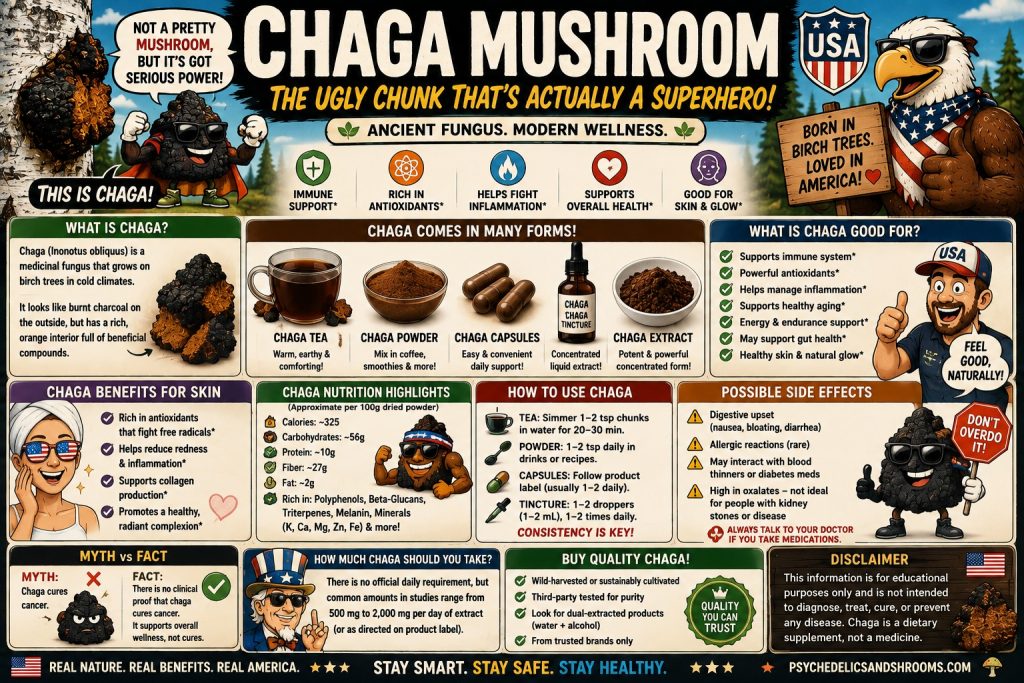
Chaga mushroom (Inonotus obliquus) is a fungus that commonly grows on birch trees in cold northern environments. It has a long history of traditional use in parts of Russia, northern Europe, and Asia and has become increasingly popular in the United States as a functional-mushroom ingredient.
Despite being called a mushroom, chaga doesn’t usually resemble the familiar cap-and-stem mushrooms sold in supermarkets.
The visible chaga structure growing from a tree typically appears as a hard, irregular black mass. Its dark exterior can resemble burnt charcoal, while the interior is usually brown to rusty orange.
Modern products include:
- chaga mushroom tea;
- chaga powder;
- chaga mushroom capsules;
- chaga tinctures;
- concentrated extracts;
- extract powders; and
- multi-mushroom dietary supplements.
Chaga contains numerous chemically interesting compounds, but its reputation online has moved considerably faster than human clinical evidence.
Claims that chaga can cure cancer, eliminate disease, reverse aging, or replace medical treatment aren’t supported by adequate clinical evidence.
For additional education about functional and medicinally researched mushrooms, explore psychedelicsandshrooms.com.
Chaga Mushroom at a Glance
| Characteristic | Chaga |
|---|---|
| Scientific name | Inonotus obliquus |
| Organism | Fungus |
| Common host | Birch trees |
| Appearance | Blackened exterior, brown/orange interior |
| Traditional preparation | Infusions/decoctions |
| Modern forms | Tea, powder, capsules, tinctures, extracts |
| Psychedelic? | No |
| Major research interest | Polysaccharides, polyphenols, triterpenoids and antioxidant chemistry |
| Evidence limitation | Much research remains laboratory or animal-based |
Where Does Chaga Grow?
Chaga is associated with colder northern forests.
It has been documented across regions of:
- northern Europe;
- Russia and Siberia;
- parts of Asia;
- Canada; and
- northern areas of the United States.
Birch is particularly important to chaga ecology.
The fungus infects living trees and can produce the distinctive dark structure commonly harvested as chaga.
Because wild harvesting has expanded alongside supplement demand, sustainable harvesting is also an ecological consideration.
Is Chaga a Normal Mushroom?
Not exactly in appearance.
What consumers typically recognize as chaga is a sterile conk or sclerotial-like fungal mass, rather than the familiar umbrella-shaped reproductive structure associated with mushrooms such as shiitake.
This is why a photograph of chaga can look more like charred wood than a conventional mushroom.
The organism is nevertheless fungal.
Chaga Mushroom Benefits: What Does Science Actually Show?
The phrase chaga mushroom benefits is associated with an extraordinary number of internet health claims.
Scientific research has examined chaga constituents for possible:
- antioxidant activity;
- anti-inflammatory activity;
- immune-related effects;
- metabolic effects;
- antimicrobial properties; and
- anticancer mechanisms.
The important word is possible.
Much of the research supporting these ideas comes from laboratory experiments and animal models rather than large, high-quality clinical trials in humans.
Research reviews have described potentially bioactive chaga compounds while simultaneously highlighting the need for substantially more human evidence. PubMed chaga research
Therefore:
Interesting biological activity does not automatically equal a proven human health benefit.
Chaga and Antioxidants
Chaga is frequently marketed as an antioxidant-rich mushroom.
Antioxidants are compounds capable of participating in reactions involving free radicals and oxidative chemistry.
Chaga extracts contain compounds that demonstrate antioxidant activity in experimental systems.
But phrases such as “antioxidant powerhouse” can become misleading when they imply that consuming chaga has been clinically demonstrated to prevent disease.
Laboratory antioxidant capacity and actual clinical outcomes are two different measurements.
A supplement can perform impressively in a chemical assay without being proven to prevent heart disease, cancer, or aging in humans.
Chaga and Inflammation
Another common claim is that chaga “fights inflammation.”
Laboratory and animal studies have investigated chaga extracts and compounds in inflammatory signaling pathways.
That makes inflammation a legitimate research area.
It does not establish chaga supplements as treatments for inflammatory diseases such as rheumatoid arthritis, inflammatory bowel disease, or other medical conditions.
People with diagnosed inflammatory diseases shouldn’t substitute mushroom supplements for prescribed treatment without discussing the decision with their healthcare professional.
Chaga Benefits for Skin
Searches for chaga benefits for skin and chaga mushroom benefits for skin have grown alongside the functional beauty and skincare markets.
Potential interest comes primarily from chaga’s:
- polyphenols;
- melanin-related compounds;
- antioxidant activity; and
- experimentally studied anti-inflammatory properties.
This has led to chaga appearing in some topical skincare products and oral beauty supplements.
However, claims need perspective.
There isn’t strong clinical evidence establishing oral chaga supplements as treatments for:
- acne;
- eczema;
- psoriasis;
- wrinkles;
- hyperpigmentation; or
- premature skin aging.
Antioxidant activity in a laboratory doesn’t mean chaga capsules will visibly reverse skin aging.
For skin health, established measures such as UV protection, avoiding tobacco, adequate nutrition, appropriate skincare, and medical treatment for dermatological disorders have much stronger practical foundations.
What Is Chaga Good For?
A cautious answer to what is chaga good for is:
Chaga is traditionally consumed as a beverage and is currently studied as a source of biologically active fungal compounds.
That is scientifically defensible.
Statements such as “chaga cures cancer” are not.
Chaga is best viewed as a functional food or dietary supplement with interesting emerging research rather than as an established medication.
What Does Chaga Do?
Chaga contains multiple classes of compounds rather than one single “active ingredient.”
Researchers have investigated:
Polysaccharides — complex carbohydrates associated with numerous fungal structures.
Beta-glucans — polysaccharides commonly investigated in mushroom research.
Polyphenolic compounds — molecules associated with antioxidant chemistry.
Triterpenoids — compounds including derivatives associated with the fungus and its birch host.
Sterols — lipid-related compounds found throughout fungal biology.
Different extraction methods can produce different chemical profiles.
Consequently, asking “what does chaga do?” without specifying the preparation is similar to asking what an entire plant does rather than investigating one standardized compound.
Chaga Tea
Chaga tea is one of the oldest and most recognizable preparations.
The resulting beverage is usually dark brown and earthy rather than mushroom-like in the conventional culinary sense.
Traditional chaga beverages and modern packaged chaga teas shouldn’t automatically be considered chemically identical.
Preparation method, fungal source, concentration and blending ingredients can all influence the finished beverage.
Chaga Tea Benefits
The supposed chaga tea benefits largely overlap with broader chaga claims:
- antioxidant intake;
- general wellness;
- traditional use;
- immune-related support;
- inflammatory pathway research; and
- caffeine-free beverage use when no caffeinated ingredients are added.
The last point is particularly straightforward.
Pure chaga itself isn’t coffee and doesn’t naturally function like caffeine.
However, commercial “chaga coffee” or tea blends may contain coffee, tea, cacao, or other ingredients that do contain stimulants.
Always read the label.
What Is Chaga Tea Good For?
For most consumers, chaga tea can reasonably be described as a functional beverage with a history of traditional use.
It shouldn’t be marketed as a guaranteed treatment for medical conditions.
Someone may enjoy it as an alternative warm beverage, but subjective feelings after drinking tea shouldn’t be converted into claims that the beverage prevents disease.
Chaga Tea Side Effects
“Tea” sounds gentle, but chaga tea side effects are still possible.
Potential concerns include:
- gastrointestinal intolerance;
- allergic reactions;
- medication interactions;
- effects related to blood glucose;
- potential interaction with anticoagulant or antiplatelet medications; and
- excessive oxalate exposure with heavy or prolonged intake.
The last concern deserves particular attention.
Chaga and Oxalates
Chaga can contain substantial amounts of oxalates.
Oxalate is a naturally occurring compound found in many foods and biological materials. Excessive exposure can become problematic for susceptible individuals because calcium oxalate is involved in many kidney stones and oxalate accumulation can damage kidneys.
Published case reports have described serious kidney injury associated with very high or prolonged chaga consumption.
Case reports cannot tell us how frequently such events occur, but they demonstrate that “natural” does not mean incapable of causing harm.
Someone with kidney disease, a history of certain kidney stones, or other relevant medical concerns should be particularly cautious.
Chaga Mushroom Capsules
Chaga mushroom capsules provide powdered chaga or extracts in a convenient format.
The advantages are primarily practical:
- portability;
- no tea preparation;
- standardized serving size; and
- easier integration into a supplement routine.
Capsules aren’t inherently more effective than tea.
The quality depends on what’s actually inside them.
A useful label should identify the species, amount, fungal material used, extract information when applicable, and other ingredients.
Chaga Capsules vs. Chaga Pills
Chaga capsules and chaga pills are commonly used as interchangeable search terms.
Technically, capsules and compressed tablets can be manufactured differently, but both provide measured oral supplement servings.
Neither format guarantees absorption, potency, or effectiveness.
Consumers should focus more on product identity and testing than on whether the container says “capsule” or “pill.”
Chaga Mushroom Powder
Chaga mushroom powder is finely ground fungal material.
Powder can be incorporated into beverages or other food preparations, depending on the product.
However, powder isn’t necessarily equivalent to an extract.
This distinction matters because fungal cell walls contain structural materials that influence how compounds become available during processing and digestion.
Chaga Powder vs. Chaga Extract
| Feature | Chaga powder | Chaga extract |
|---|---|---|
| Basic form | Ground fungal material | Processed concentrated preparation |
| Processing | Generally less extensive | Extraction involved |
| Compound concentration | Depends on raw material | May concentrate selected compounds |
| Standardization | Often limited | May be standardized |
| Automatically better? | No | No |
A concentrated extract isn’t automatically safer or more effective.
Concentration can also increase exposure to unwanted compounds if manufacturing quality is poor.
Chaga Mushroom Extract
A chaga mushroom extract is produced by extracting soluble compounds from fungal material.
Manufacturers may use water, alcohol, or multi-stage extraction depending on the compounds they want to obtain.
Water extraction tends to emphasize certain water-soluble constituents.
Alcohol can extract different classes of compounds.
“Dual extraction” generally indicates the use of more than one solvent approach.
These terms describe processing—not proof of clinical efficacy.
Chaga Mushroom Extract Powder
A chaga mushroom extract powder is usually a liquid extract that has subsequently been dried into powder.
This can provide the convenience of powder while retaining characteristics of an extracted preparation.
Consumers should look for:
- clearly stated extraction ratios;
- fungal species identification;
- beta-glucan information where meaningful;
- contaminant testing;
- heavy-metal testing; and
- transparent ingredient labeling.
Chaga Mushroom Tincture
A chaga mushroom tincture is a liquid preparation, often produced using alcohol, water, or both during extraction.
The term “tincture” doesn’t indicate a standardized strength across brands.
One bottle can therefore differ significantly from another.
Consumers shouldn’t assume that a dropper automatically provides a more concentrated or bioavailable product than powder.
Chaga Dietary Supplements
In the United States, most chaga dietary supplements fall under dietary supplement regulations rather than being FDA-approved drugs.
FDA does not generally approve dietary supplements for safety and effectiveness before they reach the market in the same manner as new pharmaceutical drugs.
Consumers can review current regulatory information through FDA Dietary Supplements.
This distinction is particularly important when chaga advertisements use disease-related language.
A dietary supplement shouldn’t be confused with a clinically validated cancer, diabetes, kidney, cardiovascular, or immune-disease treatment.
Chaga Mushroom Dosage
There is no universally established chaga mushroom dosage that has been clinically proven optimal for all adults.
Products vary dramatically:
- raw powder;
- tea;
- concentrated powder;
- capsules;
- liquid extracts; and
- blended supplements.
A quantity appropriate to one preparation cannot automatically be applied to another.
Rather than presenting an arbitrary universal dosage, consumers should follow the specific product label and consult an appropriate healthcare professional when medical conditions or medications create additional considerations.
More isn’t automatically better—particularly given chaga’s potential oxalate content.
Chaga Mushroom Vitamins
Searches for chaga mushroom vitamins and chaga vitamins can be misleading.
Chaga isn’t a multivitamin.
Like other fungi, it contains a mixture of nutrients and biologically active compounds, but its exact nutritional composition depends on source and preparation.
A supplement containing chaga alongside added vitamin C, vitamin D, zinc, or B vitamins should not lead consumers to assume those vitamins naturally came from chaga.
Check the Supplement Facts panel.
Is Chaga Healthy?
The answer depends on what “healthy” means.
Chaga contains scientifically interesting compounds and has a long history of traditional consumption.
But calling it a “superfood that prevents disease” would go beyond current evidence.
A person’s overall diet, physical activity, sleep, smoking status, alcohol use, healthcare access, and other lifestyle factors have much stronger established relationships with long-term health than any single mushroom supplement.
Chaga can be one optional dietary component—not the foundation of health.
Chaga Side Effects
Potential chaga side effects deserve as much attention as potential benefits.
Possible concerns include:
Kidney problems: Particularly relevant to excessive exposure and oxalates.
Medication interactions: Especially medications affecting blood clotting or blood glucose.
Allergic reactions: Any fungal product can potentially trigger sensitivity.
Digestive effects: Some individuals may experience gastrointestinal discomfort.
Unknown long-term effects: Large, long-duration human safety studies remain limited.
Someone experiencing serious symptoms after taking a chaga supplement should stop using it and seek appropriate medical advice.
Who Should Be Especially Careful With Chaga?
Professional guidance is particularly sensible for people who:
- have kidney disease;
- have a history of oxalate kidney stones;
- use anticoagulants or antiplatelet drugs;
- take diabetes medications;
- have significant medical conditions;
- are pregnant or breastfeeding;
- are preparing for surgery; or
- take multiple dietary supplements simultaneously.
Children shouldn’t be given concentrated mushroom supplements casually without appropriate professional guidance.
Chaga and Blood-Thinning Medications
Chaga is sometimes described as potentially affecting platelet function.
Evidence isn’t sufficient to quantify the interaction reliably, but the possibility becomes relevant for people taking anticoagulant or antiplatelet medication.
Combining multiple products affecting clotting can increase risk.
This is precisely the kind of situation in which a pharmacist or clinician can provide more individualized advice than a supplement review.
Chaga and Diabetes Medication
Laboratory and animal studies have generated interest in chaga and glucose metabolism.
However, this creates a potential safety issue rather than merely a potential benefit.
If a supplement meaningfully affects blood glucose, combining it with glucose-lowering medication could theoretically alter glycemic control.
Chaga Is Not Psychedelic
Chaga is sometimes discussed on mushroom websites alongside psilocybin, lion’s mane, reishi, cordyceps, and other fungi.
That does not mean they’re pharmacologically equivalent.
| Feature | Chaga | Psilocybin mushrooms |
|---|---|---|
| Psychedelic | No | Yes |
| Psilocybin | Not characteristic | Present |
| Traditional beverage use | Yes | Not comparable |
| Dietary supplement market | Common | Psilocybin is federally controlled |
| Main research interest | Polysaccharides, antioxidant chemistry, metabolites | Psychedelic pharmacology |
Chaga doesn’t produce a psychedelic trip.
For additional explanations of functional versus psychedelic mushrooms, visit psychedelicsandshrooms.com.
Chaga vs. White Mushrooms
One of the supporting searches—carbs in white mushrooms—refers to a completely different culinary fungus.
White button mushrooms are Agaricus bisporus, the same species that produces cremini and portobello mushrooms at different stages.
Raw white mushrooms contain relatively few carbohydrates and calories. According to standard U.S. nutrition databases, approximately 100 grams of raw white mushrooms provides roughly 3 grams of carbohydrate, although values can vary slightly by dataset and product.
Chaga powder shouldn’t be nutritionally substituted gram-for-gram for ordinary white mushrooms.
They are consumed in fundamentally different ways.
Choosing a Chaga Supplement
A high-quality chaga supplement shouldn’t need exaggerated disease claims.
Look for transparency instead.
Species identification
The label should identify Inonotus obliquus.
Source
Responsible manufacturers should disclose where and how the material is obtained.
Fungal material
Look for information about what portion or preparation is used.
Extraction information
Extract products should explain the preparation rather than hiding everything behind “proprietary technology.”
Testing
Third-party analysis for contaminants can add confidence.
Heavy metals
Fungi can accumulate environmental substances, making source quality and contaminant testing relevant.
Oxalate awareness
Consumers shouldn’t assume unlimited chaga consumption is harmless.
No miracle claims
Statements promising cures for cancer or other serious diseases are major warning signs.
Frequently Asked Questions
1. What is chaga mushroom good for?
Chaga has a history of traditional use and contains compounds being researched for antioxidant, inflammatory, immune-related, and metabolic effects. Most major disease-treatment claims remain unproven in humans.
2. What are the benefits of chaga tea?
Chaga tea provides a caffeine-free functional beverage when used without caffeinated additions and contains fungal compounds of scientific interest. Claims that it prevents or cures diseases aren’t established.
3. Is chaga good for your skin?
Chaga contains compounds with antioxidant and experimentally observed biological activity, which has generated skincare interest. Strong clinical evidence that oral chaga supplements treat acne, wrinkles, eczema, or other skin disorders is lacking.
4. What are chaga mushroom side effects?
Potential concerns include digestive problems, allergies, medication interactions and high oxalate exposure. Case reports have associated excessive chaga consumption with serious kidney injury.
5. How much chaga should you take?
There isn’t a universally established optimal dose because tea, powder, extracts, tinctures and capsules differ substantially. Follow the particular product label and seek professional guidance when health conditions or medications are relevant.
6. Is chaga psychedelic?
No. Chaga does not contain psilocybin as a characteristic component and doesn’t produce the classic psychedelic effects associated with psilocybin mushrooms.
Educational Resources
For further educational reading about chaga, functional mushrooms, mushroom supplements and differences between medicinally researched and psychedelic fungi, explore psychedelicsandshrooms.com.
Scientific research can be explored through PubMed research on Inonotus obliquus (chaga). For U.S. supplement regulation and consumer information, consult FDA Dietary Supplements.
