mushroom and shrooms
Mushroom Coffee: Benefits, Ingredients, Safety & How It Compares With Regular Coffee
Aug
What Is Mushroom Coffee?
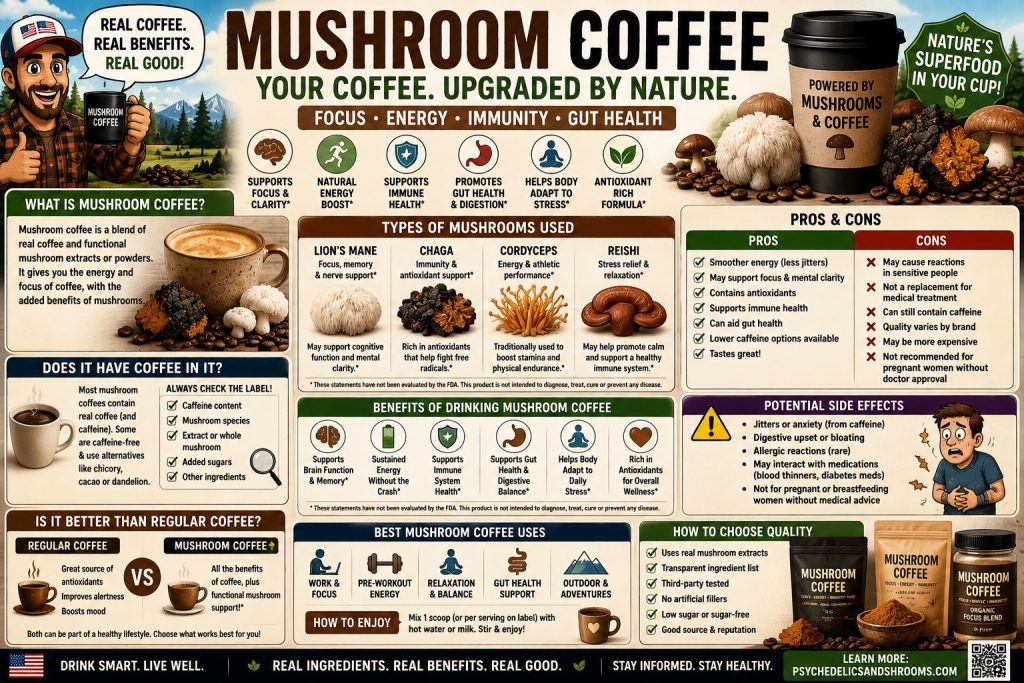
Mushroom coffee is a beverage that combines coffee—or sometimes a coffee-like base—with ingredients derived from functional mushrooms such as lion’s mane, chaga, cordyceps, or reishi.
Despite the name, mushroom coffee generally doesn’t taste like someone dropped culinary mushrooms into a cup of coffee.
Commercial products commonly use mushroom extracts or powders combined with:
- ground coffee;
- instant coffee;
- cacao;
- chicory;
- coconut-derived ingredients;
- spices;
- plant-based creamers; or
- other functional ingredients.
Some formulations contain less caffeine than conventional coffee because only part of the mixture is actually coffee. Others can contain caffeine amounts much closer to ordinary coffee.
And some mushroom beverages contain no coffee at all.
That makes label reading essential.
Functional mushrooms are also fundamentally different from psychedelic mushrooms. Products containing legal culinary mushrooms such as lion’s mane aren’t expected to produce psychedelic effects.
For broader educational material about functional mushrooms, readers can explore psychedelicsandshrooms.com.
What Types of Mushrooms Are in Mushroom Coffee?
The exact mushroom coffee blend depends on the manufacturer.
Four mushrooms appear particularly frequently.
| Mushroom | Common marketing angle | What research actually suggests |
|---|---|---|
| Lion’s mane | Focus, memory, cognition | Interesting early human research; evidence remains developing |
| Chaga | Antioxidants, immunity | Strong laboratory interest; limited clinical evidence |
| Cordyceps | Energy, exercise | Some human performance research, but results aren’t universally consistent |
| Reishi | Stress, immunity, relaxation | Biologically interesting; many commercial claims exceed clinical evidence |
Products may also contain:
- turkey tail;
- maitake;
- shiitake;
- tremella; or
- combinations of several fungi.
The presence of a mushroom’s name doesn’t establish that the finished beverage provides clinically meaningful amounts of its researched compounds.
Mushroom Coffee Benefits
Claims about mushroom coffee benefits usually come from three different sources:
- established effects of coffee;
- research on individual mushrooms; and
- marketing claims about the finished blend.
These shouldn’t be treated as interchangeable.
Coffee itself contains caffeine and numerous polyphenolic compounds and has been studied extensively in human populations.
Functional mushrooms contain polysaccharides, beta-glucans, terpenoids, phenolic compounds, and other constituents depending on the species.
Combining them creates an interesting beverage.
It doesn’t automatically mean the combination provides all proposed benefits of every ingredient.
Is Mushroom Coffee Good for You?
For many healthy adults, a reasonably formulated mushroom coffee can fit within a balanced diet.
Whether it is “good for you” depends on:
- caffeine content;
- mushroom species;
- amount of mushroom extract;
- added sugar;
- creamer ingredients;
- individual caffeine sensitivity;
- medications;
- medical conditions; and
- overall dietary pattern.
A low-sugar beverage containing coffee and a clearly identified mushroom extract is very different nutritionally from a sweetened mushroom latte containing substantial sugar and saturated fat.
The word mushroom doesn’t automatically make a beverage healthy.
What Does Mushroom Coffee Do for You?
The immediate effect many consumers notice probably comes from the coffee component, particularly caffeine.
Caffeine can temporarily increase:
- alertness;
- attention;
- wakefulness; and
- perceived energy.
Functional mushroom ingredients may contribute additional compounds, but their effects are usually subtler and less established than caffeine’s acute stimulant effects.
Someone who drinks mushroom coffee and feels alert within 20–60 minutes shouldn’t automatically attribute that sensation to lion’s mane or cordyceps.
The caffeine may explain much of it.
Does Mushroom Coffee Have Coffee in It?
Often—but not always.
Traditional mushroom coffee blends combine actual coffee with mushroom extracts or powders.
However, the category has expanded to include coffee alternatives containing mushrooms alongside:
- cacao;
- chicory;
- herbal ingredients;
- adaptogenic ingredients; or
- roasted plant materials.
Therefore, the answer to does mushroom coffee have coffee in it? depends entirely on the product.
Check the ingredients and caffeine declaration.
Mushroom Coffee vs. Regular Coffee
Is mushroom coffee better than regular coffee?
Not universally.
| Feature | Regular coffee | Mushroom coffee |
|---|---|---|
| Coffee | Yes | Usually, but not always |
| Caffeine | Typically present | Varies widely |
| Mushroom extracts | No | Usually |
| Taste | Familiar coffee profile | Coffee-like to earthy |
| Human research | Extensive | Finished-product research limited |
| Cost | Usually lower | Often higher |
| Functional ingredients | Limited | Usually several |
| Health superiority proven? | — | No |
Someone who enjoys ordinary coffee doesn’t need mushroom coffee simply because functional beverages are fashionable.
Conversely, someone who likes the taste or wants a lower-caffeine product may find certain mushroom blends useful.
Is Mushroom Coffee Better Because It Has Less Caffeine?
Lower caffeine can be beneficial for some people.
Excess caffeine can contribute to:
- nervousness;
- jitteriness;
- insomnia;
- rapid heartbeat;
- headaches;
- gastrointestinal discomfort; and
- anxiety.
If a mushroom coffee contains half as much caffeine as someone’s usual beverage, switching could reduce these caffeine-related effects.
But that benefit would primarily come from reducing caffeine, not necessarily from mushrooms.
Decaffeinated regular coffee could accomplish something similar for caffeine reduction.
Why Drink Mushroom Coffee?
People choose mushroom-enhanced coffee for several reasons.
Some want less caffeine.
Others enjoy functional-mushroom products.
Some prefer its flavor.
Others are interested in lion’s mane, cordyceps, chaga, or reishi research.
And some simply like trying new wellness beverages.
The strongest reason doesn’t need to be medicinal.
Enjoying the beverage is a perfectly legitimate reason to drink it.
Lion’s Mane Mushroom Coffee
Lion’s mane (Hericium erinaceus) has become one of the most popular functional mushrooms in coffee products.
Research interest centers heavily on neurological and cognitive biology.
Small human studies have investigated areas such as cognitive function and mood, but the evidence remains considerably less established than advertising sometimes suggests.
Lion’s mane coffee shouldn’t be considered a treatment for:
- dementia;
- ADHD;
- depression;
- Alzheimer’s disease; or
- other neurological disorders.
More clinical research is needed.
Cordyceps Mushroom Coffee
Cordyceps products typically use cultivated fungal materials, especially Cordyceps militaris, or preparations associated with Ophiocordyceps sinensis.
These Cordyceps research includes:
- exercise performance;
- energy metabolism;
- respiratory physiology; and
- bioactive compounds such as cordycepin.
Does cordyceps give instant energy?
Not in the same pharmacological manner as caffeine.
A cordyceps coffee may feel energizing because it contains coffee.
Chaga Mushroom Coffee
Chaga (Inonotus obliquus) is usually marketed around antioxidant and immune-related claims.
Laboratory studies have identified biologically interesting compounds in chaga.
However, strong human clinical evidence for many advertised benefits remains limited.
Chaga also deserves a specific safety consideration: oxalates.
Heavy or prolonged chaga consumption has been associated in published case reports with kidney injury involving oxalate.
People with kidney problems or relevant stone histories should therefore be particularly cautious about concentrated chaga products.
Reishi Mushroom Coffee
Reishi refers primarily to fungi in the Ganoderma group.
Traditional use and modern research have generated interest in polysaccharides and triterpenoid compounds.
Reishi is commonly marketed for:
- relaxation;
- immune support;
- stress;
- sleep; and
- general wellness.
These aren’t all equally supported by strong clinical evidence.
A cup of reishi coffee also creates an interesting contradiction if it’s marketed for relaxation while containing substantial caffeine.
Again, the complete formulation matters.
Functional Mushrooms Coffee
The term functional mushrooms coffee generally refers to coffee enhanced with non-psychedelic mushroom ingredients marketed beyond basic nutrition.
Functional mushrooms aren’t a formal pharmacological class.
The category usually includes:
- lion’s mane;
- reishi;
- cordyceps;
- chaga;
- turkey tail;
- maitake; and
- tremella.
Different fungi contain different compounds.
It isn’t scientifically accurate to discuss “mushroom benefits” as though all mushroom species were chemically identical.
Mushroom Coffee Powder
Mushroom coffee powder typically comes in instant sachets or containers.
It may contain:
- instant coffee;
- mushroom extract powder;
- flavorings;
- sweeteners;
- powdered creamer; and
- additional functional ingredients.
Convenience is the primary advantage.
The disadvantage is that complex blends can make it difficult to determine how much of each mushroom is actually present.
A proprietary blend containing six mushrooms doesn’t necessarily provide a substantial amount of all six.
Mushroom Powder to Add to Coffee
Another approach is purchasing a mushroom powder separately and adding it to ordinary coffee.
Common options include lion’s mane, cordyceps, chaga, and reishi.
However, consumers should distinguish whole mushroom powder from mushroom extract powder.
An extract undergoes processing designed to concentrate or make particular constituents available.
Whole powder is simply dried fungal material that has been ground.
Neither format is automatically superior.
Species identity, processing quality, contamination testing, concentration, and labeling matter more than buzzwords.
Does Mushroom Coffee Really Work?
This depends entirely on what “work” means.
Does it provide caffeine?
If the product contains coffee, yes.
Can it increase alertness?
A caffeinated product can.
Does it provide mushroom-derived compounds?
A genuine mushroom-containing product does.
Does it cure disease?
There is no credible basis for treating mushroom coffee as a cure.
Does it dramatically improve cognition?
Evidence for finished commercial mushroom coffees is insufficient to make that universal claim.
Does it transform gut health?
That claim also requires more evidence.
This distinction prevents ingredient-level laboratory findings from being incorrectly transformed into product-level medical promises.
Mushroom Coffee and Gut Health
Searches for the best mushroom coffee for gut health are increasingly common.
Mushrooms contain structural polysaccharides including beta-glucans, and researchers are interested in interactions between fungal polysaccharides and gut microbiology.
However, the amount and type of mushroom material in commercial coffee products varies enormously.
The finished beverage may contain relatively little fungal material.
Furthermore, gut health depends on a broad dietary pattern.
Foods rich in diverse fibers—including vegetables, legumes, fruits, whole grains, nuts, and seeds—have much more established roles in supporting dietary fiber intake than relying on a mushroom-coffee sachet.
Does Mushroom Coffee Help With Bloating?
There isn’t strong evidence that mushroom coffee universally reduces bloating.
In fact, some people may experience more gastrointestinal symptoms depending on:
- caffeine;
- sweeteners;
- sugar alcohols;
- creamers;
- mushroom ingredients; or
- individual sensitivities.
Someone whose bloating improves after switching from regular coffee to mushroom coffee may have reduced their caffeine intake, changed creamer ingredients, reduced serving size, or changed another variable simultaneously.
That doesn’t prove mushrooms caused the improvement.
Mushroom Coffee and Diabetes
The search for mushroom coffee and diabetes requires particular caution.
Researchers have investigated various mushroom compounds for potential effects on glucose metabolism.
But mushroom coffee isn’t an established diabetes treatment.
People with diabetes should pay attention to:
- added sugar;
- total carbohydrates;
- sweetened creamers;
- medication interactions;
- caffeine response; and
- overall dietary pattern.
Replacing prescribed diabetes medication with mushroom coffee would be inappropriate.
Someone using glucose-lowering medication should discuss concentrated mushroom supplements with a clinician or pharmacist when relevant.
“Best Mushroom Coffee for Diabetes”
There isn’t enough clinical evidence to identify a particular commercial mushroom coffee as the best mushroom coffee for diabetes.
A more useful product-selection approach is to prioritize:
- little or no added sugar;
- transparent ingredients;
- clearly disclosed caffeine;
- reputable manufacturing;
- contaminant testing; and
- compatibility with the person’s medical plan.
The American Diabetes Association provides broader evidence-based nutrition information for people managing diabetes through American Diabetes Association.
Benefits of RYZE Coffee
RYZE Mushroom Coffee is one commercial product frequently searched alongside the phrase benefits of RYZE coffee.
As with any branded mushroom blend, it’s important to distinguish three things:
What’s actually in the current formula, what research says about individual ingredients, and what has been demonstrated specifically for the finished product.
These aren’t interchangeable.
Consumer testimonials about focus, digestion, energy, or reduced coffee jitters are subjective experiences—not controlled clinical evidence proving that the product treats a medical condition.
Because commercial formulas can change, consumers should check the current package rather than relying on old reviews.
Mushroom Coffee Benefits and Side Effects
Potential advantages and disadvantages can be summarized simply.
| Potential advantage | Potential disadvantage |
|---|---|
| May contain less caffeine | Often more expensive |
| Convenient functional-mushroom format | Benefits sometimes overstated |
| Provides mushroom-derived compounds | Mushroom quantities may be unclear |
| May replace higher-caffeine drinks | Can still cause caffeine effects |
| Often easy to prepare | Allergies/intolerances possible |
| Different flavor options | Some blends contain added sugar |
Is Mushroom Coffee Safe?
For many healthy adults, moderate consumption of a reputable food product containing commonly consumed mushroom ingredients is likely to be tolerated.
But safety isn’t universal.
Extra caution may be appropriate for people who:
- have mushroom allergies;
- have kidney disease;
- take anticoagulants;
- use diabetes medication;
- are pregnant or breastfeeding;
- have significant autoimmune conditions;
- take multiple medications; or
- are highly sensitive to caffeine.
The relevant mushroom species also matters.
A safety concern associated with concentrated chaga isn’t automatically applicable to lion’s mane.
Mushroom Coffee Side Effects
Possible side effects depend on both the mushrooms and the coffee.
Potential effects include:
- stomach discomfort;
- nausea;
- diarrhea;
- allergic reactions;
- jitteriness;
- insomnia;
- headache;
- palpitations; and
- medication interactions.
Some of these may come from caffeine rather than mushroom ingredients.
If symptoms consistently occur after drinking a particular product, discontinuing it and reviewing its ingredients is more useful than assuming “detox symptoms” are occurring.
Is Mushroom Coffee Healthy?
Mushroom coffee can be part of a healthy diet, but it doesn’t make an unhealthy diet healthy.
Consider the entire product.
A simple coffee-and-mushroom extract containing minimal added sugar can be very different from a beverage containing large amounts of sweetener and creamer.
Likewise, mushroom coffee isn’t automatically healthier than ordinary unsweetened coffee.
Regular coffee itself has a substantial body of nutritional and epidemiological research.
Pros and Cons of Mushroom Coffee
Pros
Mushroom coffee can provide a convenient way to consume functional-mushroom ingredients. Some formulations contain less caffeine than conventional coffee, and consumers may enjoy the flavor or experience fewer caffeine-related symptoms when switching to a lower-caffeine product.
Cons
Products can be expensive, mushroom concentrations aren’t always transparent, medical claims may exceed the evidence, and some blends contain added sugars or numerous unnecessary ingredients.
Perhaps the biggest limitation is that research on individual mushroom species is frequently presented as though it proves the effectiveness of commercial mushroom coffee products.
It doesn’t.
How to Choose a Mushroom Coffee
Instead of searching for one universal healthiest mushroom coffee, compare products using objective criteria.
Look for:
Clearly identified mushroom species
“Organic mushroom blend” isn’t very informative by itself.
Transparent amounts
Knowing how much mushroom material is included is preferable to an unexplained proprietary blend.
Extract information
If extracts are used, reputable manufacturers should explain what they are.
Caffeine disclosure
This is particularly important for people limiting caffeine.
Added sugar
Check the Nutrition Facts panel.
Independent quality testing
Testing can help verify contaminants and composition, although it doesn’t prove health benefits.
No miracle claims
Products promising to cure diabetes, prevent cancer, reverse dementia, or permanently “heal the gut” deserve skepticism.
Mushroom Coffee vs. Psychedelic Mushrooms
Mushroom coffee does not normally mean psychedelic coffee.
Commercial functional-mushroom beverages typically use species such as lion’s mane, cordyceps, chaga, and reishi.
These don’t produce the classic psychedelic effects associated with psilocybin.
For more educational comparisons between culinary, functional, medicinally researched, and psychedelic fungi, explore psychedelicsandshrooms.com.
Frequently Asked Questions
1. What are the main benefits of mushroom coffee?
Potential advantages include lower caffeine in some formulations and convenient consumption of functional-mushroom ingredients. Many broader health claims remain under investigation.
2. Is mushroom coffee better than regular coffee?
Not necessarily. Both can fit within a healthy diet. Mushroom coffee adds fungal ingredients and may contain less caffeine, while regular coffee has a much larger body of direct human research.
3. Does mushroom coffee contain caffeine?
Many products do because they contain actual coffee. Others are caffeine-free coffee alternatives. Check the individual label.
4. Does mushroom coffee really work?
It reliably provides whatever nutrients, caffeine, and mushroom-derived compounds are actually present. Evidence is much weaker for sweeping claims about cognition, immunity, gut health, weight loss, or disease treatment.
5. Can mushroom coffee help with bloating?
There isn’t strong evidence that mushroom coffee universally reduces bloating. Individual responses vary, and some ingredients can actually cause gastrointestinal discomfort.
6. Is mushroom coffee safe for people with diabetes?
It isn’t a diabetes treatment. People with diabetes should check added sugars and carbohydrates and consider possible interactions between concentrated mushroom ingredients and medications with their healthcare professional.
Educational Resources
For further educational reading about functional mushrooms, lion’s mane, chaga, cordyceps, reishi, and mushroom products, explore psychedelicsandshrooms.com.
Scientific literature concerning functional mushrooms can be explored through PubMed functional mushroom research. For information about dietary supplements and their regulation in the United States, consult FDA Dietary Supplements.
