mushroom and shrooms
Drug-Induced Schizophrenia: Substance-Induced Psychosis, Drugs, Symptoms & Recovery
Sep
The phrase drug-induced schizophrenia is widely used online, but it isn’t always medically precise. Drugs can cause substance/medication-induced psychotic disorder, worsen an existing psychotic illness, or coincide with the first recognizable episode of schizophrenia in someone already vulnerable to the condition.
These possibilities aren’t interchangeable.
Someone experiencing hallucinations or paranoia after using a psychoactive substance therefore shouldn’t automatically be diagnosed with schizophrenia. Determining the cause requires professional assessment, particularly when symptoms persist after intoxication has ended.
This guide also addresses the mushroom-growing keywords associated with this topic. It discusses legal edible-mushroom cultivation while avoiding instructions for cultivating psilocybin-producing mushrooms where doing so would facilitate production of a controlled substance.
What Is Substance-Induced Psychotic Disorder?
Substance-induced psychotic disorder describes psychotic symptoms associated with intoxication, withdrawal, medication exposure, or another substance-related process.
Psychosis affects a person’s ability to accurately interpret reality.
Symptoms can include:
- hallucinations;
- delusions;
- paranoia;
- disorganized thinking;
- unusual behavior; and
- significant confusion.
A hallucination involves experiencing something without a corresponding external stimulus—for example, hearing a voice other people cannot hear.
A delusion is a strongly held belief that persists despite compelling evidence that it isn’t true.
Psychosis itself is a symptom or syndrome, not one single disease.
Drug-Induced Psychosis vs. Schizophrenia
The distinction is extremely important.
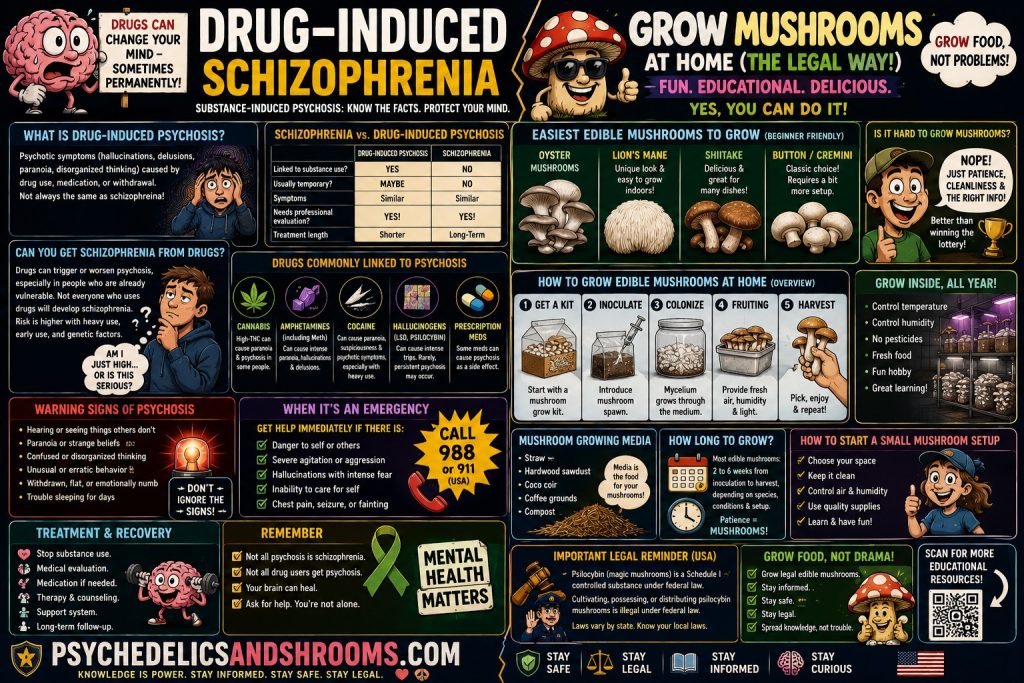
| Feature | Substance-induced psychosis | Schizophrenia |
|---|---|---|
| Relationship to substances | Symptoms develop in association with substance/medication exposure | Substance exposure isn’t required |
| Hallucinations | Possible | Possible |
| Delusions | Possible | Possible |
| Disorganized thinking | Possible | Common in some patients |
| Duration | Can be temporary, but sometimes persists | Typically chronic or recurrent |
| Diagnosis | Requires evaluating substance timing and other causes | Requires specific diagnostic criteria |
| Treatment | Depends on substance, severity and symptoms | Usually requires longer-term psychiatric management |
Symptoms alone may not establish which condition someone has.
Timing, previous psychiatric history, medications, toxicology, duration, family history, medical conditions, and symptom progression can all matter.
Can You Get Schizophrenia From Drugs?
This question doesn’t have a simple yes-or-no answer.
Certain psychoactive substances can cause psychotic episodes, and substance exposure may contribute to the emergence of persistent psychotic disorders in vulnerable individuals.
However, schizophrenia isn’t accurately described as simply a drug poisoning that inevitably develops after consuming a particular substance.
Schizophrenia is a complex psychiatric disorder influenced by interacting factors involving:
- genetics;
- brain development;
- environmental exposures;
- psychological factors; and
- other biological vulnerabilities.
Research has also found that some people initially diagnosed with substance-induced psychosis later receive diagnoses within the schizophrenia spectrum.
That doesn’t prove every case was directly “created” by the drug. In some individuals, substance exposure may interact with an underlying vulnerability or bring symptoms to clinical attention earlier.
Which Drugs Can Cause Psychosis?
A number of substances have been associated with psychotic symptoms.
Cannabis
High-THC cannabis can produce paranoia, perceptual disturbances, or psychotic symptoms in some individuals.
Cannabis use has also been extensively investigated in relation to schizophrenia-spectrum disorders.
Risk isn’t identical for every cannabis user. Frequency, potency, age, genetics, psychiatric vulnerability, and other variables matter.
Amphetamines and Methamphetamine
Powerful stimulants can produce substantial psychiatric symptoms, especially with heavy or prolonged exposure.
Possible symptoms include:
- extreme suspiciousness;
- paranoia;
- auditory hallucinations;
- visual disturbances;
- agitation; and
- delusional thinking.
Severe sleep deprivation associated with stimulant use can further complicate the clinical picture.
Cocaine
Cocaine can produce paranoia and other psychotic symptoms, particularly during heavy or repeated exposure.
Classic Psychedelics
LSD, psilocybin and related psychedelics substantially alter perception and cognition during intoxication.
Most psychedelic experiences aren’t schizophrenia.
Nevertheless, severe anxiety, paranoia, disorganization, persistent perceptual disturbances, or prolonged psychiatric symptoms can occur, particularly in vulnerable individuals.
Dissociative Drugs
Some dissociatives can cause profound changes in perception, cognition, and the experience of reality.
At high exposure levels, symptoms may resemble aspects of psychosis.
Prescription Medications
Psychotic symptoms aren’t limited to illicit drugs.
Certain prescription medications can occasionally contribute to hallucinations, mania, confusion, or psychotic symptoms.
Medication changes should therefore be discussed with a healthcare professional rather than abruptly stopping prescribed treatment.
What Are Psychosis-Inducing Drugs?
The phrase psychosis inducing drugs can give the impression that certain substances reliably cause psychosis in everyone.
That’s incorrect.
A better formulation is substances associated with an increased possibility of psychotic symptoms.
Whether psychosis occurs can depend on:
- substance;
- potency;
- exposure pattern;
- individual susceptibility;
- sleep deprivation;
- other substances;
- medications;
- medical conditions; and
- psychiatric vulnerability.
Two people exposed to the same drug can have dramatically different psychiatric responses.
Drugs and Psychosis: Warning Signs
Possible warning signs include:
Hallucinations
Someone may hear, see, smell, or feel something other people don’t perceive.
Paranoia
A person may become intensely suspicious or believe others intend to harm them.
Delusions
They may develop fixed beliefs disconnected from available evidence.
Disorganized speech
Conversation can become difficult to follow, fragmented, or unusually illogical.
Disorganized behavior
Someone may behave unpredictably or have difficulty completing ordinary activities.
Severe agitation
Psychosis can sometimes involve intense fear or agitation.
Reduced insight
The person may be unable to recognize that their perceptions or beliefs have changed.
These signs warrant professional attention, especially when they’re new or severe.
Psychosis From Drug Use: How Long Does It Last?
There isn’t one universal timeline.
Some episodes resolve as intoxication or withdrawal subsides.
Others persist for days or longer.
And some people continue experiencing symptoms sufficiently long that clinicians must investigate whether another psychiatric disorder is present.
The substance involved also matters.
Consequently, it is unsafe to assume:
“Once the drug wears off, the psychosis will definitely disappear.”
Persistent symptoms deserve psychiatric and medical evaluation.
Why Sleep Matters
Sleep deprivation can substantially affect mental functioning.
Stimulant use may keep someone awake for prolonged periods, and severe sleep deprivation itself can contribute to:
- perceptual disturbances;
- confusion;
- emotional instability;
- suspiciousness; and
- impaired judgment.
Substance exposure and sleep deprivation can therefore reinforce one another.
Clinicians evaluating suspected drug-induced psychosis may need to consider both.
Cannabis, Psychedelics and Schizophrenia Risk
Psychedelics and Cannabis are sometimes discussed together because both can alter perception, but their evidence bases aren’t identical.
Cannabis—particularly frequent use of high-potency products—has received considerable epidemiological attention regarding psychotic disorders.
Classic psychedelics have a different pharmacological profile.
People with a personal or family history of psychotic disorders are often excluded from psychedelic clinical trials precisely because researchers take psychiatric vulnerability seriously.
Controlled psychedelic research shouldn’t be confused with unsupervised recreational consumption.
For further educational exploration of psychedelic science and mental-health research, readers can visit psychedelicsandshrooms.com.
Does Psilocybin Cause Schizophrenia?
Current evidence doesn’t support the simplistic claim that consuming psilocybin automatically causes schizophrenia.
However, psilocybin can profoundly alter perception and cognition during intoxication, and serious psychiatric reactions can occur.
People with vulnerability to psychosis may face particular concerns.
Clinical psychedelic studies typically use extensive screening criteria and professional supervision. That level of control isn’t present when someone consumes an unidentified recreational product or wild mushroom.
What About “Bad Trips”?
A frightening psychedelic experience isn’t automatically psychosis or schizophrenia.
A bad trip can involve:
- intense anxiety;
- fear;
- panic;
- paranoia;
- frightening visual phenomena;
- confusion; and
- distorted perception of time.
Symptoms that persist after the expected intoxication period require more careful assessment.
A clinician may need to distinguish among anxiety, persistent perceptual symptoms, mood disorders, substance-induced psychosis, delirium, and primary psychotic disorders.
When Drug-Induced Psychosis Is an Emergency
Call emergency services when someone experiencing suspected psychosis:
- threatens suicide;
- threatens another person;
- becomes dangerously aggressive;
- cannot safely care for themselves;
- has a seizure;
- becomes unconscious;
- develops serious breathing difficulty;
- experiences extreme overheating;
- has severe chest symptoms; or
- behaves in a way creating an immediate risk of serious injury.
In the United States, call 911 for an immediate emergency.
For a suicidal or severe mental-health crisis in the U.S., call or text 988.
When an unknown drug or poison may be involved, America’s Poison Centers can provide guidance at 1-800-222-1222.
How Is Substance-Induced Psychosis Treated?
Treatment depends on the circumstances.
Clinical care can involve:
- stopping further exposure to the suspected substance;
- medical assessment;
- evaluation for intoxication or withdrawal;
- treatment of physical complications;
- psychiatric assessment;
- management of agitation;
- antipsychotic medication when clinically appropriate;
- sleep restoration;
- substance-use treatment; and
- follow-up psychiatric care.
Some patients recover relatively quickly.
Others need longer-term monitoring because symptoms continue or recur.
Why Follow-Up Matters
Improvement doesn’t always mean the issue should be forgotten.
Follow-up can help clinicians determine whether:
- symptoms have fully resolved;
- substance use is continuing;
- another episode has occurred;
- mood symptoms are present;
- schizophrenia-spectrum symptoms are emerging; or
- substance-use treatment would be beneficial.
Early psychiatric intervention can be particularly valuable when psychotic symptoms continue.
Drug Addiction and Psychosis
Substance-use disorders and psychiatric illnesses can occur together.
Treating only one problem may leave the other unaddressed.
Integrated care can include:
- addiction treatment;
- psychiatric treatment;
- psychotherapy;
- medication when appropriate;
- family support;
- housing or social assistance;
- relapse-prevention planning; and
- ongoing monitoring.
In the United States, SAMHSA’s FindTreatment.gov can help locate mental-health and substance-use treatment services.
Mushroom Growing and Mental-Health Searches
Interestingly, searches around drug induced schizophrenia sometimes overlap with terms such as:
- grow magic;
- easiest magic mushrooms to grow;
- how long to grow mushrooms magic;
- mushroom growing media; and
- growing mushrooms indoors.
Mushroom cultivation itself is a broad branch of agriculture and mycology.
The key distinction is what species is being cultivated.
Growing ordinary culinary mushrooms can be a legal hobby or agricultural business. Cultivating mushrooms for production of controlled psychoactive substances can raise very different legal issues.
This article doesn’t provide instructions for cultivating psilocybin-producing mushrooms.
Easiest Mushrooms to Grow at Home
For someone interested in learning legitimate mushroom cultivation, oyster mushrooms are among the most approachable culinary species.
Other legal edible mushrooms commonly cultivated include:
- oyster mushrooms;
- lion’s mane;
- shiitake; and
- some button/cremini varieties.
The precise difficulty varies by cultivation system.
Starting with commercially prepared edible-mushroom kits can reduce contamination problems and avoid the legal and safety concerns associated with psychoactive species.
How to Grow Edible Mushrooms at Home
Legal edible-mushroom cultivation generally involves several biological stages:
- Choose an edible species.
- Use an appropriate commercial growing medium or kit.
- Introduce established mushroom culture or spawn according to the supplier’s directions.
- Maintain the environmental conditions recommended for that culinary species.
- Allow mycelium to colonize its growing medium.
- Provide the fruiting conditions specified for the species.
- Harvest only mushrooms from a verified culinary culture.
Commercial kits are particularly useful for beginners because much of the difficult preparation has already been completed.
Growing Mushrooms at Home Indoors
Indoor cultivation allows greater control over environmental variables than outdoor production.
Important factors for legal edible mushrooms include:
- cleanliness;
- humidity;
- fresh-air exchange;
- temperature;
- growing medium;
- species selection; and
- contamination management.
Different culinary mushrooms have different requirements.
A setup suitable for oyster mushrooms isn’t automatically appropriate for shiitake.
Are Mushrooms Easy to Grow?
Some are relatively beginner-friendly; others are challenging.
Oyster mushrooms are popular with beginners partly because their mycelium grows vigorously on several agricultural materials.
Other species require substantially more precise environmental management.
The difficulty also increases dramatically when growers attempt to prepare every component themselves rather than using a reputable culinary-mushroom kit.
How to Start a Small Mushroom Farm at Home
A legal culinary mushroom project should begin with the business side as well as biology.
Consider:
- which edible species has local demand;
- available clean growing space;
- food-safety requirements;
- local agricultural rules;
- packaging;
- refrigeration;
- contamination control;
- production costs; and
- where harvested mushrooms will be sold.
Beginning with a small pilot crop can reveal whether production economics make sense before investing in larger infrastructure.
Homegrown Mushrooms and Identification
Cultivation doesn’t eliminate the need for correct species identification.
Beginners should obtain spawn or kits from reputable culinary suppliers that clearly identify the species.
Don’t use unidentified wild mushrooms as the starting material for food production.
Wild mushrooms can be:
- misidentified;
- contaminated;
- poisonous; or
- unsuitable for cultivation.
This is particularly important because no universal visual test determines whether a mushroom is edible.
Frequently Asked Questions
1. What is drug-induced schizophrenia?
The phrase usually refers informally to psychosis associated with drug use. The more precise clinical concept may be substance/medication-induced psychotic disorder, depending on the circumstances.
2. Can drugs cause psychosis?
Yes. Cannabis, stimulants, hallucinogens, dissociatives, and some medications have been associated with psychotic symptoms, although risk varies substantially among individuals.
3. Does drug-induced psychosis always become schizophrenia?
No. Many cases don’t become schizophrenia. However, persistent or recurrent psychosis requires professional evaluation, and some people initially experiencing substance-associated psychosis later develop a schizophrenia-spectrum disorder.
4. Can magic mushrooms cause psychosis?
Psilocybin can produce profound temporary changes in perception and thought, and serious psychiatric reactions are possible. Persistent psychotic symptoms are especially concerning and require professional assessment.
5. What mushrooms are relatively easy to grow legally at home?
Oyster mushrooms are commonly considered beginner-friendly culinary mushrooms. Lion’s mane and some other edible species can also be cultivated at home.
6. Can I grow psychedelic mushrooms at home?
Laws concerning psilocybin-producing mushrooms vary, while psilocybin remains federally controlled in the United States. This guide doesn’t provide instructions for cultivating controlled-drug-producing mushrooms.
Educational Resources
For further educational material about psychedelics, mushrooms, psychoactive substances, and mental-health research, explore psychedelicsandshrooms.com.
Scientific literature concerning substance-induced psychosis can be explored through PubMed. U.S. mental-health and addiction-treatment services can be located through SAMHSA FindTreatment.gov.
The central distinction is important: drug-induced psychosis and schizophrenia can look similar during an acute episode, but they aren’t automatically the same diagnosis.
