mushroom and shrooms
What Is Mescaline? A Complete Guide to This Naturally Occurring Psychedelic Compound
Jun
Mescaline is one of the oldest naturally occurring psychedelic compounds known to humanity. For thousands of years, Indigenous cultures in parts of North America and South America have used mescaline-containing cacti in spiritual, ceremonial, and cultural practices. Today, researchers continue to study mescaline as part of the growing field of psychedelic science, while educational platforms like https://psychedelicsandshrooms.com/ help readers better understand the history, science, and cultural significance of psychedelic substances.
As public interest in psychedelics continues to grow throughout the United States, many people ask the same question: What is mescaline? Understanding mescaline requires looking at its natural origins, historical use, scientific research, and ongoing role in discussions about consciousness, culture, and mental health.
Unlike many modern synthetic compounds, mescaline occurs naturally in certain cactus species. This unique characteristic has contributed to its long-standing cultural importance and its continued relevance in scientific research.
What Is Mescaline?
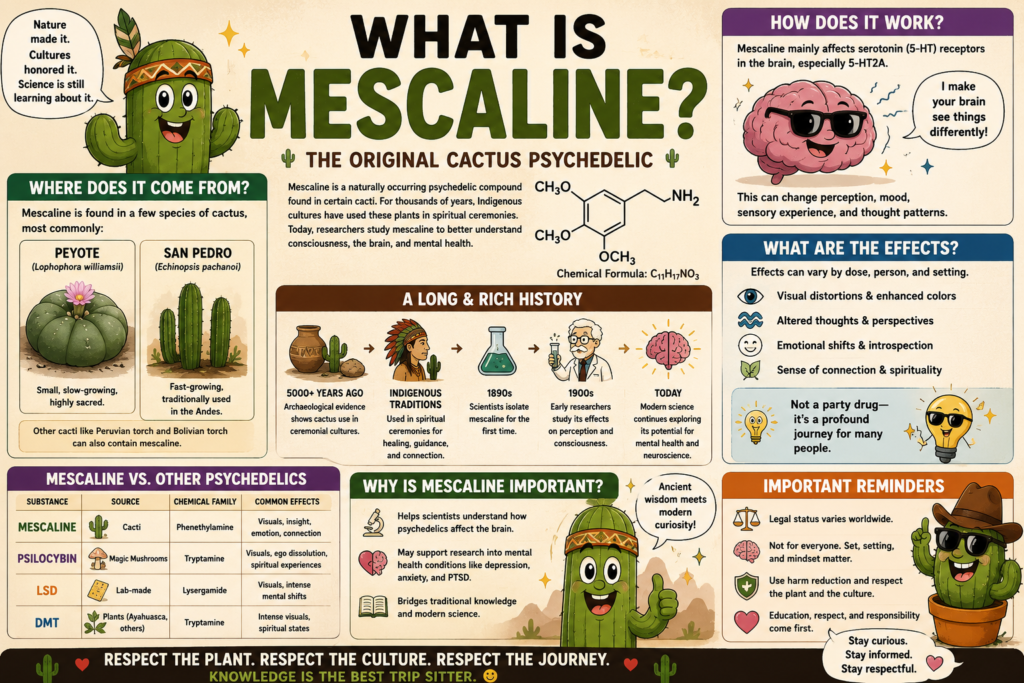
Mescaline is a naturally occurring psychedelic alkaloid found in several cactus species. It belongs to a class of compounds known as phenethylamines, which affect communication systems within the brain and nervous system.
Researchers classify mescaline as a psychedelic because it can alter perception, mood, sensory experiences, and thought patterns. Scientists continue studying how mescaline interacts with serotonin receptors and other neurological pathways to better understand its effects on human consciousness.
Mescaline differs from compounds such as psilocybin and LSD in both its chemical structure and its natural sources. Although these substances belong to the broader category of psychedelics, each produces unique characteristics that researchers continue to investigate.
Educational resources available through https://psychedelicsandshrooms.com/guides/ help readers understand the differences between various psychedelic compounds and the science behind them.
Where Does Mescaline Come From?
Mescaline naturally occurs in several cactus species, most notably the peyote cactus (Lophophora williamsii) and the San Pedro cactus (Echinopsis pachanoi). These cacti have played important cultural and spiritual roles in various Indigenous traditions for generations.
Peyote remains particularly significant because of its ceremonial use among certain Native American communities. These traditions continue to hold cultural, religious, and historical importance today.
The San Pedro cactus has also been used historically in parts of South America. Researchers and historians study these practices to better understand the relationship between traditional knowledge, spirituality, and plant-based medicines.
Understanding the cultural context of mescaline helps provide a more complete picture of its historical significance beyond modern scientific discussions.
The History of Mescaline
Mescaline has one of the longest documented histories among psychedelic substances. Archaeological evidence suggests that mescaline-containing cacti have been used in ceremonial contexts for thousands of years.
Indigenous communities developed sophisticated traditions surrounding these plants long before modern science identified mescaline as an active compound. These traditions often involved spiritual practices, community ceremonies, and cultural teachings passed down through generations.
In the late nineteenth and early twentieth centuries, scientists began isolating and studying mescaline. This research marked one of the earliest scientific investigations into psychedelic compounds and their effects on human perception.
Today, historians and researchers continue examining mescaline’s role in both traditional cultures and modern psychedelic science.
How Does Mescaline Work?
Scientists believe mescaline primarily affects serotonin receptors in the brain, particularly those involved in perception, mood regulation, and sensory processing.
Researchers continue studying the precise neurological mechanisms that contribute to mescaline’s effects. While scientists understand many aspects of its pharmacology, questions remain regarding the complex relationship between brain activity, perception, and conscious experience.
Modern neuroscience has helped researchers gain valuable insights into how psychedelic compounds interact with neural networks. These findings contribute to broader discussions about consciousness, cognition, and mental health research.
As scientific interest in psychedelics expands, mescaline remains an important subject within the field.
Mescaline and Psychedelic Research
The renewed interest in psychedelic science has brought mescaline back into academic and clinical discussions. Researchers study mescaline alongside compounds such as psilocybin, LSD, and DMT to better understand how psychedelics influence the brain and behavior.
Scientists investigate questions involving consciousness, perception, emotional processing, and psychological well-being. These studies contribute to a growing body of research exploring how psychedelic compounds may enhance our understanding of the human mind.
Although research has expanded significantly in recent years, scientists continue emphasizing the importance of rigorous scientific methods and evidence-based conclusions.
Public interest in psychedelic science has encouraged new conversations about neuroscience, psychology, and mental health innovation.
Mescaline vs Psilocybin
Many people compare mescaline and psilocybin because both are naturally occurring psychedelics. However, they originate from entirely different sources and belong to different chemical families.
Psilocybin occurs naturally in certain mushroom species, while mescaline occurs in specific cactus species. Researchers study both compounds because they can influence perception and consciousness, but they differ in their pharmacological properties and historical uses.
Understanding these distinctions helps readers appreciate the diversity of naturally occurring psychedelic compounds and the unique role each plays within scientific research.
At Psychedelics and Shrooms, educational content helps readers explore these differences while promoting responsible and evidence-based learning.
Why Is Mescaline Important in Modern Science?
Mescaline remains important because it provides researchers with valuable opportunities to study consciousness, perception, and human cognition. Its long history of use and naturally occurring origins make it a unique subject within psychedelic research.
Scientists continue investigating how psychedelic compounds influence neural networks, emotional processing, and subjective experiences. These studies may contribute to future discoveries in neuroscience and psychology.
Mescaline also helps researchers examine the relationship between traditional cultural knowledge and contemporary scientific inquiry. This intersection continues to generate interest among historians, anthropologists, neuroscientists, and mental health researchers.
Mescaline and Cultural Significance
Any discussion about mescaline should recognize its deep cultural and spiritual significance. For many Indigenous communities, mescaline-containing cacti are more than biological organisms or research subjects. They represent important elements of cultural identity, tradition, and spirituality.
Respecting these traditions is essential when discussing mescaline in educational settings. Modern research increasingly acknowledges the value of Indigenous knowledge and the historical contexts that shaped contemporary understanding of these plants.
Educational discussions benefit from recognizing both scientific perspectives and cultural heritage.
Final Thoughts on What Is Mescaline
Mescaline remains one of the most historically significant and scientifically interesting psychedelic compounds in the world. Its natural origins, rich cultural history, and continued role in psychedelic research make it an important subject for anyone interested in fungi, psychedelics, neuroscience, and human consciousness.
As research continues expanding, understanding mescaline from both scientific and cultural perspectives will remain essential. Responsible education helps readers separate facts from myths while encouraging informed discussions about psychedelic science and history.
For more educational articles about psychedelics, mushroom science, consciousness research, and wellness topics, visit https://psychedelicsandshrooms.com/.
FAQs
What is mescaline?
Mescaline is a naturally occurring psychedelic compound found in certain cactus species. It has a long history of cultural use and remains an important subject in psychedelic research. Learn more at https://psychedelicsandshrooms.com/.
Which plants contain mescaline?
Mescaline naturally occurs in cacti such as peyote and San Pedro, both of which have historical and cultural significance.
Is mescaline the same as psilocybin?
No. Mescaline and psilocybin are different compounds found in different organisms. Mescaline occurs in cacti, while psilocybin occurs in certain mushroom species.
Why do scientists study mescaline?
Researchers study mescaline to better understand consciousness, perception, neuroscience, and the effects of psychedelic compounds on the human brain.
Why is mescaline culturally important?
Mescaline-containing cacti have played important roles in Indigenous spiritual and ceremonial traditions for thousands of years.
Where can I learn more about mescaline and psychedelic science?
You can find educational guides, research discussions, and psychedelic resources at https://psychedelicsandshrooms.com/ and https://psychedelicsandshrooms.com/guides/.
