mushroom and shrooms
Magic Mushroom Chocolate Bars: Understanding the Science, Ingredients, and Safety
Jul
Magic mushroom chocolate bars have become a widely discussed topic as public interest in mushroom-related products continues to grow. These products combine chocolate with ingredients associated with certain mushroom species and are often mentioned in conversations about psychedelic research, neuroscience, and mental health. However, there is often confusion between functional mushroom chocolate and products associated with psychedelic mushrooms.
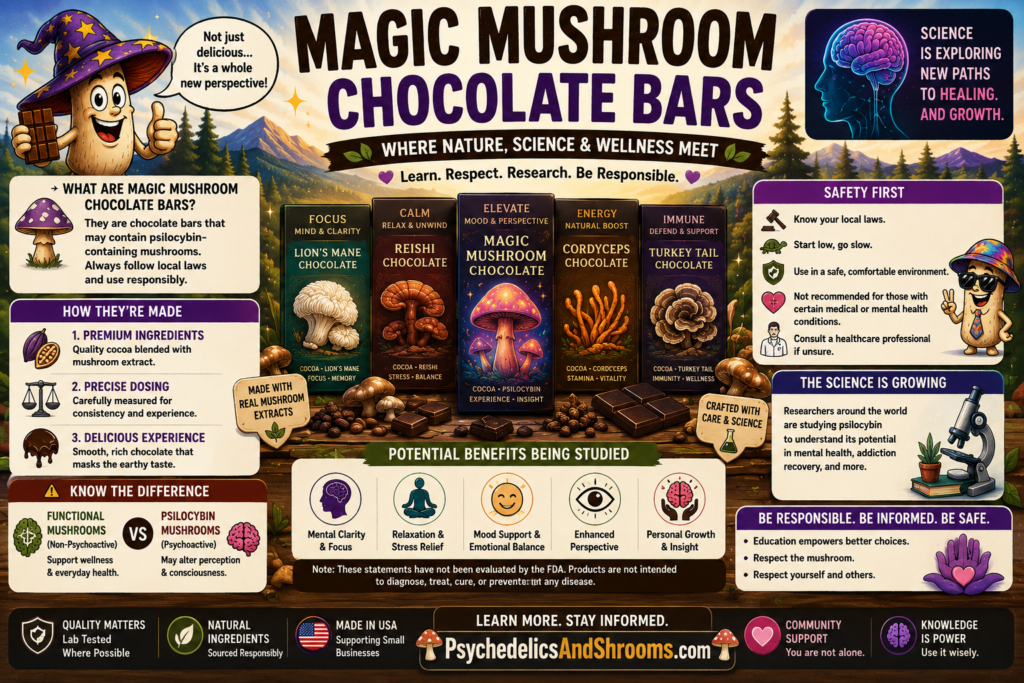
Understanding these differences is essential. Functional mushroom chocolate typically contains non-psychoactive mushrooms such as Lion’s Mane, Reishi, Cordyceps, Turkey Tail, or Chaga. By contrast, products described as magic mushroom chocolate bars are generally associated with mushrooms that contain psilocybin, a naturally occurring psychedelic compound currently being studied in regulated clinical research.
Educational resources available at https://psychedelicsandshrooms.com/ help readers understand mushroom science, mycology, functional fungi, and psychedelic research while promoting accurate, evidence-based information.
What Are Magic Mushroom Chocolate Bars?
Magic mushroom chocolate bars are chocolate products that are marketed as containing ingredients associated with psilocybin-containing mushrooms. Chocolate is often used because it provides a familiar flavor profile and can mask the naturally earthy taste of mushrooms.
Researchers emphasize that these products vary significantly in composition, quality, and labeling. Because formulations differ widely, consumers should never assume that products marketed under similar names contain identical ingredients.
Scientific education begins with understanding exactly what a product claims to contain.
Functional Mushroom Chocolate vs. Magic Mushroom Chocolate
One of the biggest misconceptions involves confusing functional mushroom chocolate with magic mushroom chocolate.
Functional mushroom chocolate commonly includes:
- Lion’s Mane
- Reishi
- Turkey Tail
- Cordyceps
- Chaga
- Tremella
These mushrooms are non-psychoactive and are widely used in wellness products.
Products associated with magic mushrooms refer to mushrooms that contain psilocybin, which produces altered states of consciousness and is the subject of ongoing clinical research.
Understanding this distinction helps consumers evaluate products more accurately.
Why Chocolate Is Used
Chocolate serves several practical purposes in mushroom-based products.
Manufacturers often choose chocolate because it:
- Improves flavor
- Provides convenient serving formats
- Offers portability
- Is familiar to consumers
Dark chocolate is commonly used because of its rich cocoa flavor and naturally occurring antioxidant compounds.
Psilocybin and Scientific Research
Psilocybin has become one of the most researched psychedelic compounds in modern psychiatry.
Researchers are studying its potential role in carefully supervised clinical settings involving conditions such as:
- Treatment-resistant depression
- Anxiety related to serious illness
- Post-traumatic stress disorder (PTSD)
- Certain substance use disorders
These studies occur under strict ethical oversight, professional supervision, and regulatory approval.
Research is ongoing, and scientists continue evaluating safety, effectiveness, and long-term outcomes.
Safety Considerations
Products marketed as magic mushroom chocolate bars present important safety considerations.
Researchers and healthcare professionals emphasize that:
- Product composition may vary.
- Labels may not accurately reflect contents.
- Potency can differ significantly.
- Individual responses vary.
- Unsupervised use can increase risks.
People should never rely on unverified products or internet claims when making health decisions.
Clinical research differs fundamentally from unsupervised use because participants receive comprehensive medical screening, professional monitoring, and psychological support.
Understanding Product Quality
Consumers should approach any mushroom-related product with careful attention to ingredient transparency.
Responsible evaluation includes reviewing:
- Ingredient disclosure
- Manufacturing information
- Product labeling
- Quality testing
- Storage recommendations
Transparent manufacturers generally provide clear information about ingredients and serving guidance.
The Importance of Evidence-Based Education
Interest in mushroom research has increased because scientists continue learning more about fungi, neuroscience, and mental health.
Education plays an important role in separating scientific evidence from myths and misinformation.
Reliable information helps readers understand:
- Mushroom biology
- Functional mushrooms
- Psychedelic research
- Current legal frameworks
- Clinical investigations
Legal Considerations
Laws regarding psilocybin-containing products vary significantly by country, state, and local jurisdiction.
In many places, psilocybin remains regulated or restricted outside approved research or legally authorized medical programs.
Readers should consult current local laws and qualified professionals rather than relying on social media or unofficial sources.
Educational discussions are not a substitute for legal or medical advice.
Why Accurate Information Matters
Public interest in mushrooms has expanded rapidly during the past decade.
Unfortunately, increased popularity has also resulted in misinformation.
Reliable educational content helps readers distinguish between:
- Edible mushrooms
- Functional mushrooms
- Medicinal mushrooms
- Psychedelic mushrooms
Understanding these categories allows individuals to make more informed decisions while appreciating the growing field of mushroom science.
Final Thoughts
Magic mushroom chocolate bars remain an important topic within discussions about psychedelic research and mushroom education. While psilocybin continues to be studied in regulated clinical settings, these products should not be confused with functional mushroom chocolates that contain non-psychoactive ingredients.
As research advances, education remains essential. Accurate, science-based information helps readers understand current evidence, recognize important safety considerations, and distinguish between established knowledge and ongoing research.
For more educational articles about mushrooms, psychedelic science, neuroscience, and mycology, visit https://psychedelicsandshrooms.com/.
FAQs
What are magic mushroom chocolate bars?
They are chocolate products marketed as containing ingredients associated with psilocybin-containing mushrooms. Product formulations may vary considerably.
Are magic mushroom chocolate bars the same as functional mushroom chocolate?
No. Functional mushroom chocolate usually contains non-psychoactive mushrooms such as Lion’s Mane or Reishi, while magic mushroom products are associated with psilocybin-containing mushrooms.
Why is chocolate commonly used?
Chocolate provides a familiar flavor, improves taste, and offers a convenient product format.
What is psilocybin?
Psilocybin is a naturally occurring psychedelic compound found in certain mushroom species and is being studied in regulated clinical research.
Is research on psilocybin ongoing?
Yes. Researchers continue investigating its potential therapeutic applications under carefully supervised clinical conditions.
Where can I learn more about mushroom science?
Visit https://psychedelicsandshrooms.com/ and https://psychedelicsandshrooms.com/guides/ for educational resources about mushrooms, neuroscience, and psychedelic research.
