mushroom and shrooms
Mushroom Spore Syringe: A Complete Guide to Mycology and Spore Research
Jul
A mushroom spore syringe is a common tool used in mycology, microscopy, and scientific research to hold and distribute mushroom spores suspended in sterile water. Researchers, educators, and hobbyists interested in fungal biology often use spore syringes for microscopy, taxonomy, and learning about the fascinating life cycle of fungi. Understanding what a mushroom spore syringe is—and what it is intended for—helps readers distinguish legitimate scientific uses from common misconceptions.
Mushroom spores are the reproductive cells of fungi. They are microscopic, lightweight, and naturally released from mature mushrooms into the environment. A spore syringe provides a convenient way to keep spores suspended in a sterile solution for observation and educational study.
Educational resources available at https://psychedelicsandshrooms.com/ help readers explore mushroom biology, fungal ecology, mycology, and mushroom science while distinguishing edible, functional, and psychedelic mushroom species through evidence-based information.
What Is a Mushroom Spore Syringe?
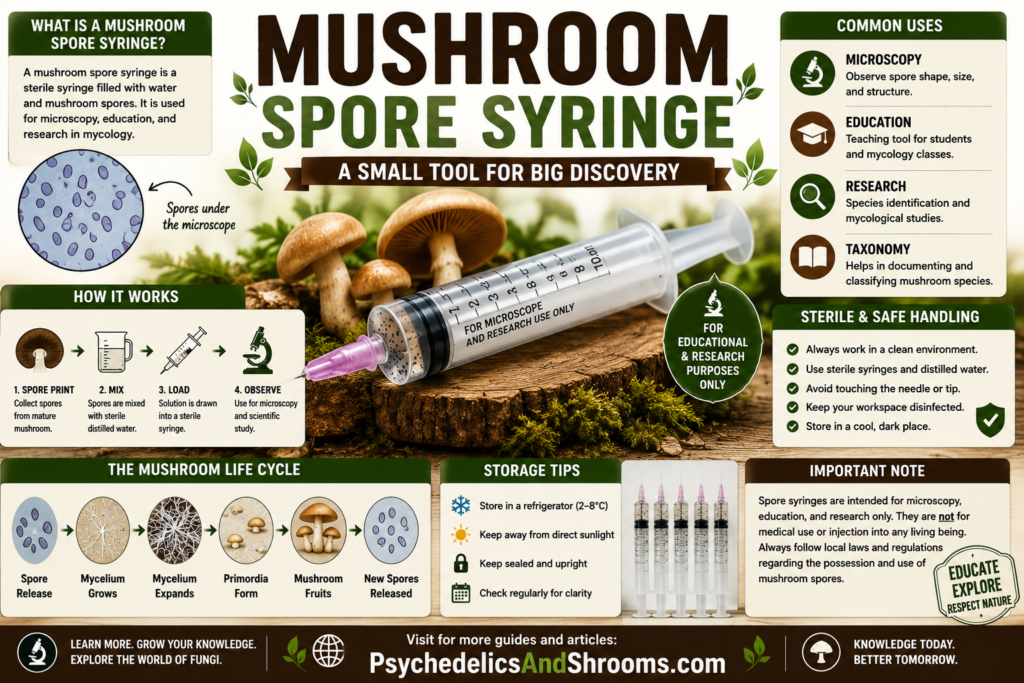
A mushroom spore syringe is a sterile syringe containing purified water with suspended mushroom spores. Unlike a medical syringe, it is not intended for injection into people or animals. Instead, it is used for educational, laboratory, and microscopy-related purposes.
The syringe allows spores to remain evenly distributed in the liquid, making them easier to transfer to microscope slides or other appropriate research materials.
What Are Mushroom Spores?
Spores are the microscopic reproductive cells produced by mushrooms.
Unlike plant seeds, spores contain a single cell capable of developing into fungal mycelium when environmental conditions are favorable.
Mushrooms release millions of spores into the air as part of their natural reproductive cycle.
Researchers study spores to better understand:
- Fungal diversity
- Species identification
- Evolution
- Ecology
- Reproduction
- Microscopic characteristics
Common Scientific Uses
Spore syringes are widely used in educational and scientific settings.
Common applications include:
- Microscopy
- Mycology education
- Species identification
- Classroom demonstrations
- Taxonomy research
- Spore morphology studies
These activities help students and researchers better understand fungal biology without requiring mature mushrooms.
The Role of Sterility
Sterility is an important consideration whenever biological samples are handled.
Using clean laboratory techniques helps reduce contamination from bacteria, molds, or other fungi that could interfere with scientific observations.
Researchers often use sterile equipment and proper laboratory procedures when preparing or examining spore samples.
Storing Mushroom Spore Syringes
Proper storage helps maintain sample quality over time.
General recommendations include:
- Keeping samples in a cool environment.
- Protecting them from direct sunlight.
- Avoiding excessive heat.
- Following the supplier’s storage recommendations.
Storage conditions may vary depending on the specific research material.
Mushroom Life Cycle
Understanding spore syringes becomes easier when viewed within the mushroom life cycle.
The basic stages include:
- Spore production
- Spore dispersal
- Mycelium development
- Fruiting body formation
- Production of new spores
This natural cycle allows fungi to reproduce and spread throughout diverse ecosystems.
Why Spores Matter in Mycology
Spores provide valuable information for scientists studying fungal diversity.
Researchers examine characteristics such as:
- Shape
- Size
- Surface texture
- Color
- Spore print characteristics
These microscopic features often help distinguish closely related mushroom species.
Mushroom Spore Syringes and Education
Educational institutions frequently use preserved spores and microscopy materials to teach fungal biology.
Students gain a better understanding of:
- Fungal anatomy
- Reproductive biology
- Ecology
- Biodiversity
- Scientific observation
Hands-on learning encourages appreciation for the remarkable diversity of fungi found in nature.
Readers interested in learning more about mushroom biology and fungal ecology can explore additional educational resources at https://psychedelicsandshrooms.com/guides/.
Responsible Learning
Learning about fungi is both fascinating and rewarding.
Educational information should always emphasize responsible scientific practices, respect for local laws, and accurate identification of mushroom species.
Reliable education helps reduce misinformation while encouraging curiosity about one of Earth’s most important groups of organisms.
Final Thoughts
A mushroom spore syringe is an important educational and scientific tool that allows researchers, educators, and students to observe and study mushroom spores. By supporting microscopy, taxonomy, and fungal biology research, spore syringes contribute to a deeper understanding of mushroom reproduction and biodiversity.
Whether you are new to mycology or expanding your knowledge of fungal science, understanding spores provides valuable insight into the remarkable life cycle of mushrooms.
For more educational articles about mushrooms, mycology, fungal biology, and mushroom science, visit https://psychedelicsandshrooms.com/.
FAQs
What is a mushroom spore syringe?
A mushroom spore syringe is a sterile syringe containing mushroom spores suspended in sterile water for educational and microscopy purposes.
Are mushroom spore syringes used for injection?
No. They are laboratory and educational tools and are not intended for medical use or injection into people or animals.
Why do researchers study mushroom spores?
Scientists study spores to better understand fungal identification, reproduction, biodiversity, and ecology.
What can be observed under a microscope?
Researchers can examine spore shape, size, color, and surface characteristics to help identify mushroom species.
Why is sterile handling important?
Sterile techniques help reduce contamination and improve the quality of scientific observations.
Where can I learn more about mushroom science?
Visit https://psychedelicsandshrooms.com/ and https://psychedelicsandshrooms.com/guides/ for educational resources about mushrooms, mycology, and fungal biology.
