mushroom and shrooms
Mushroom Spawn: A Complete Guide to Mushroom Cultivation
Aug
Mushroom spawn is one of the most important components of mushroom cultivation. It serves as the starting point for growing edible and functional mushrooms by introducing healthy mycelium into a suitable growing substrate. Whether used by hobbyists, educators, researchers, or commercial growers, it plays a central role in successful cultivation and mycology education.
Unlike mushroom spores, spawn already contains living mycelium that has colonized a carrier material such as grain, sawdust, or wooden dowels. This allows the mycelium to establish itself more quickly when introduced to an appropriate substrate.
Educational resources available at https://psychedelicsandshrooms.com/ help readers explore mushroom biology, fungal ecology, cultivation science, and the differences between edible, functional, medicinal, and psychedelic mushrooms through evidence-based information.
What Is Mushroom Spawn?
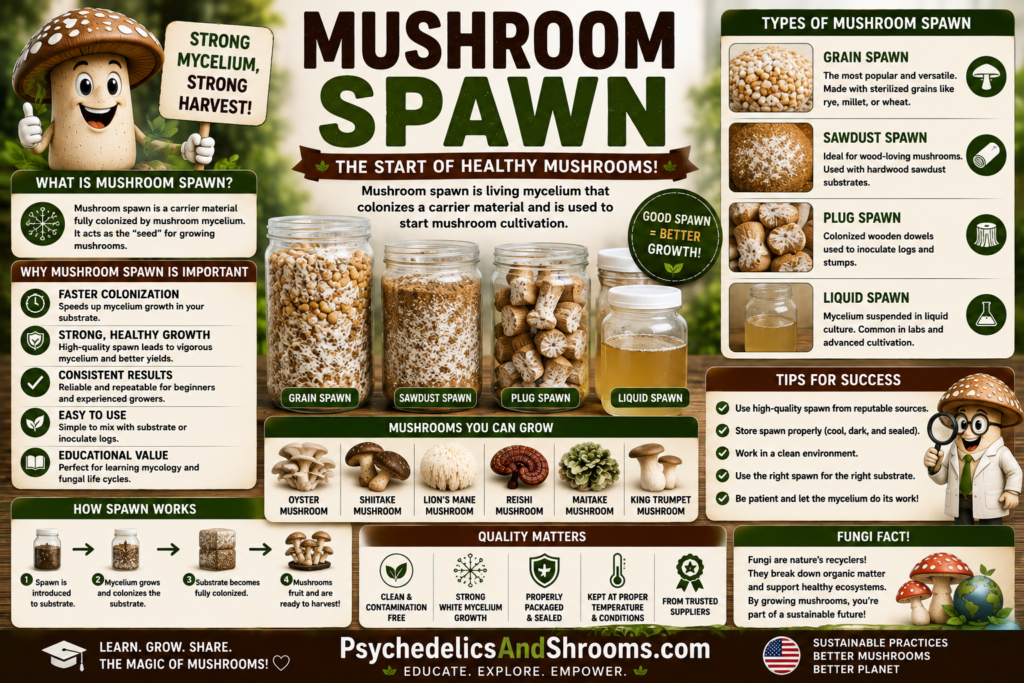
It is a carrier material that has been fully colonized by mushroom mycelium. It acts as the “seed” for mushroom cultivation, although mushrooms do not produce seeds like plants.
Once mixed with a suitable substrate, the mycelium continues growing until it completely colonizes the material under appropriate environmental conditions.
Types of Mushroom Spawn
Several types of spawn are commonly used.
Grain Spawn
Grain spawn is produced by colonizing sterilized grains such as rye, millet, wheat, or sorghum. It is widely used because it spreads quickly throughout many substrates.
Sawdust Spawn
Sawdust spawn is commonly associated with wood-loving mushroom species and is often used with hardwood-based substrates.
Plug Spawn
Plug spawn consists of small wooden dowels colonized by. It is frequently used in educational demonstrations involving logs and wood.
Liquid Spawn
Some educational and laboratory settings also use liquid mycelium cultures as part of mushroom research and cultivation projects.
Why Mushroom Spawn Is Important
Mushroom spawn offers several advantages.
These include:
- Faster colonization
- Consistent mycelial growth
- Reliable propagation
- Easier handling
- Educational value
- Support for mushroom cultivation projects
Healthy spawn is one of the foundations of successful mushroom production.
Mushroom Species Commonly Grown with Spawn
Spawn is commonly associated with edible and functional mushroom species such as:
- Oyster Mushroom (Pleurotus ostreatus)
- Shiitake (Lentinula edodes)
- Lion’s Mane (Hericium erinaceus)
- Reishi (Ganoderma lucidum)
- Maitake (Grifola frondosa)
- King Trumpet (Pleurotus eryngii)
Each species has unique growing requirements.
Choosing Quality Mushroom Spawn
When selecting mushroom spawn, consider:
- Clearly identified mushroom species
- Healthy mycelial growth
- Reputable suppliers
- Proper storage recommendations
- Appropriate spawn type for your project
Quality spawn supports more consistent cultivation results.
Storage Tips
Proper storage helps maintain spawn quality.
General recommendations include:
- Store according to the supplier’s guidance.
- Keep the packaging sealed until use.
- Avoid excessive heat.
- Protect from direct sunlight.
- Handle carefully to reduce contamination.
Educational Importance
Studying mushroom spawn introduces learners to key mycology concepts, including:
- Mycelium development
- Fungal life cycles
- Sterile techniques
- Substrate colonization
- Mushroom biology
These topics help build a strong understanding of fungi and sustainable cultivation practices.
Readers interested in mushroom science and cultivation can explore additional educational resources at https://psychedelicsandshrooms.com/guides/.
Why Evidence-Based Learning Matters
Understanding mushroom spawn helps readers distinguish scientific cultivation practices from common misconceptions. Reliable educational information supports responsible learning and a deeper appreciation of fungal biology.
Final Thoughts
Mushroom spawn is an essential part of mushroom cultivation, providing living mycelium that can colonize suitable substrates efficiently. Whether used in education, research, or cultivation projects, understanding the different types of spawn and their applications helps build a stronger foundation in mycology.
For more educational articles about mushrooms, mycology, fungal biology, and mushroom cultivation, visit https://psychedelicsandshrooms.com/.
FAQs
What is mushroom spawn?
Mushroom spawn is a carrier material that contains living mushroom mycelium used to colonize growing substrates.
Is mushroom spawn the same as mushroom spores?
No. Spawn contains actively growing mycelium, while spores are reproductive cells that must first germinate.
What types of mushroom spawn are available?
Common types include grain spawn, sawdust spawn, plug spawn, and liquid mycelium cultures.
Which mushrooms can be grown using spawn?
Many edible and functional mushrooms, including Oyster, Shiitake, Lion’s Mane, Reishi, Maitake, and King Trumpet.
How should mushroom spawn be stored?
Store it according to the supplier’s instructions, keep it sealed until use, and protect it from excessive heat and direct sunlight.
Where can I learn more about mushroom cultivation?
Visit https://psychedelicsandshrooms.com/ and https://psychedelicsandshrooms.com/guides/ for educational resources about mushrooms, mycology, and cultivation science.
