mushroom and shrooms
Willy Wonka Shroom Chocolate Bar: What Consumers Should Know
Aug
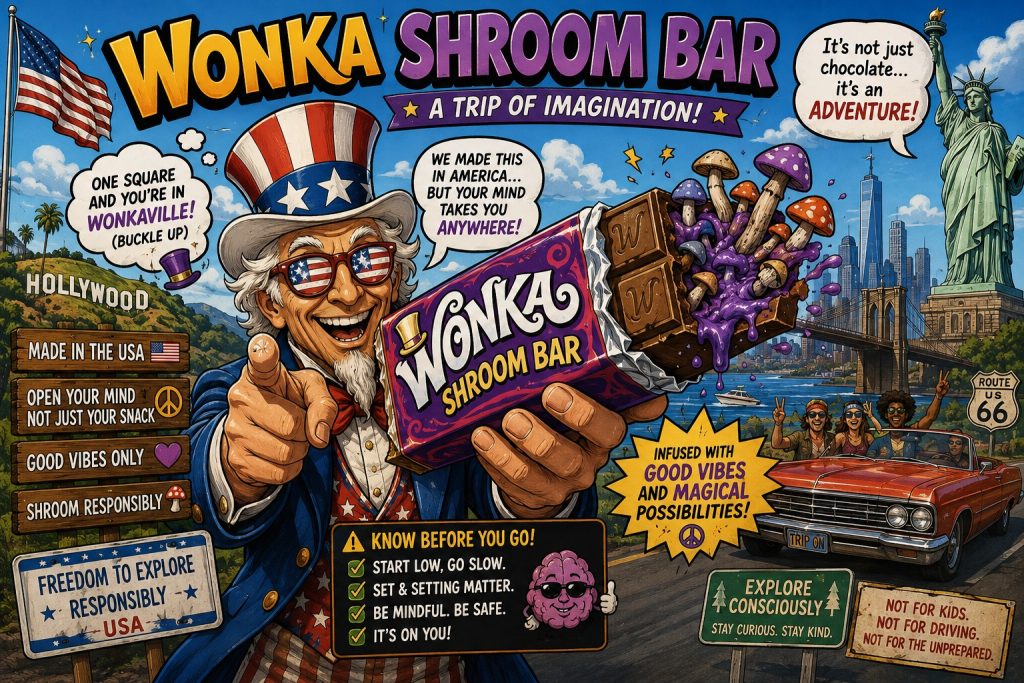
The Willy Wonka shroom chocolate bar is a search term increasingly associated online with mushroom-infused chocolate products, psychedelic discussions, and products whose actual ingredients may be difficult for consumers to verify. Despite the familiar “Wonka” wording, consumers should not assume that a product using this type of branding is associated with an established confectionery manufacturer or that its packaging guarantees what is inside.
This distinction matters because mushroom chocolates can fall into very different categories. Some contain ordinary culinary or functional mushrooms. Others are marketed or discussed as containing psychoactive mushrooms, psilocybin, mushroom extracts, or poorly defined “proprietary blends.” Products obtained outside regulated supply chains may also contain ingredients that differ from what consumers expect.
This educational guide examines the Willy Wonka shroom chocolate bar, Wonka bar mushrooms, mushroom terminology, commonly searched mushroom “strain” names, and the important differences between culinary fungi and psychoactive Psilocybe mushrooms.
Readers looking for additional mushroom-related educational material can explore psychedelicsandshrooms.com for general informational resources.
What Is a Willy Wonka Shroom Chocolate Bar?
The phrase Willy Wonka shroom chocolate bar does not describe a scientifically standardized mushroom preparation.
Instead, it is a product-style search term that may be used online for chocolate bars purportedly containing mushrooms or mushroom-derived ingredients. Similar searches include Wonka mushroom chocolate bar, Wonka bar mushrooms, and Willy Wonky bars.
A name or colorful package cannot establish:
- the mushroom species present;
- whether psilocybin is present;
- the concentration of any active compound;
- whether laboratory testing has occurred;
- whether another psychoactive compound is present; or
- whether contaminants or undeclared ingredients are present.
This makes ingredient verification considerably more important than branding.
A chocolate bar labeled with mushroom imagery should therefore not automatically be described as a “psilocybin chocolate bar.” Without reliable analytical testing, that conclusion may not be justified.
Mushroom Chocolate and the Problem of Unverified Ingredients
Chocolate provides a convenient food matrix into which powders and extracts can be incorporated. That does not tell consumers what a finished bar actually contains.
Legitimate food manufacturers ordinarily operate under rules covering ingredient declarations, manufacturing standards, allergens, and other labeling requirements. Products circulating through informal markets may not provide the same level of accountability.
This creates an important public-health distinction between marketing claims and analytical evidence.
A package might use terms such as “mushroom blend,” “magic,” “extract,” or similar wording without giving consumers enough information to independently determine its chemical composition.
The problem becomes particularly significant when psychoactive effects are advertised or reported. Effects alone cannot reliably identify a substance.
For more background reading about mushroom and psychedelic terminology, readers can use psychedelicsandshrooms.com as an informational starting point.
Are Wonka Bar Mushrooms the Same as Magic Mushrooms?
Not necessarily.
“Wonka bar mushrooms” is primarily an internet search phrase rather than a recognized biological category. Magic mushrooms, by contrast, generally refers to mushroom species containing the naturally occurring psychedelic compounds psilocybin and psilocin.
The genus Psilocybe contains numerous species, but not every mushroom associated with psychedelic-looking packaging is a Psilocybe mushroom.
Likewise, not every mushroom product is psychoactive.
Consumers should avoid assuming that a chocolate product contains a particular species simply because its packaging includes mushroom illustrations or psychedelic imagery.
Psilocybin, Psilocin and Psilocybe Mushrooms
Understanding the terminology helps separate internet marketing from mycology.
Psilocybin is a naturally occurring psychedelic compound found in certain fungi. In the human body, psilocybin is converted into psilocin, which interacts strongly with serotonin receptors, particularly the 5-HT2A receptor.
Changes associated with psilocybin can include alterations in perception, mood, time perception and cognition. Responses vary considerably between people and circumstances.
Clinical research involving psilocybin should also not be confused with unsupervised consumption of an unidentified mushroom chocolate.
Research environments can involve carefully characterized compounds, screening, controlled doses, trained professionals and structured monitoring. An unverified commercial-looking chocolate wrapper does not reproduce those conditions.
What Does “Best Psilocybe” Mean?
The search phrase best psilocybe can be misleading because Psilocybe is a biological genus rather than a consumer quality grade.
Mycologists distinguish mushrooms using characteristics such as morphology, genetics, habitat and microscopic features. Internet discussions frequently use informal variety or “strain” names instead.
From an educational perspective, there is no scientifically universal “best” psychoactive mushroom.
Potency can vary between species and even between individual specimens. Storage conditions, genetics and other biological variables further complicate comparisons.
Yeti Mushroom Strain and Yeti Magic Mushrooms
Yeti mushroom strain and Yeti magic mushrooms are terms commonly encountered in online psychedelic communities.
It is generally used as an informal cultivar or variety designation rather than a formally recognized species name.
That distinction is important.
Internet strain names should not be treated like pharmaceutical formulations. A prescription medication with a standardized active ingredient can be manufactured according to defined specifications. Informally named mushroom material does not necessarily have comparable chemical consistency.
Two samples sold or discussed under the same cultivar name can potentially differ substantially.
Z Strain Mushrooms Information
The terms Z strain mushroom and Z strain mushrooms information commonly appear in searches relating to Psilocybe cubensis.
Again, “Z strain” is an informal cultivation or community designation rather than a separate scientifically accepted mushroom species.
Descriptions online sometimes make strong claims about particular varieties being unusually potent or producing specific subjective experiences. Such claims should be interpreted cautiously unless supported by controlled analytical evidence.
Names alone cannot predict an individual’s response or establish the concentration of active compounds in a specimen.
Tattoo Mushroom Strain and Avalanche Mushroom Strain
Searches for tattoo mushroom strain and avalanche mushroom strain illustrate another difficulty with internet mushroom terminology.
New cultivar names can spread rapidly through forums, social media and commercial-style websites. Their popularity does not necessarily mean they correspond to formally described taxa or extensively researched chemical profiles.
For readers evaluating these names, useful questions include:
What species is actually being discussed?
Is the name taxonomic or merely an informal cultivar label?
Are potency claims supported by laboratory analysis?
Can the underlying source be independently verified?
This evidence-first approach is more reliable than assuming that an appealing strain name represents a scientifically distinct substance.
Wood Ear Mushroom Benefits: A Completely Different Type of Mushroom
Not every supporting mushroom search associated with this subject concerns psychedelics.
The wood ear mushroom is an edible fungus widely used in Asian cuisines. It has a distinctive thin, flexible and ear-like appearance.
Wood ear mushrooms belong to a completely different culinary context from psilocybin-containing Psilocybe mushrooms.
Research has examined the nutritional characteristics and biological compounds of edible fungi, but consumers should distinguish preliminary research from proven clinical benefits.
Claims about wood ear mushroom benefits should therefore be appropriately qualified rather than presented as established treatments for disease.
Cloud Ear Fungus and Black Fungus
Cloud ear fungus, black fungus, and wood ear are overlapping common names applied to edible fungi within Auricularia.
These mushrooms are valued primarily as food.
Their texture makes them common ingredients in soups, stir-fries and other dishes. Nutritionally, edible mushrooms can provide fiber and various micronutrients, although composition depends on species and preparation.
Searches for black fungus mushroom benefits and black fungus benefits frequently lead to exaggerated wellness claims.
The responsible interpretation is simpler: black fungus can form part of a varied diet, while claims that it prevents or cures particular medical conditions require much stronger evidence.
This distinction also demonstrates why the word “mushroom” alone tells consumers very little about a product’s effects.
What Is “Mushroom Goo”?
Mushroom goo is not a standardized scientific term.
Depending on the context, people may use the expression for mushroom-containing foods, extracts, concentrates, mixtures, cultivation material or simply substances with a thick mushroom-based consistency.
A vague description such as “mushroom goo” does not establish composition.
When evaluating mushroom-related information, scientific names and clearly declared ingredients provide substantially more useful information than slang.
Culinary Mushrooms vs Psychoactive Mushrooms
The difference between ordinary edible mushrooms and psilocybin-containing fungi is fundamental.
Wood ear and black fungus are foods. Certain Psilocybe species contain psychoactive compounds. Other mushroom species may contain entirely different chemicals, including potentially toxic compounds.
Visual appearance alone is not a safe identification method.
Misidentification of wild mushrooms can result in serious poisoning, and some toxic mushrooms can resemble edible species. This is one reason mushroom identification requires appropriate expertise.
Why Chocolate Products Create Additional Uncertainty
Whole mushrooms retain physical features that trained specialists may use for identification. Once fungal material has been powdered, extracted and mixed into chocolate, many of those visible characteristics disappear.
Consumers examining a finished chocolate bar generally cannot determine its contents by sight.
Taste and smell are also unreliable analytical methods.
Consequently, attractive packaging, QR codes, printed potency numbers or strain names should not automatically be interpreted as independent evidence that a product contains what its label claims.
Psychedelic Mushroom Research Is Not the Same as Retail Marketing
Interest in psilocybin research has increased considerably in the United States.
Researchers have investigated psychedelic-assisted approaches in carefully controlled clinical environments for several psychiatric conditions. This research is scientifically important, but headlines about promising studies can easily become disconnected from what those studies actually demonstrate.
Clinical research does not establish that an unidentified mushroom chocolate is safe or therapeutically effective.
Researchers generally know what substance participants receive and use structured protocols. Consumers dealing with an unverified Wonka mushroom chocolate bar may lack those fundamental safeguards.
Readers exploring the broader scientific and cultural context can find additional educational material through psychedelicsandshrooms.com.
U.S. Legal Context
Psilocybin remains federally controlled in the United States, although the legal landscape at state and local levels has become more complex.
Some jurisdictions have changed enforcement priorities or established tightly regulated frameworks concerning certain psychedelic substances.
Those developments should not be interpreted as nationwide legalization.
There is also an important difference between decriminalization, regulated access, clinical research, and unrestricted commercial sale. These concepts are frequently blurred in online discussions.
People should consult current official rules applicable to their jurisdiction rather than assuming that a product is legal because it is openly advertised online.
Public-Health Concerns Around Unregulated Mushroom Chocolates
The central concern with an unidentified Willy Wonka shroom chocolate bar is uncertainty.
Possible problems with unregulated psychoactive products include inaccurate labeling, inconsistent concentrations, contamination and ingredients that differ from consumer expectations.
There are psychological considerations as well. Psychedelic experiences can produce intense changes in perception and thinking. Adverse experiences may include severe anxiety, confusion, panic or dangerous impairment.
Interactions with medications and individual health circumstances can further change risk.
A product’s candy-like presentation does not remove these concerns.
Frequently Asked Questions
Is a Willy Wonka shroom chocolate bar an official Wonka product?
Consumers should not assume that mushroom chocolate using Wonka-style terminology or imagery has an official relationship with the established confectionery brand. Branding alone does not authenticate a product or its ingredients.
Do Wonka mushroom chocolate bars contain psilocybin?
The name alone cannot establish this. Products using similar packaging may have different compositions, and an unverified label cannot substitute for reliable chemical analysis.
Are Yeti magic mushrooms a separate species?
“Yeti” is generally encountered as an informal cultivar or variety name in psychedelic mushroom discussions rather than a separate formally recognized species.
What are Z strain mushrooms?
Z strain is commonly used as an informal name associated with Psilocybe cubensis. Consumers should not assume that the name guarantees a particular potency or chemical profile.
Is black fungus a psychedelic mushroom?
No. Black fungus or wood ear refers to edible Auricularia fungi used as food. It should not be confused with psilocybin-containing Psilocybe mushrooms.
What is the safest way to interpret mushroom chocolate marketing?
Focus on verifiable composition rather than packaging, strain names or promotional claims. Unknown psychoactive ingredients and unverifiable potency are meaningful warning signs.
Final Perspective
The Willy Wonka shroom chocolate bar topic sits at the intersection of internet branding, mushroom culture and growing public interest in psychedelics.
The most important distinction is between what packaging suggests and what evidence can establish.
Terms such as Wonka bar mushrooms, Yeti mushroom strain, Tattoo mushroom strain, Avalanche mushroom strain, and Z strain mushroom may generate substantial search interest, but names do not establish chemical composition or potency.
Likewise, wood ear mushroom benefits, cloud ear fungus, and black fungus benefits concern edible fungi and should not be conflated with psychedelic mushrooms.
As psychedelic research develops, accurate public education requires keeping clinical evidence, informal mushroom terminology, food fungi, unregulated products and U.S. law clearly separated.
