Uncategorized
Natural Remedies for Depression: Evidence-Based Options, Holistic Care and Cannabis Risks
Aug
Depression can affect mood, motivation, sleep, concentration, relationships, appetite, and everyday functioning. That explains why searches for natural remedies for depression, natural treatment for depression, and home remedies for depression remain so common in the United States.
The word “natural,” however, deserves careful treatment. Depression is a health condition, and no herb, food, cannabis product, psychedelic, or lifestyle hack should be presented as a guaranteed natural cure for depression.
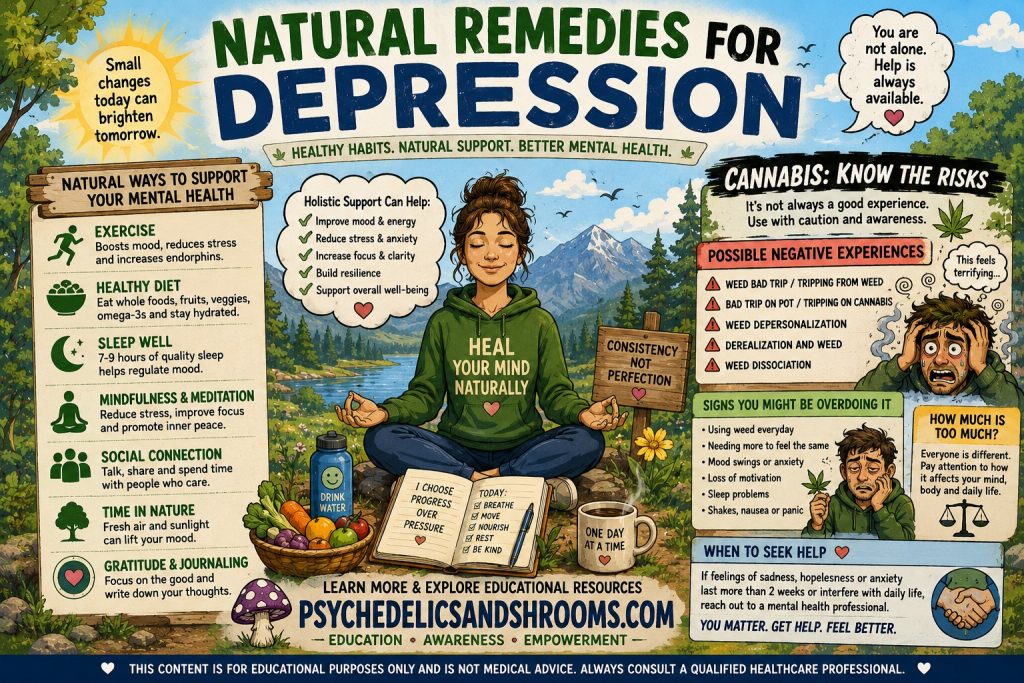
There are nevertheless evidence-supported lifestyle and behavioral approaches that can form part of depression care. Exercise, adequate sleep, social connection, stress management, and psychological therapies can all matter. For significant or persistent depression, these approaches may complement rather than replace professional assessment and established treatment.
Readers researching mental health and psychoactive substances can also explore educational material at psychedelicsandshrooms.com.
What Does “Natural Treatment for Depression” Actually Mean?
A natural treatment for depression can mean several different things.
Some people mean lifestyle interventions such as exercise, sleep, time outdoors, and social interaction. Others mean meditation, yoga, nutritional changes, or supplements. Still others use “natural” when discussing cannabis or psychedelic substances.
These categories should not be treated as equivalent.
A useful evidence-based approach asks three questions:
- Is there reliable research showing a meaningful effect?
- What are the potential risks?
- Is the intervention appropriate as an addition to standard treatment or as a replacement?
The third question is particularly important because severe depression can require professional treatment.
The U.S. National Institute of Mental Health notes that healthy habits such as regular exercise, adequate sleep, nutritious eating, social connection, and relaxation activities can support people experiencing milder symptoms, while persistent or worsening symptoms warrant professional attention.
Exercise Is One of the Best-Studied Natural Approaches
Physical activity has substantially stronger evidence than many products marketed as a natural anti depression solution.
A major 2024 systematic review and network meta-analysis examined 218 studies involving 14,170 participants. It found reductions in depressive symptoms associated with activities including walking or jogging, yoga, strength training, and mixed aerobic exercise, although certainty varied between interventions.
More recent systematic-review evidence also supports exercise as a useful complementary intervention for depressive symptoms.
This does not mean someone with severe depression should simply be told to exercise.
Depression itself can make physical activity difficult. Fatigue, reduced motivation, sleep problems, and loss of pleasure may create substantial barriers. Treatment needs to reflect the individual rather than treating exercise as a test of willpower.
Sleep and Depression Are Closely Connected
Sleep deserves a prominent place in discussions about natural depression relief.
Depression can cause insomnia, early waking, excessive sleep, or disrupted sleep patterns. Poor sleep can in turn make emotional regulation and daytime functioning more difficult.
Helpful general habits include maintaining reasonably consistent sleeping and waking times, reducing disruptive late-night routines, and creating a sleep environment conducive to rest.
For people with persistent insomnia, simply advising “get more sleep” may not be sufficient. Sleep disorders and depression can coexist and may require professional evaluation.
Nutrition: Important, but Not a Miracle Cure
Nutrition affects overall health, and dietary quality is worth discussing as part of holistic ways to treat depression.
A balanced eating pattern emphasizing vegetables, fruits, whole grains, legumes, appropriate protein sources, and other nutrient-dense foods can support general physical health.
What should be avoided is the claim that one particular food “cures depression.”
Depression is biologically and psychologically complex. Nutritional deficiencies can sometimes contribute to symptoms, but correcting a deficiency is different from claiming that a supplement universally treats major depressive disorder.
This distinction is especially important in online wellness content, where “natural” supplements are sometimes marketed with stronger claims than the underlying evidence supports.
Social Connection Can Be Part of Holistic Care
Depression frequently encourages withdrawal.
A person may stop seeing friends, participating in activities, exercising, or maintaining everyday routines. Unfortunately, increasing isolation can make recovery more difficult for some people.
Meaningful social connection can therefore form part of a holistic strategy.
That might involve family, trusted friends, community activities, volunteering, support groups, or structured therapy.
The goal isn’t constant socializing. It is maintaining supportive human connections instead of allowing depression to progressively narrow everyday life.
Mindfulness, Meditation and Stress Management
People searching how to treat depression holistically frequently encounter mindfulness and meditation.
These approaches can help some people manage stress, become more aware of thought patterns, and develop healthier responses to difficult emotions.
Relaxation techniques and breathing practices are also among the self-care activities NIMH identifies as potentially useful for mild symptoms.
However, mindfulness should not be advertised as a guaranteed cure for major depression.
It is better understood as one possible component of a broader mental-health strategy.
Psychotherapy Can Fit a Holistic Approach
“Holistic” does not have to mean rejecting conventional medicine.
Psychotherapy addresses psychological, behavioral, emotional, interpersonal, and environmental factors—exactly the kinds of interconnected issues that a genuinely holistic approach should consider.
Different evidence-based therapies may be appropriate depending on a person’s symptoms and circumstances.
Combining professional care with sleep, exercise, nutrition, relationships, and healthy routines is often a more scientifically grounded definition of holistic care than relying on a single supplement or alternative product.
What Is the Best Natural Remedy for Depression?
There is no universal best natural remedy for depression.
Among non-drug approaches, exercise has a particularly substantial research base. A 2024 umbrella review of 27 reviews covering 190 experiments found that exercise reduced depressive symptoms, although effects became smaller when analyses were restricted to studies with low risk of bias.
That is a useful example of how health evidence should be communicated.
The evidence supports exercise, but researchers still examine study quality, individual differences, intensity, adherence, and the role of exercise alongside other treatments.
A scientifically responsible article should not transform “evidence of benefit” into “guaranteed cure.”
How to Prevent Depression
People also search how to prevent depression, but prevention is not completely under an individual’s control.
Depression can involve genetic, biological, psychological, medical, environmental, and social factors.
Healthy routines may help support mental well-being and potentially reduce some risk factors. These include physical activity, adequate sleep, social relationships, stress management, limiting harmful substance use, and obtaining help when symptoms begin interfering with everyday life.
Prevention should never be framed as a guarantee.
Someone can maintain excellent health habits and still develop depression.
Cannabis Is Not a Simple Natural Antidepressant
The supporting searches weed everyday, how bad is weed for me, and how much weed is too much weed highlight an important issue.
Cannabis is sometimes discussed online as a “natural” solution for emotional distress. Natural origin, however, does not establish antidepressant effectiveness or guarantee psychological safety.
Cannabis experiences vary substantially according to THC exposure, individual sensitivity, frequency of use, product composition, and personal circumstances.
Using cannabis repeatedly to escape difficult emotions can also complicate the underlying question: is the substance actually improving long-term functioning, or temporarily changing how distress feels?
Anyone noticing worsening mood, anxiety, functioning, or increasing reliance on cannabis should take those changes seriously.
What Is a Weed Bad Trip?
A weed bad trip or bad trip on pot generally describes an intensely unpleasant cannabis experience.
High THC exposure can sometimes produce severe anxiety, panic, confusion, suspiciousness, altered time perception, or a frightening sense of losing control.
Although the expression “trip” is more traditionally associated with psychedelics, people searching tripping from weed or tripping on cannabis may be describing pronounced intoxication or perceptual and psychological effects.
Cannabis and classic psychedelics are pharmacologically different substances, so the terminology should not imply that their mechanisms are identical.
Weed Depersonalization and Derealization
Searches for weed depersonalization, derealization and weed, and weed dissociation often come from people trying to understand disturbing changes in their sense of reality.
Depersonalization generally refers to feeling detached from oneself.
Derealization generally describes surroundings feeling unreal, dreamlike, distant, or unfamiliar.
“Dissociation” is a broader term involving disruptions in normally integrated aspects of awareness, identity, memory, perception, or experience.
Cannabis can produce unusual perceptual and psychological experiences in some individuals, particularly during an adverse intoxication experience.
Persistent or severe symptoms should not simply be dismissed as a normal cannabis effect. Professional assessment can help determine what is happening and whether another condition is contributing.
What Are Weed Shakes?
Weed shakes is an informal expression people sometimes use for trembling or shaking experienced during or after cannabis use.
Several factors could potentially contribute, including anxiety, panic, intoxication, temperature perception, or another unrelated medical issue.
Because shaking is nonspecific, internet articles cannot reliably determine its cause for an individual.
Severe, persistent, or otherwise concerning physical symptoms warrant appropriate medical attention.
How Much Weed Is Too Much Weed?
There is no single universal threshold answering how much weed is too much weed for every person.
A more useful approach is to look for consequences.
Cannabis use deserves reconsideration when it begins interfering with school, employment, relationships, finances, sleep, motivation, memory, mental health, or responsibilities—or when a person repeatedly uses more than intended and struggles to reduce use.
Similarly, weed everyday should not automatically be interpreted as harmless merely because someone has developed tolerance to some effects.
Frequency is only one dimension. Potency, amount, psychological effects, impairment, and consequences also matter.
“Natural” Does Not Automatically Mean Safe
This principle extends beyond cannabis.
Plants can contain powerful pharmacologically active compounds. Mushrooms can be psychoactive, medicinal, edible, or poisonous. Supplements can interact with prescription medications.
Natural origin and clinical safety are therefore separate questions.
Readers exploring the relationship between psychoactive substances and mental health can find additional educational material through psychedelicsandshrooms.com and its broader psychedelic education resources.
Natural Approaches vs. Established Depression Treatment
A balanced approach does not require choosing between “natural” and “medical.”
| Approach | Evidence/role |
|---|---|
| Exercise | Meaningful evidence supports reducing depressive symptoms |
| Consistent sleep | Important for general mental and physical health |
| Balanced nutrition | Supports health; not a stand-alone depression cure |
| Social connection | Important component of emotional well-being |
| Mindfulness | May be useful as part of broader care |
| Psychotherapy | Established professional treatment option |
| Prescription treatment | Appropriate for some patients following clinical evaluation |
| Cannabis | Should not be presented as an established natural antidepressant |
| Supplements | Evidence and safety vary substantially by product |
The strongest approach is individualized and based on symptoms, severity, medical history, preferences, risks, and evidence.
When Natural Depression Relief Is Not Enough
Self-care has limits.
NIMH advises seeking professional help when significant symptoms persist or interfere with daily functioning. Symptoms such as persistent hopelessness, loss of interest, major changes in sleep or appetite, difficulty functioning, or thoughts of death or self-harm require more than a wellness-blog solution.
Depression is treatable, and asking for professional assessment does not prevent someone from also pursuing healthy lifestyle changes.
Frequently Asked Questions
What are the best natural remedies for depression?
Exercise, healthy sleep, social connection, balanced nutrition, and stress-management practices can support mental health. Exercise has particularly substantial evidence for reducing depressive symptoms, but no single natural intervention works universally.
Can depression be treated naturally?
Lifestyle interventions may help, especially with mild symptoms, but persistent or severe depression can require psychotherapy, medication, or other professional treatment. “Natural” and medical approaches do not have to be mutually exclusive.
What is a natural anti depression approach?
Rather than looking for a single natural antidepressant product, consider evidence-supported behaviors such as physical activity, adequate sleep, supportive relationships, and stress management alongside appropriate professional care.
Can cannabis naturally treat depression?
Cannabis should not be presented as an established treatment for depression. Experiences differ, and cannabis can produce unwanted psychological effects in some people.
Can weed cause derealization or depersonalization?
Some people report depersonalization, derealization, panic, or other disturbing experiences in association with cannabis. Persistent or severe symptoms warrant professional evaluation.
How can depression be prevented naturally?
Healthy sleep, exercise, social connection, stress management, and reducing harmful substance use can support mental health, but depression cannot always be prevented through lifestyle choices.
Further Reading
For evidence-based information about recognizing depression symptoms and deciding when professional care may be needed, see the National Institute of Mental Health mental-health guide. A large peer-reviewed review of exercise and depression involving 218 studies and 14,170 participants is available through PubMed, with additional recent evidence available in a 2026 systematic review of supervised physical exercise.
