mushroom and shrooms
Are Mushrooms Vegetables? Nutrition, Health Benefits, Fiber & What Science Says
Aug
Are Mushrooms Vegetables?
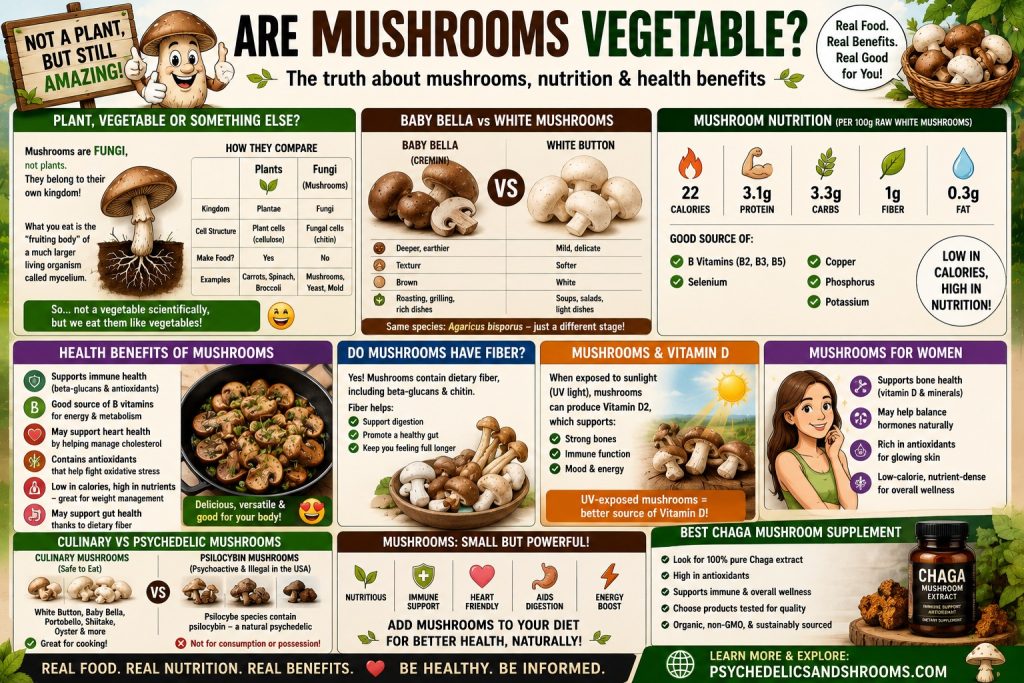
Are mushrooms vegetables? Botanically and biologically, no. Mushrooms are fungi, not plants, so they aren’t true vegetables in scientific classification.
In nutrition and cooking, however, mushrooms are commonly grouped with vegetables because they’re eaten in similar ways. You’ll find them beside vegetables in grocery stores, dietary guidance may include them in vegetable-style food groupings, and cooks use them in salads, soups, pasta, pizza, stir-fries, and countless other savory dishes.
This creates two correct answers depending on context:
Biology: Mushrooms belong to Kingdom Fungi and aren’t vegetables.
Nutrition and cooking: Mushrooms are commonly treated similarly to vegetables.
More importantly, edible mushrooms can be nutritious foods. Common varieties provide B vitamins, minerals, fiber, protein, and biologically interesting compounds while generally contributing relatively few calories.
For additional educational material about mushroom biology and the differences between culinary and psychoactive fungi, readers can explore psychedelicsandshrooms.com.
Are Mushrooms Veg?
The search are mushrooms veg often reflects confusion about the word “vegetable.”
“Vegetable” is primarily a culinary and nutritional category rather than a strict scientific classification. Foods called vegetables can come from several different plant structures, including roots, stems, leaves, flowers, and fruits.
Mushrooms are different because they aren’t plants at all.
Fungi don’t perform photosynthesis the way green plants do. Instead, they obtain nutrients from organic material or through ecological relationships with other organisms.
The mushroom we eat is usually the fruiting body of a fungus. Much of the organism can exist as mycelium, a network of microscopic fungal filaments growing through its substrate.
So although mushrooms can occupy the vegetable section of your dinner plate, biologically they’re members of an entirely separate kingdom.
Mushroom Nutrition: What Is Actually Inside a Mushroom?
Mushroom nutrition depends on the species, growing environment, preparation method, and serving size.
Common edible varieties include:
- white button;
- cremini or baby bella;
- portobello;
- shiitake;
- oyster;
- maitake; and
- enoki.
White button, cremini, and portobello mushrooms are particularly interesting because they’re all forms of the species Agaricus bisporus.
Raw white mushrooms contain about 22 calories per 100 grams, along with roughly 3 grams of protein, relatively little fat, carbohydrates, and several micronutrients. USDA-derived food-composition data also identify nutrients including riboflavin, niacin, pantothenic acid, potassium, copper, selenium, and phosphorus.
Exact values differ between mushroom varieties.
Nutritional Value of Mushrooms and Calories
People searching nutritional value of mushrooms calories are often interested in mushrooms for weight-conscious eating.
Most fresh culinary mushrooms have relatively low energy density because a large proportion of their weight is water.
A simplified example for approximately 100 grams of raw white mushrooms is:
| Nutritional component | Approximate amount |
|---|---|
| Calories | 22 kcal |
| Protein | 3.1 g |
| Carbohydrate | 3.3 g |
| Dietary fiber | 1 g |
| Fat | 0.3 g |
Values vary by species and database entry. Preparation can change them dramatically.
Mushrooms sautéed in substantial amounts of butter or oil, for example, can contain far more calories than the raw mushrooms themselves.
This is why nutritional comparisons should consider the entire recipe rather than the mushroom alone.
Are Mushrooms Good for You?
For most people who can safely eat them, mushrooms can form part of a healthy, varied diet.
That doesn’t mean mushrooms are a miracle food.
Their advantages come from an overall nutritional profile that combines low energy density with useful micronutrients and a range of fungal compounds that continue to receive scientific attention.
The healthiest interpretation of are mushrooms good for you is therefore not “mushrooms prevent every disease.”
It’s that edible mushrooms can contribute useful nutrients and dietary variety when incorporated into an appropriate overall eating pattern.
Are Mushrooms Healthy?
Yes, ordinary edible mushrooms can be considered a healthy food choice within a balanced diet.
The word “healthy,” however, depends partly on preparation.
Fresh mushrooms incorporated into a vegetable-rich meal are very different nutritionally from heavily breaded and deep-fried mushrooms or a cream-heavy mushroom sauce.
Individual considerations also matter. Allergies can occur, and wild mushrooms introduce an entirely different safety issue because poisonous species can be mistaken for edible fungi.
Edible does not mean every mushroom is edible.
Only properly identified food species should be consumed.
What Nutrients Are in Mushrooms?
The nutrients in mushrooms differ according to species, but commonly include several B vitamins and minerals.
Riboflavin
Riboflavin, or vitamin B2, helps the body process nutrients and supports normal cellular energy metabolism.
Niacin
Vitamin B3 contributes to numerous metabolic processes and normal cellular function.
Pantothenic Acid
Vitamin B5 is involved in energy metabolism and the synthesis of biologically important molecules.
Copper
Copper contributes to normal iron metabolism, connective tissues, nervous-system function, and antioxidant defense.
Selenium
Selenium is an essential trace element with roles in antioxidant enzymes and thyroid function.
Potassium
Potassium is an important electrolyte involved in nerve, muscle, and cardiovascular physiology.
Different mushrooms contain these nutrients in different proportions, so there isn’t one universal mushroom nutrition profile.
Do Mushrooms Have Fiber?
Yes. Mushrooms contain dietary fiber, although amounts vary by species and serving size.
Fungal cell walls are structurally different from plant cell walls and contain compounds such as chitin and beta-glucans.
This is another interesting example of why mushrooms shouldn’t simply be described as vegetables.
Their fungal biology gives them a distinct biochemical composition.
Fiber is associated with digestive health and can contribute to satiety, but mushrooms should be one of many fiber-containing foods in a balanced diet rather than someone’s only source.
Do Mushrooms Have Nutritional Value?
Absolutely.
The question do mushrooms have nutritional value may arise because mushrooms contain a great deal of water and relatively few calories.
Low calorie content doesn’t mean nutritionally empty.
Fresh mushrooms can provide protein in modest amounts, fiber, B vitamins, copper, selenium, potassium, and other nutrients.
Some mushrooms can also provide vitamin D when exposed to ultraviolet light because fungi can convert ergosterol into vitamin D2.
This feature has made UV-exposed mushrooms particularly interesting from a nutritional perspective. Research has examined mushrooms as a dietary source of vitamin D, while emphasizing that concentrations depend heavily on UV exposure and processing.
Benefits of Eating Mushrooms
The benefits of eating mushrooms begin with their practical nutritional characteristics.
They can increase dietary variety without adding many calories. Their savory flavor can also help make plant-forward dishes more satisfying.
Potential dietary advantages include:
Low energy density: Many fresh mushrooms contain relatively few calories.
Micronutrients: Different varieties provide B vitamins and minerals.
Fiber: Mushrooms contain fungal fibers, including beta-glucan-related compounds.
Flavor: Their umami characteristics can add substantial savory flavor.
Versatility: Mushrooms work in numerous dishes and eating patterns.
Potential vitamin D: UV-exposed mushrooms can contain meaningful vitamin D2.
These advantages are more defensible than exaggerated claims that mushrooms detoxify the body or cure disease.
Health Benefits of Mushrooms: What Does Research Show?
Research has examined mushrooms in relation to cardiovascular health, metabolic health, immune biology, cancer, cognitive health, and other outcomes.
However, much of this literature ranges from laboratory research to observational human studies. Those levels of evidence shouldn’t automatically be translated into treatment claims.
For example, a systematic review and meta-analysis examining mushroom consumption and cancer risk found an association between higher mushroom consumption and lower overall cancer risk in observational studies. The researchers also emphasized limitations inherent to the available evidence.
An association doesn’t prove that mushrooms themselves prevented cancer.
People who eat more mushrooms may differ in numerous other dietary and lifestyle characteristics.
This is why nutritional science needs careful language.
Mushroom Advantages for Health
The strongest mushroom advantages for health are often less sensational than internet headlines suggest.
Mushrooms can help diversify a diet, provide useful micronutrients, contribute fiber, and offer savory flavor without requiring large amounts of fat, sugar, or sodium.
They can also substitute for part of the meat in certain recipes.
This doesn’t make mushrooms nutritionally equivalent to meat—their protein amount and nutrient composition differ—but blending mushrooms into dishes can change the overall nutritional profile while maintaining savory characteristics.
Why Are Mushrooms Good for You?
If we reduce why are mushrooms good for you to the most evidence-supported points, the answer is straightforward.
They provide nutrients while generally being relatively low in calories. They contain fiber and distinctive fungal compounds. Some can provide vitamin D2 after UV exposure, and their strong savory flavor makes them useful in balanced meals.
Their value is therefore nutritional and culinary rather than miraculous.
No single mushroom needs to be labeled a “superfood” for mushrooms to be worth eating.
Mushroom Benefits Nutrition vs. Mushroom Supplements
Mushroom benefits nutrition should also be distinguished from mushroom-supplement marketing.
Eating shiitake, oyster, baby bella, or white button mushrooms as food isn’t the same as taking a concentrated extract sold as a supplement.
Supplements can differ in:
- species;
- fungal material used;
- extraction process;
- concentration;
- contaminants;
- active-compound levels; and
- quality testing.
Evidence concerning eating mushrooms cannot automatically prove claims made for a concentrated supplement.
Likewise, research on an isolated mushroom compound shouldn’t automatically be used to claim that an ordinary serving of mushrooms produces the same pharmacological effect.
Mushroom Benefits for Women
Searches for mushroom benefits for women frequently produce claims about hormones, fertility, menopause, weight loss, immunity, and skin health.
Most nutritional benefits of ordinary edible mushrooms aren’t exclusive to women.
Women can obtain the same basic nutrients—including B vitamins, minerals, fiber, and potentially vitamin D—from mushrooms as other adults.
Specific medical claims require stronger evidence.
For example, a mushroom shouldn’t be advertised as correcting hormonal problems or treating fertility conditions merely because it contains antioxidants or micronutrients.
Nutritional support and medical treatment are separate concepts.
Culinary Mushrooms vs. Psychedelic Mushrooms
Because “mushrooms” describes an enormous group of fungi, nutritional articles should distinguish culinary species from psychoactive ones.
White button, baby bella, portobello, shiitake, and oyster mushrooms are ordinary foods.
Certain Psilocybe species contain psilocybin, a serotonergic psychedelic compound.
Those fungi belong to a completely different pharmacological and legal discussion.
| Mushroom category | Example | Typical context |
|---|---|---|
| Culinary | White button | Food |
| Culinary | Baby bella | Food |
| Culinary | Portobello | Food |
| Culinary | Shiitake | Food |
| Culinary/supplement | Lion’s mane | Food and supplements |
| Psychedelic | Certain Psilocybe species | Psychoactive/research |
| Poisonous | Various wild species | Toxicology concern |
An important takeaway is that “natural mushroom” does not automatically mean “safe mushroom.”
Readers interested in mushroom classification and psychedelic science can find additional educational material at psychedelicsandshrooms.com.
Are Wild Mushrooms Healthy?
Some properly identified wild mushrooms are valued foods.
Others are poisonous.
A mushroom’s appearance, smell, whether animals eat it, or whether it resembles a supermarket variety does not establish safety.
Some dangerous mushrooms can cause severe gastrointestinal illness, neurological toxicity, liver injury, kidney damage, or death.
Wild mushrooms should therefore never be consumed solely because a photograph, app, or online post suggests a particular identification.
Identification safety is more important than potential nutritional benefits.
Mushrooms and a Balanced Diet
The most useful way to think about mushrooms is as one component of dietary diversity.
A balanced eating pattern can include mushrooms alongside vegetables, fruits, whole grains, legumes, protein foods, nuts, seeds, and other nutrient-rich foods according to individual dietary requirements.
Mushrooms don’t need to replace vegetables simply because cooks treat them similarly.
In fact, combining mushrooms with actual vegetables can increase flavor, texture, and variety.
Frequently Asked Questions
Are mushrooms vegetables or fungi?
Mushrooms are fungi, not vegetables, according to biological classification. They’re nevertheless commonly grouped with vegetables in cooking and nutrition.
Are mushrooms good for you?
Edible mushrooms can be a nutritious part of a balanced diet. They generally provide relatively few calories while contributing B vitamins, minerals, fiber, and other compounds.
Do mushrooms have fiber?
Yes. Mushrooms contain dietary fiber, including components of fungal cell walls such as chitin and beta-glucans.
What nutrients are in mushrooms?
Depending on the variety, mushrooms can provide riboflavin, niacin, pantothenic acid, copper, selenium, potassium, phosphorus, and other nutrients. UV-exposed mushrooms can also contain vitamin D2.
Are mushrooms healthy for women?
Mushrooms provide useful nutrients for women as part of a balanced diet, but claims that ordinary mushrooms specifically treat hormonal, reproductive, or other women’s health conditions require appropriate clinical evidence.
Are psychedelic mushrooms nutritionally the same as grocery-store mushrooms?
No. Culinary and psilocybin-containing mushrooms represent different species and contexts. Ordinary grocery mushrooms are foods, while psilocybin-containing fungi involve psychoactive effects and controlled-substance considerations.
Where to Explore Further
For more educational information about mushroom biology, nutrition, mushroom species, and the differences between culinary and psychoactive fungi, explore psychedelicsandshrooms.com.
For scientific literature, PubMed mushroom nutrition research provides access to peer-reviewed studies and reviews.
