mushroom and shrooms
Growable Mushrooms: Growing Kits, Supplies, Spawn & Home Mycology
Aug
What Are Growable Mushrooms?
Growable mushrooms are mushroom species that people can cultivate under managed conditions rather than obtaining them exclusively from the wild. In the United States, home mushroom growing has become increasingly visible through culinary gardening, mycology education, specialty agriculture, and ready-to-fruit mushroom kits.
For beginners, familiar legal edible species can include oyster, lion’s mane, shiitake, and some other gourmet mushrooms. Each species has its own environmental and substrate requirements, which is why a mushroom growing kit designed for one species isn’t necessarily suitable for another.
Mushrooms also aren’t plants. They’re fungi. Much of a fungus grows as microscopic filaments collectively called mycelium, while the structure we normally call a mushroom is generally its reproductive fruiting body.
This article focuses on ordinary culinary and gourmet mushroom cultivation. It does not provide instructions for cultivating controlled or illegal psychoactive mushrooms.
For additional educational reading about fungi, mushroom biology, and the distinctions between culinary and psychoactive species, explore psychedelicsandshrooms.com.
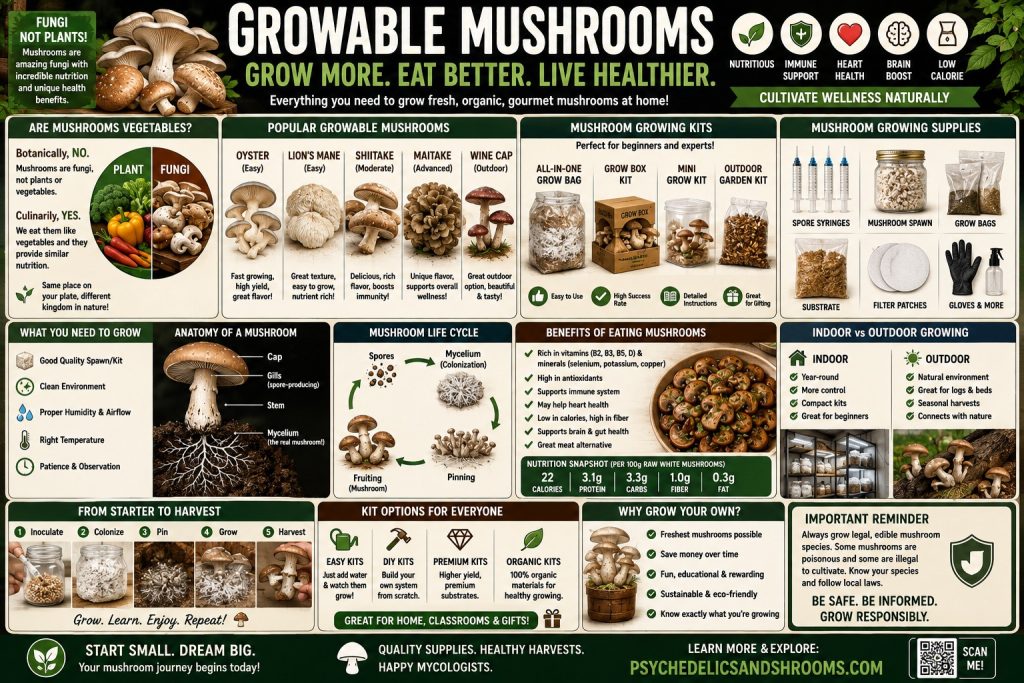
Popular Growable Mushrooms for Home Mycology
Not every mushroom is equally practical for home cultivation.
Several edible species have become particularly popular because commercial kits and established cultivation methods are widely available.
| Mushroom | Common home-growing format | Beginner suitability |
|---|---|---|
| Oyster mushroom | Ready-to-fruit block | High |
| Lion’s mane | Colonized block | High–moderate |
| Shiitake | Blocks or inoculated logs | Moderate |
| Wine cap | Outdoor wood-chip beds | Moderate |
| Button/cremini | Compost-based systems | Moderate |
| Maitake | Specialized blocks/log systems | More advanced |
Oyster mushrooms are frequently recommended as an introduction because several species grow relatively aggressively and commercial kits are widely available.
Lion’s mane has also become a recognizable home-growing option because of its distinctive white, tooth-like fruiting body.
What Is a Mushroom Growing Kit?
A mushroom growing kit is a packaged system containing some or most of the materials required to fruit a particular mushroom.
Beginner kits frequently contain an already-colonized growing block.
Instead of starting with spores, the purchaser receives fungal mycelium that has already colonized its substrate. The remaining process generally involves providing the environmental conditions specified by the manufacturer.
This distinction matters when comparing a mushroom starter with a complete kit.
Some products contain almost everything necessary for fruiting. Others contain only spawn, substrate components, containers, or laboratory supplies.
Before choosing a kit, determine exactly what stage of mushroom development you’re purchasing.
Best Mushroom Growing Kit: What Should You Look For?
There isn’t one universally best mushroom growing kit.
The best choice depends on experience, species, available space, climate, and how involved you want the process to be.
For a beginner, useful characteristics include:
Clearly identified species. The package should state exactly what mushroom it contains.
Already-colonized substrate. This removes several technical steps from the beginner experience.
Straightforward instructions. Environmental requirements should be clearly explained.
Fresh material. Living mycelium doesn’t have an unlimited shelf life.
Appropriate species. Oyster and lion’s mane kits are common beginner options.
Transparent company information. Avoid mystery products making unrealistic promises.
A beginner’s goal should generally be learning fungal biology successfully rather than buying the most complicated mushroom growing system available.
Mushroom Growing Supplies
The phrase mushroom growing supplies encompasses many different products.
Depending on the cultivation system, supplies can include substrate materials, spawn, containers, humidity-monitoring equipment, gloves, cleaning materials, bags, shelving, and other environmental equipment.
More advanced growers may use specialized laboratory or sterilization equipment.
The necessary supplies depend heavily on the species.
An outdoor wine-cap bed and an indoor oyster-mushroom block, for example, are fundamentally different growing systems.
Buying equipment before choosing a species can therefore result in unnecessary expense.
Mushroom Growing Materials
Mushroom growing materials can be divided into several categories.
Fungal Material
This can include spawn or already-colonized substrate for lawful culinary species.
Substrate
The substrate is the material on which the fungus grows and obtains nutrients.
Different edible fungi are associated with different substrates, including wood-derived materials, straw-based materials, compost, or other organic substrates.
Containers
Grow bags, blocks, trays, buckets, beds, and logs are used in different cultivation systems.
Environmental Equipment
Depending on scale, growers may monitor temperature, humidity, air exchange, and lighting.
Hygiene Equipment
Clean working practices become increasingly important when handling nutrient-rich materials because unwanted molds and bacteria can compete with the intended fungus.
What Is Mushroom Spawn?
Mushroom spawn is material colonized by living mushroom mycelium.
It can be thought of loosely as a way of establishing a desired fungus in a new growing substrate, although spawn isn’t botanically equivalent to plant seed.
Common commercial formats for edible mushrooms can include grain spawn, sawdust spawn, and plug spawn.
A mushroom spawn kit may contain colonized material intended for a particular cultivation project.
This is different from spores.
Spores are reproductive cells. Spawn already contains established mycelial growth.
Mushroom Spores vs. Mushroom Spawn
Understanding this distinction is fundamental to mycology.
| Feature | Spores | Spawn |
|—|—|
| Biological state | Reproductive cells | Colonized material containing mycelium |
| Individual visibility | Usually microscopic | Visible mycelial growth |
| Beginner cultivation | More technically involved | Often more practical |
| Common use | Microscopy, reproduction, culture work | Establishing edible mushroom cultivation |
| Genetic characteristics | Can introduce genetic variation | Represents established culture |
For ordinary culinary cultivation, beginners often find established spawn or colonized blocks substantially easier than beginning with spores.
What Is a Mycology Kit?
A mycology kit is a broad term.
Some kits are designed specifically for growing edible mushrooms. Others focus on microscopy, culture work, identification, laboratory techniques, or educational demonstrations.
The word mycology simply means the scientific study of fungi.
Therefore, consumers should check exactly what a mycology kit contains rather than assuming every product is a mushroom-growing system.
For more background on mushroom biology, readers can explore psychedelicsandshrooms.com.
What Is a Mushroom Grow Box?
A mushroom grow box or mushroom box usually refers to a compact cultivation package or enclosure.
The terminology isn’t standardized.
One manufacturer may call an already-colonized fruiting block a grow box, while another may use the term for an environmental chamber.
The important questions are:
What mushroom species does it contain?
Is the substrate already colonized?
Does it require additional materials?
What environmental conditions does the manufacturer specify?
Is the species lawful to cultivate where you live?
Those questions provide considerably more information than the phrase “grow box.”
Organic Mushroom Growing Kits
Organic mushroom growing kits are popular among consumers interested in organic food production.
However, “organic” has a regulatory meaning when used in certified agricultural contexts.
Consumers should distinguish between a product that merely uses organic-sounding marketing language and one whose applicable ingredients or production system actually meet recognized certification requirements.
Organic certification also doesn’t necessarily make a kit easier to use or produce larger mushrooms.
Species, genetics, substrate quality, environmental management, and freshness remain important.
Organic Mushroom Kits vs. Conventional Kits
For beginners, the practical differences may concern how the substrate ingredients were sourced rather than the basic fungal biology.
Mycelium still needs an appropriate nutritional environment.
The mushroom still needs suitable conditions to form fruiting bodies.
Contamination can still occur.
And the finished mushroom still needs appropriate food handling.
An organic mushroom kit therefore doesn’t eliminate the fundamentals of cultivation.
Outdoor Mushroom Growing Kits
Outdoor mushroom growing kits represent a different approach from countertop kits.
Certain edible species can be established in appropriate outdoor materials such as wood chips or logs.
Outdoor cultivation is more exposed to seasonal conditions, competing organisms, insects, rainfall, and temperature fluctuations.
That makes outdoor cultivation potentially slower and less predictable, but it can also provide a fascinating way to observe fungi as part of a garden ecosystem.
A mushroom garden kit should identify the species and the climate or substrate conditions for which it is intended.
Mushroom Garden Kit
A mushroom garden isn’t quite like a vegetable garden.
Plants rely heavily on photosynthesis. Fungi obtain nutrition from organic material and frequently participate in decomposition or ecological partnerships.
A garden intended for edible mushrooms therefore needs to accommodate the biology of the selected fungus.
Wood-associated species, compost-associated species, and fungi adapted to other substrates can’t simply be treated identically.
This is why choosing the mushroom comes before choosing the garden system.
Mushroom Mini Grow Kit
A mushroom mini grow kit can be particularly useful for educational projects because it requires relatively little space.
Compact kits are commonly marketed for kitchen counters, classrooms, and apartments.
Their advantages can include:
- limited space requirements;
- fewer materials;
- relatively simple setup;
- easy observation of mushroom development; and
- lower initial investment.
Their main limitation is scale.
A small block shouldn’t be expected to produce the same amount as a dedicated cultivation room or outdoor bed.
Easy Mushroom Grow Kit for Beginners
An easy mushroom grow kit generally minimizes the number of steps performed by the user.
For someone completely new to fungi, a ready-to-fruit legal gourmet mushroom block can provide a clearer introduction than immediately attempting laboratory culture work.
The beginner can observe important biological changes, including mycelium, primordia formation, fruiting-body development, and eventual maturation.
After understanding these stages, someone interested in mycology can explore more advanced legal cultivation techniques.
DIY Mushroom Kit vs. Ready-Made Kit
A DIY mushroom kit provides greater control but usually requires more knowledge.
A ready-made kit trades some control for convenience.
Beginners should consider what they actually want to learn.
If the goal is simply watching mushrooms grow, a colonized kit is often sufficient.
If the goal is understanding substrate preparation, fungal culture, environmental management, and contamination control, a more advanced legal edible-mushroom project may eventually be appropriate.
There’s no requirement to begin with the most technically demanding method.
Gourmet Mushroom Growing Kits
A gourmet mushroom growing kit generally focuses on edible specialty species.
Popular examples include oyster mushrooms, lion’s mane, shiitake, and sometimes maitake.
Gourmet mushrooms have attracted interest among home gardeners partly because specialty varieties can be expensive or difficult to find fresh in some supermarkets.
Home growing also provides an educational opportunity to see what a fungal organism looks like before it reaches the produce aisle.
Is There a Hydroponic Mushroom Kit?
The phrase hydroponic mushroom kit is somewhat misleading.
Hydroponics traditionally refers to growing plants without soil using nutrient solutions.
Mushrooms aren’t plants.
They generally require an organic substrate from which the fungus obtains nutrients rather than using a conventional plant hydroponic root system.
Some highly controlled mushroom systems may use water reservoirs, automated humidity systems, or equipment that visually resembles hydroponic gardening. That doesn’t make mushroom cultivation biologically identical to hydroponic plant production.
Mushroom Making Kits: A Better Term Is Growing Kit
People sometimes search for mushroom making kits.
“Mushroom growing kit” is more scientifically accurate.
The grower isn’t manufacturing a mushroom like a product. They’re providing conditions that allow a living fungus to develop and form fruiting bodies.
This distinction may sound minor, but it helps beginners understand mycology correctly.
Weed Mushroom Plant: Mushrooms Aren’t Weed or Plants
The phrase weed mushroom plant combines three biologically different concepts.
Cannabis is a flowering plant.
Mushrooms are fungi.
Psychoactive mushrooms are also fungi, not cannabis.
Some online discussions combine cannabis and psychedelic mushrooms because both are discussed within drug-policy and psychoactive-substance communities. That doesn’t make them biologically or pharmacologically related.
Similarly, ordinary oyster or shiitake cultivation has nothing to do with cannabis cultivation.
Mushroom Spore Grow Kits and Legal Considerations
A mushroom spore grow kit can mean different things depending on the species involved.
For legal culinary mushrooms, cultivation kits are ordinary gardening or food-production products.
The situation changes when a kit is associated with mushrooms that produce controlled substances.
In the United States, psilocybin and psilocin remain federally controlled substances. Laws and enforcement can also vary by jurisdiction and by what activity is occurring.
This article therefore focuses exclusively on cultivation of lawful culinary and gourmet mushrooms and doesn’t provide psychedelic mushroom cultivation procedures.
What About Midwest Spores?
Midwest Spores appears in searches related to spores and mushroom cultivation. When researching any commercial supplier, consumers should independently verify exactly what species and materials are being offered, applicable laws, product quality, and intended use.
For this educational guide, we don’t recommend or direct readers to vendors supplying materials for producing controlled psychoactive mushrooms.
For ordinary culinary cultivation, established gardening, agricultural, and gourmet-mushroom suppliers offer legal edible-mushroom options.
How to Choose a Mushroom Kit
When comparing options to buy a mushroom kit, focus on the biology rather than flashy packaging.
A practical checklist is:
- Identify the species. Know exactly what you’re growing.
- Choose an appropriate difficulty level. Beginners can start with oyster or lion’s mane kits.
- Check what is included. Some boxes require additional supplies.
- Check freshness and storage guidance. Mycelium is living material.
- Understand the growing environment. Indoor and outdoor kits aren’t interchangeable.
- Check seller transparency. Species and contents should be clearly identified.
- Consider food safety. Grow only properly identified edible species intended for consumption.
- Check applicable law. This is particularly important when products are associated with psychoactive fungi.
The “best” kit is one appropriate to the grower’s experience, environment, and lawful intended purpose.
Why Mushroom Cultivation Is Educational
Home cultivation of culinary fungi provides a practical introduction to ecology.
Mushrooms demonstrate decomposition, nutrient cycling, fungal reproduction, environmental responses, and the relationship between mycelium and fruiting bodies.
They also help correct the widespread misconception that fungi are simply unusual plants.
Mycology is its own scientific field, and home cultivation can serve as an accessible introduction.
For additional mushroom educational resources, visit psychedelicsandshrooms.com.
Frequently Asked Questions
1. What are the easiest growable mushrooms for beginners?
Oyster mushrooms are commonly considered beginner-friendly, particularly when purchased as an already-colonized fruiting block. Lion’s mane is another popular home-kit option.
2. What comes in a mushroom growing kit?
Contents vary. Beginner kits may contain an already-colonized substrate block and instructions, while more advanced kits can contain spawn, containers, substrate materials, or other mycology supplies.
3. What is mushroom spawn?
Mushroom spawn is material already colonized by fungal mycelium. It is commonly used to establish legal edible mushrooms in an appropriate growing substrate.
4. Are mushrooms grown hydroponically?
Not in the conventional plant-growing sense. Mushrooms are fungi and generally obtain nutrients from organic substrates rather than plant-style hydroponic nutrient solutions.
5. Are organic mushroom growing kits better?
Not necessarily. Organic sourcing may matter to some consumers, but cultivation success also depends on species, substrate quality, healthy mycelium, environmental conditions, and proper handling.
6. Can psychedelic mushrooms be grown from mushroom kits?
Some products online may be associated with psychoactive species, but psilocybin and psilocin remain federally controlled in the United States. This guide covers only lawful culinary and gourmet mushroom cultivation.
Educational Resources
For broader information on mushroom biology, species, mycology, and distinctions between edible and psychoactive fungi, explore psychedelicsandshrooms.com.
For peer-reviewed research, PubMed mushroom cultivation research provides scientific literature covering edible mushrooms and cultivation.
