
mushroom and shrooms
Alice Mushroom Chocolates: Nightcap, Brainstorm, Reviews, Ingredients & Safety
Aug
What Are Alice Mushroom Chocolates?
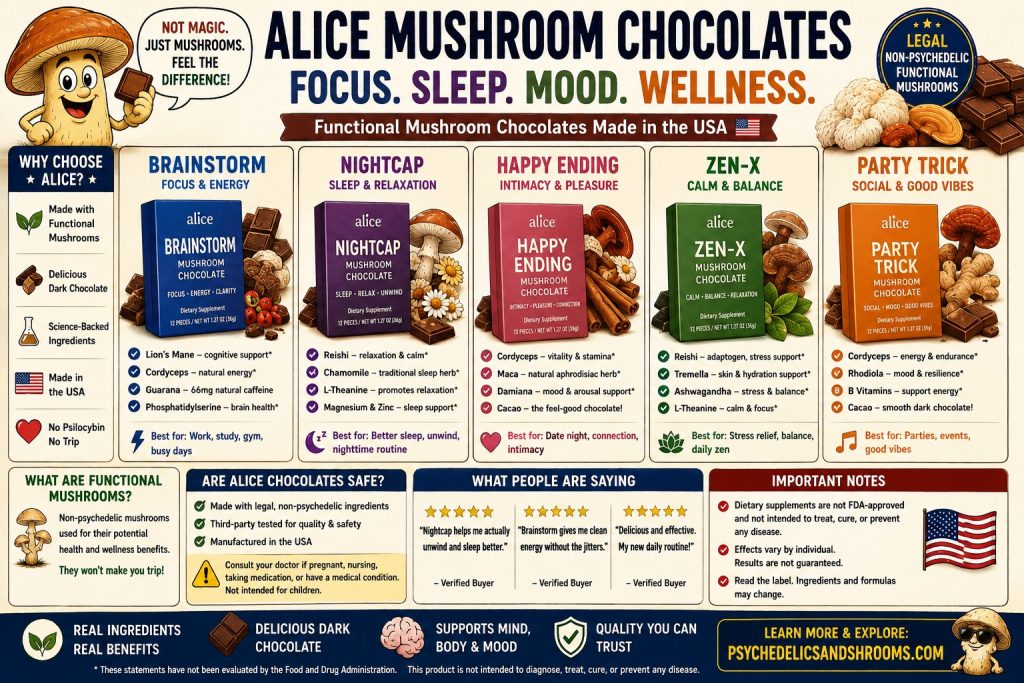
Alice mushroom chocolates are functional mushroom dietary-supplement chocolates marketed in the United States for purposes such as sleep support, focus, energy, relaxation, and other wellness goals.
The most important distinction for readers researching these products is straightforward:
Alice’s functional mushroom chocolates are not psychedelic mushroom chocolates.
According to Alice’s current help information, its products use legal functional mushrooms and do not contain psilocybin.
That places products such as Nightcap by Alice and Brainstorm by Alice in a very different category from chocolates containing psilocybin-producing mushrooms.
Alice combines dark chocolate with different mushroom extracts, botanicals, minerals, amino acids, caffeine-containing ingredients, and other compounds depending on the particular formula.
For additional educational reading about functional versus psychedelic mushrooms, visit psychedelicsandshrooms.com.
Alice Chocolates at a Glance
The formulas have different intended purposes rather than being different flavors of the same supplement.
| Alice product | Marketed purpose | Notable ingredients |
|---|---|---|
| Brainstorm | Focus & energy | Lion’s mane, cordyceps, guarana, phosphatidylserine |
| Nightcap | Sleep & relaxation | Reishi, chamomile, L-theanine, magnesium and zinc listed on current retail labeling |
| Happy Ending | Intimacy/pleasure | Cordyceps among its functional mushroom ingredients |
| Zen-X | Relaxation/stress support | Includes reishi and tremella |
| Party Trick | Social/night-out formula | Includes functional ingredients such as cordyceps |
The company says Brainstorm contains 66 mg of naturally occurring caffeine per square, whereas Nightcap and Happy Ending are caffeine-free.
Formulations can change, so consumers should prioritize the package’s current Supplement Facts and ingredient list over older reviews.
What Is Functional Mushroom Chocolate?
Functional mushroom chocolate combines conventional chocolate with extracts or powders from non-psychedelic mushroom species.
Common functional mushrooms include:
- lion’s mane (Hericium erinaceus);
- reishi (Ganoderma species);
- cordyceps-related fungal ingredients;
- tremella; and
- turkey tail.
“Functional” isn’t synonymous with psychedelic.
It generally refers to mushrooms consumed as foods or supplements for potential nutritional or wellness properties.
These products also shouldn’t automatically be considered medicines. A dietary supplement marketed for supporting sleep or focus is fundamentally different from an FDA-approved treatment for insomnia, ADHD, depression, or another medical disorder.
Do Alice Mushroom Chocolates Contain Psilocybin?
According to Alice’s current product information, no.
The company specifically states that its products contain functional mushrooms rather than psilocybin mushrooms.
This is particularly important because “mushroom chocolate” has become an extremely broad online category.
A consumer might encounter:
Culinary mushroom chocolate — food incorporating ordinary mushrooms.
Functional mushroom chocolate — products incorporating mushrooms such as lion’s mane or reishi.
Psychedelic mushroom chocolate — products represented as containing psilocybin-producing mushrooms.
These shouldn’t be treated as interchangeable.
Educational material explaining these distinctions can also be found through psychedelicsandshrooms.com.
Brainstorm by Alice
Brainstorm by Alice is the company’s focus-and-energy-oriented chocolate.
Current U.S. retail labeling lists a blend containing organic lion’s mane extract, organic cordyceps extract, guarana and phosphatidylserine. The chocolate base includes organic semi-sweet dark chocolate and other ingredients.
Lion’s Mane
Lion’s mane has attracted substantial scientific interest for compounds associated with nervous-system biology.
That doesn’t mean eating a lion’s mane chocolate has been proven to make everyone smarter or cure cognitive disorders.
Evidence should be separated into laboratory research, animal experiments, human clinical studies and product-specific clinical evidence.
Those are different standards.
Cordyceps
Cordyceps-related fungi have a long history in traditional practices and are now common in functional supplements.
They are frequently marketed around energy and exercise performance, although effects depend on preparation, population, dosage and study design.
Guarana and Caffeine
Guarana provides a much more immediately understandable reason someone might perceive Brainstorm as energizing: caffeine.
Alice currently states that one Brainstorm square contains 66 mg of natural caffeine from guarana.
Therefore, a consumer reviewing Brainstorm should not attribute every perceived energy or focus effect exclusively to mushrooms.
Caffeine itself can increase alertness.
It can also cause unwanted effects in susceptible people, including jitteriness, headache, difficulty sleeping or a rapid heartbeat.
This distinction becomes particularly important when reading enthusiastic Alice chocolates reviews.
Alice Focus and Energy Mushroom Chocolate
The phrase Alice focus and energy mushroom chocolate largely refers to Brainstorm.
It is tempting to describe the product simply as “mushrooms for focus,” but that misses an important part of its formulation.
Brainstorm combines:
Functional mushrooms + caffeine-containing guarana + phosphatidylserine + chocolate.
Consequently, a person’s experience is the result of the complete formulation rather than lion’s mane alone.
This is also why people who are caffeine-sensitive should pay particular attention to the label.
A recent Delish reviewer, for example, reported headaches after Brainstorm and specifically described herself as highly sensitive to caffeine. That is one individual’s experience, not proof that the product generally causes headaches, but it illustrates why tolerance matters.
Alice Sleep Chocolate: Understanding Nightcap
Alice Nightcap chocolate is positioned differently.
Instead of focus and daytime energy, Nightcap by Alice is marketed as a nighttime dietary supplement supporting sleep and relaxation.
Current retail labeling lists reishi extract, chamomile extract and L-theanine, while the Supplement Facts also list magnesium and zinc.
That makes Nightcap more than simply “reishi covered in chocolate.”
Reishi
Reishi mushrooms have a long history of traditional use and remain widely marketed in functional-mushroom supplements.
Claims surrounding reishi can become exaggerated online.
Research into individual reishi compounds or extracts doesn’t automatically demonstrate that a particular chocolate reliably treats insomnia.
Product-specific evidence matters.
L-Theanine
L-theanine is an amino acid particularly associated with tea.
It has been investigated for effects involving relaxation, stress and sleep, but consumers should still distinguish preliminary or ingredient-specific research from evidence that an entire commercial product treats a medical sleep disorder.
Chamomile
Chamomile is one of the most familiar herbal ingredients associated with nighttime routines.
It has also been scientifically investigated for sleep and anxiety-related outcomes.
Again, the existence of research doesn’t transform a chocolate supplement into an approved insomnia medication.
Magnesium and Zinc
Current Nightcap retail labeling lists magnesium and zinc quantities in its Supplement Facts.
Consumers should pay attention to the entire supplement regimen when using products containing minerals.
For example, taking several supplements simultaneously can unintentionally result in duplicated ingredients.
Mushroom Chocolates for Sleep
The broader category of mushroom chocolates for sleep deserves some skepticism.
A chocolate isn’t automatically sleep-promoting because it contains reishi.
A better evaluation considers:
- the mushroom species;
- extract composition;
- additional active ingredients;
- quantities shown on the label;
- evidence behind individual ingredients;
- evidence for the finished formulation; and
- individual health circumstances.
Sleep is also affected by caffeine, alcohol, medications, stress, light exposure, sleep schedules and numerous health conditions.
Supplements are only one part of that picture.
Does Alice Nightcap Chocolate Actually Work?
This question can’t be answered universally.
Some published reviewers report positive experiences.
Bon Appétit’s testers reported feelings of relaxation and tiredness after Nightcap while explicitly acknowledging that placebo effects could have contributed.
A 2026 Delish reviewer also reported a favorable personal experience with Nightcap.
Those reports are useful for understanding consumer experience.
They are not equivalent to randomized, placebo-controlled clinical evidence demonstrating that Nightcap treats insomnia.
That distinction is essential when evaluating supplement reviews.
Alice Sleep Aid vs. Medical Sleep Treatment
People searching for Alice sleep aid, Alice sleep, or Alice sleeping may be experiencing anything from occasional difficulty winding down to chronic insomnia.
Those situations shouldn’t automatically receive the same response.
Persistent insomnia can have multiple causes, including medical conditions, medications, sleep disorders, substance use, anxiety, depression, circadian disruption and environmental factors.
A dietary supplement should not delay appropriate medical evaluation when sleep problems are persistent or severe.
Alice Happy Ending Mushroom Chocolates
Alice Happy Ending chocolates are marketed around intimacy, pleasure and arousal rather than sleep or concentration.
Bon Appétit reported that Happy Ending was introduced as a product designed around pleasure and arousal and described its cinnamon-forward flavor.
Alice’s current help information identifies cordyceps as one of the mushrooms used in Happy Ending.
Searches such as Alice Happy Ending mushroom chocolates review should nevertheless be interpreted carefully.
Sexual desire is affected by numerous factors, including relationships, psychological state, hormones, medications, cardiovascular health, stress, sleep and general health.
Testimonials claiming dramatic aphrodisiac effects don’t establish clinical efficacy.
The product also shouldn’t be confused with FDA-approved medications used for specific sexual-health conditions.
Are Alice Mushroom Chocolates Safe?
For most supplements, “safe” isn’t a simple yes-or-no characteristic.
The more useful question is:
Safe for whom, at what amount, alongside what medications and under what circumstances?
Alice’s current information says its primary chocolates use functional mushrooms rather than psilocybin. It also identifies important considerations involving caffeine and allergens.
Potential considerations include the following.
Caffeine Sensitivity
Brainstorm currently contains 66 mg caffeine per square according to Alice.
People who already consume coffee, tea, energy drinks, pre-workout supplements or caffeine-containing medications need to consider their total daily intake.
Allergies
Alice states that its chocolates are processed on shared equipment and may contain peanuts, tree nuts, milk, eggs or soy. People with significant allergies should therefore examine current packaging carefully.
Medication and Supplement Interactions
Functional mushrooms, herbal extracts, minerals and other supplement ingredients can be relevant to medications or medical conditions.
Someone taking prescription medications should discuss supplement use with an appropriate healthcare professional when interactions are a concern.
Pregnancy and Breastfeeding
Pregnancy isn’t an appropriate situation for assuming that a multi-ingredient supplement is safe simply because its ingredients are marketed as “natural.”
Medical guidance is appropriate.
Children
Current U.S. retail listings for Brainstorm and Nightcap designate them for adults.
Chocolate and Pets
Chocolate should also be stored away from dogs and other pets for which chocolate can be toxic.
“Natural” Doesn’t Automatically Mean Risk-Free
This principle applies far beyond Alice supplements.
Mushrooms, herbs, minerals and botanical compounds can be biologically active.
Natural substances can produce side effects, interact with medications or be inappropriate for particular individuals.
“Functional” should therefore not be interpreted as “guaranteed safe for everybody.”
Alice Mushrooms Reviews: How Should You Read Them?
Alice Mushrooms reviews are useful—but only for certain questions.
Consumer reviews can tell you about:
- flavor;
- texture;
- packaging;
- convenience;
- subjective feelings;
- perceived energy;
- perceived relaxation; and
- whether someone would personally use the product again.
They cannot reliably establish whether a supplement prevents or treats disease.
Bon Appétit’s testers described Brainstorm and Nightcap positively overall. A more recent Delish test produced a mixed experience: the reviewer liked Nightcap but reported headaches with Brainstorm.
That contrast is useful.
Different people can experience exactly the same supplement differently.
Alice Chocolates Review: Evidence vs. Experience
A good review should separate four levels of information:
| Evidence | What it tells us |
|---|---|
| Manufacturer claims | What the product is intended/marketed to support |
| Ingredient research | What scientists have studied about individual ingredients |
| Product clinical trials | Evidence about the finished formulation |
| Consumer reviews | Individual subjective experiences |
Problems arise when the fourth category is presented as though it were the third.
“I slept better after eating it” is a legitimate personal observation.
“This chocolate clinically treats insomnia” is a substantially stronger medical claim requiring substantially stronger evidence.
Are Functional Mushrooms Psychedelic?
No.
This misconception has become increasingly important as mushroom foods and supplements become mainstream.
Lion’s mane, reishi and cordyceps aren’t psilocybin mushrooms.
They don’t become psychedelic simply because they’re incorporated into chocolate.
Similarly, a product using mushroom imagery shouldn’t automatically be assumed to contain psilocybin.
Consumers should read the ingredient label rather than making assumptions from packaging.
For additional explanations of functional, culinary and psychedelic mushroom categories, explore psychedelicsandshrooms.com.
Brainstorm vs. Nightcap by Alice
The two products serve almost opposite purposes.
Brainstorm is a daytime focus-and-energy formula containing lion’s mane, cordyceps, guarana and phosphatidylserine. Its caffeine content is especially important for understanding its immediate effects.
Nightcap is a nighttime formula centered around reishi, chamomile and L-theanine, with magnesium and zinc appearing on current retail Supplement Facts.
Someone researching Alice shouldn’t therefore ask only, “Do mushroom chocolates work?”
A better question is:
Which formula, which ingredients, which claimed outcome, and what quality of evidence supports it?
That’s a much more scientifically meaningful way to evaluate functional foods.
Frequently Asked Questions
1. Are Alice mushroom chocolates psychedelic?
According to Alice’s current information, no. The company says its chocolates use legal functional mushrooms and don’t contain psilocybin.
2. What is Alice Nightcap chocolate?
Nightcap is a nighttime functional chocolate marketed for sleep and relaxation support. Current labeling includes reishi, chamomile, L-theanine, magnesium and zinc.
3. What is Brainstorm by Alice?
Brainstorm is Alice’s focus-and-energy formulation. Current labeling lists lion’s mane, cordyceps, guarana and phosphatidylserine. Alice states that a square contains 66 mg of natural caffeine.
4. Are Alice mushroom chocolates safe?
They contain non-psychedelic functional mushrooms according to the manufacturer, but individual safety depends on factors including allergies, caffeine sensitivity, medications, health conditions and other supplements. “Functional” doesn’t mean universally risk-free.
5. Do Alice mushroom chocolates really help with sleep?
Some reviewers report better relaxation or sleep after using Nightcap, but personal testimonials aren’t proof that the product treats insomnia. People with persistent sleep problems should consider appropriate medical evaluation.
6. Does Alice Brainstorm contain caffeine?
Yes. Alice currently states that Brainstorm contains 66 mg of natural caffeine per square, sourced from guarana.
Educational Resources
For broader educational material about mushrooms, functional fungi, psychedelics and the differences between wellness supplements and psychoactive mushroom products, explore psychedelicsandshrooms.com.
Current mainstream retail information also confirms that Brainstorm and Nightcap are sold as dietary-supplement chocolates in the United States rather than psilocybin products.
When evaluating functional mushroom research, readers can also use PubMed to search peer-reviewed literature on lion’s mane, reishi, cordyceps, L-theanine and other ingredients rather than relying solely on product testimonials.
