
mushroom and shrooms
Molly Drug: MDMA Effects, Side Effects, Comedown, Addiction & Safety
Aug
What Is the Molly Drug?
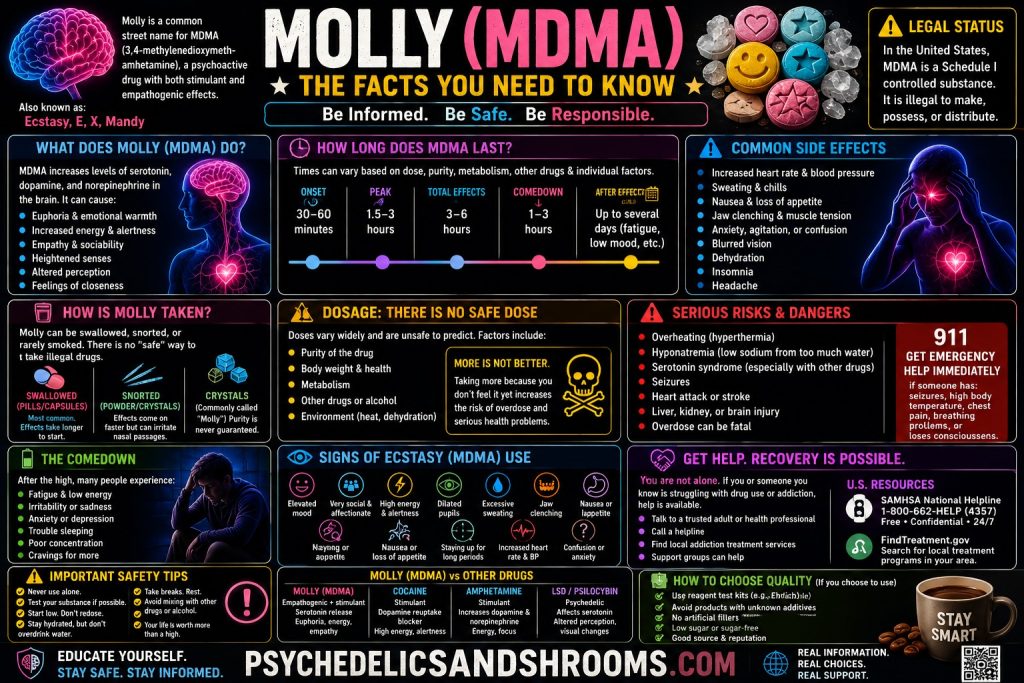
The molly drug is a common street name associated with MDMA (3,4-methylenedioxymethamphetamine), a psychoactive substance with both stimulant and perception-altering properties.
Other names include ecstasy and, particularly in the United Kingdom, Mandy. However, these street names don’t guarantee chemical identity or purity. A powder, crystal, capsule, or tablet sold as Molly or ecstasy may contain MDMA, another substance, a mixture, or potentially no MDMA at all.
In the United States, MDMA is federally classified as a Schedule I controlled substance.
MDMA has also been investigated scientifically in tightly controlled psychotherapy research. That clinical research shouldn’t be confused with unregulated recreational products.
For broader educational material about psychoactive substances, readers can explore psychedelicsandshrooms.com.
Molly, MDMA, Ecstasy and Mandy: Are They the Same?
The terms overlap, but they’re not reliable chemical descriptions.
| Term | Typical meaning | Important limitation |
|---|---|---|
| MDMA | Specific chemical compound | Laboratory identity can be established |
| Molly | Street term commonly referring to MDMA | Purity and contents aren’t guaranteed |
| Ecstasy | Often tablets marketed as MDMA | Tablets may contain additional substances |
| Mandy | Slang for MDMA in some regions | Same uncertainty as other street names |
This distinction is important because unexpected ingredients can dramatically alter toxicity.
How Does MDMA Affect the Brain?
MDMA affects several neurotransmitter systems, particularly:
- serotonin;
- norepinephrine; and
- dopamine.
Its strong effects on serotonin are associated with changes in mood, sociability, emotional processing, sensory experience, and feelings of interpersonal closeness.
Norepinephrine contributes to cardiovascular and stimulant effects, including increased heart rate and blood pressure.
These effects also explain why MDMA isn’t harmless simply because some users describe the experience positively.
What Does Molly Feel Like?
Reported effects can include:
- elevated mood;
- increased sociability;
- emotional openness;
- increased energy;
- altered sensory perception;
- feelings of closeness to other people; and
- increased responsiveness to music or touch.
Unwanted effects can occur simultaneously.
These may include anxiety, confusion, jaw clenching, nausea, sweating, rapid heartbeat, overheating, or panic.
The experience is particularly unpredictable when the substance’s actual identity is unknown.
MDMA Side Effects
Commonly reported MDMA side effects can include:
- increased heart rate;
- elevated blood pressure;
- sweating;
- nausea;
- reduced appetite;
- jaw clenching;
- muscle tension;
- restlessness;
- blurred vision;
- chills;
- headache;
- anxiety; and
- difficulty sleeping.
More serious complications are possible.
Serious MDMA Complications
Potential emergencies include:
Hyperthermia: Dangerous elevation of body temperature.
Hyponatremia: Dangerously low blood sodium, sometimes associated with excessive water consumption and MDMA-related physiological effects.
Cardiovascular complications: MDMA can increase cardiovascular stress.
Seizures: Severe toxicity can produce seizures.
Serotonin toxicity: Risk may increase when serotonergic substances are combined.
Liver or kidney injury: Severe toxicity can affect major organs.
Altered consciousness: Confusion, agitation, collapse, or unconsciousness require urgent attention.
These complications can become life-threatening.
How Long Does MDMA Last?
There isn’t one exact duration applicable to everyone.
The timing of MDMA effects varies with:
- the actual substance consumed;
- individual metabolism;
- other substances present;
- medications;
- health status; and
- other biological factors.
Acute psychoactive effects generally occur over a period of hours, while sleep disturbance, fatigue, mood changes, or other after-effects can persist beyond the main intoxication period.
This means “How long does a Molly high last?” and “How long until someone feels completely normal?” aren’t necessarily the same question.
How Long Does MDMA Take to Kick In?
Questions about how quickly ecstasy or MDMA “kicks in” are often attempts to plan recreational consumption.
There is substantial variation, and providing timing instructions can encourage additional consumption when someone believes a drug hasn’t worked yet. That can increase poisoning risk—particularly because a substance sold as Molly may contain something unexpected.
A delayed subjective effect should never be treated as proof that taking more is safe.
How to Take Molly or MDMA
Searches such as how to take Molly, how to take MDMA, how to take crystal Molly, best way to ingest Molly, and how much Molly to take are common.
There isn’t a risk-free recreational method of taking illicit MDMA, and this guide won’t provide administration techniques or dosing instructions.
A major reason is that illicit products have uncertain:
- identity;
- concentration;
- purity;
- contaminants; and
- interactions.
Giving a numerical “safe dose” for an unidentified street product would create a false level of certainty.
MDMA Dosage
There is no recreational MDMA dosage that can be guaranteed safe.
Body size alone doesn’t resolve the problem because toxicity can also depend on:
- individual susceptibility;
- product composition;
- environmental conditions;
- medications;
- underlying health conditions; and
- use of other substances.
Clinical research uses known pharmaceutical material under controlled protocols with medical screening and supervision. Those conditions aren’t transferable to an unknown street product.
Why Molly Purity Is a Major Safety Issue
“Molly” has sometimes been marketed as though the term implies pure MDMA.
It doesn’t.
Illicit products can contain unexpected stimulants, synthetic cathinones, or other substances.
Appearance isn’t enough to identify a drug chemically.
A white crystal isn’t proof of MDMA.
A recognizable tablet logo isn’t proof.
And two visually identical tablets can contain different chemicals or concentrations.
Ecstasy Symptoms and Signs of Use
Possible ecstasy symptoms during intoxication include:
- unusually elevated energy;
- increased sociability;
- dilated pupils;
- sweating;
- jaw clenching;
- restlessness;
- rapid heartbeat;
- changes in perception;
- reduced appetite; and
- difficulty sleeping.
These aren’t diagnostic.
Several other drugs and medical conditions can produce similar signs.
The MDMA Comedown
A comedown on MDMA refers to the period after the main psychoactive effects diminish.
Some people report:
- fatigue;
- low mood;
- irritability;
- anxiety;
- difficulty concentrating;
- reduced motivation;
- disturbed sleep;
- appetite changes; and
- feeling emotionally depleted.
Experiences vary substantially.
A difficult comedown doesn’t necessarily mean someone has developed an addiction, but repeated or severe after-effects deserve attention.
Why Does an MDMA Comedown Happen?
Several mechanisms may contribute.
MDMA substantially alters neurotransmitter signaling during acute intoxication. Sleep deprivation, prolonged physical activity, inadequate nutrition, environmental stress, dehydration, other substances, and the unknown composition of illicit products can also influence how someone feels afterward.
The popular explanation that MDMA simply “uses up all your serotonin” is an oversimplification of much more complicated neurobiology.
Coming Down From Molly
Someone experiencing an uncomplicated post-MDMA period generally benefits from ordinary supportive measures such as a calm environment, normal food and fluid intake, sleep, and avoiding further substance use.
However, symptoms shouldn’t automatically be dismissed as a “comedown.”
Severe confusion, extreme agitation, very high temperature, seizures, chest pain, breathing difficulty, collapse, or significantly impaired consciousness require emergency medical attention.
MDMA and Overheating
Hyperthermia is one of MDMA’s most important acute dangers.
Risk can become particularly concerning in hot, crowded environments involving prolonged physical activity.
Severe overheating can contribute to:
- muscle breakdown;
- kidney injury;
- liver injury;
- abnormal blood clotting; and
- cardiovascular collapse.
Someone who becomes extremely hot, confused, or severely ill after suspected MDMA exposure needs urgent medical assessment.
Water Can Also Become Dangerous
MDMA discussions sometimes emphasize dehydration so heavily that another risk gets overlooked: drinking excessive amounts of water.
Too much water can dangerously lower sodium concentration in the blood.
Severe hyponatremia can cause:
- headache;
- vomiting;
- confusion;
- seizures;
- brain swelling; and
- death.
“Drink as much water as possible” is therefore unsafe advice.
MDMA and Serotonin Toxicity
Because MDMA strongly affects serotonin signaling, interactions with other serotonergic substances are medically important.
Serotonin toxicity can involve symptoms such as:
- agitation;
- confusion;
- sweating;
- elevated temperature;
- rapid heart rate;
- muscle rigidity;
- tremor; and
- abnormal reflexes.
Severe cases are medical emergencies.
People taking prescription medications shouldn’t discontinue or modify them to accommodate recreational drug use. Medication decisions should be made with an appropriate healthcare professional.
MDMA and Alcohol
Combining psychoactive substances increases unpredictability.
Alcohol can impair judgment and contribute to dehydration and other physiological stress.
Using multiple substances also makes it more difficult to determine what’s causing symptoms during an emergency.
A person experiencing serious symptoms should tell medical professionals what substances may have been involved whenever possible.
MDMA and Other Stimulants
Combining MDMA with other stimulants can increase physiological stress.
Potential concerns include increased:
- heart rate;
- blood pressure;
- body temperature;
- agitation; and
- cardiovascular demand.
Unknown street products can make this particularly problematic because a person may unknowingly consume multiple stimulant-type substances.
Can You Become Addicted to Molly?
MDMA can produce patterns of repeated use and problematic substance-related behavior.
Researchers distinguish physical dependence, tolerance, and substance use disorder rather than treating every repeated exposure as identical.
Warning signs of a developing problem can include:
- increasing time spent obtaining or using drugs;
- repeated unsuccessful attempts to stop;
- continued use despite consequences;
- neglecting responsibilities;
- using despite mental or physical problems;
- needing increasing amounts to achieve desired effects; or
- organizing social life primarily around drug use.
Professional assessment can help determine the appropriate level of support.
How Can You Get Help for Drug Addiction?
Effective help doesn’t require waiting until a substance problem becomes catastrophic.
Treatment can involve:
- medical assessment;
- behavioral therapies;
- counseling;
- mental-health treatment;
- peer-support programs;
- outpatient care;
- intensive outpatient programs;
- residential treatment; or
- treatment for co-occurring psychiatric conditions.
The appropriate approach depends on the individual and substances involved.
In the United States, SAMHSA’s FindTreatment.gov provides a national treatment locator.
Drug Rehab and Addiction Treatment
The phrase drug rehab covers several different levels of treatment.
| Treatment setting | General purpose |
|---|---|
| Outpatient | Treatment while living at home |
| Intensive outpatient | More structured recurring care |
| Residential | Live-in treatment environment |
| Medical care | Manages health complications and withdrawal when relevant |
| Behavioral therapy | Addresses patterns, triggers and coping |
| Dual-diagnosis care | Treats substance use alongside mental-health disorders |
| Recovery support | Helps maintain longer-term recovery |
Quality treatment should be individualized rather than based solely on a facility’s marketing.
MDMA Research vs. Recreational Molly
Scientific interest in MDMA has generated confusion about its legal and medical status.
Researchers have studied MDMA-assisted psychotherapy, particularly in relation to post-traumatic stress disorder.
But controlled clinical research involves:
- pharmaceutical-quality material;
- known quantities;
- screened participants;
- structured psychological support;
- defined protocols; and
- medical monitoring.
Those conditions are fundamentally different from taking an unknown substance sold as Molly.
The existence of clinical research therefore doesn’t establish recreational MDMA as safe or therapeutic.
Molly vs. Psilocybin Mushrooms
MDMA and psilocybin are pharmacologically different.
| Feature | MDMA | Psilocybin |
|---|---|---|
| Drug class | Entactogen/stimulant-like psychoactive | Classic psychedelic |
| Major signaling | Strong serotonin release plus other monoamines | Primarily serotonin 5-HT2A receptor agonism via psilocin |
| Street term | Molly/ecstasy | Shrooms/magic mushrooms |
| Main research areas | PTSD and psychotherapy | Depression, addiction and other psychiatric research |
| Federally controlled in U.S. | Yes | Yes |
Neither should be considered safe merely because clinical researchers are studying potential therapeutic applications.
For broader comparisons of psychoactive substances and psychedelic research, explore psychedelicsandshrooms.com.
When Is MDMA Exposure an Emergency?
Call 911 or seek emergency medical attention when someone develops symptoms such as:
- seizure;
- collapse;
- severe confusion;
- loss of consciousness;
- dangerously elevated body temperature;
- severe agitation;
- chest pain;
- serious breathing difficulty; or
- rapidly worsening symptoms.
In the United States, poison-exposure guidance is also available through America’s Poison Centers at 1-800-222-1222.
Don’t allow fear of embarrassment to delay emergency treatment.
Frequently Asked Questions
1. Is Molly the same as MDMA?
Molly is a street term intended to refer to MDMA, but a substance sold as Molly isn’t guaranteed to contain pure MDMA—or MDMA at all.
2. How long do MDMA effects last?
The main psychoactive effects generally occur over several hours, while fatigue, mood changes, or sleep disruption can continue afterward. Timing varies substantially with the substance, individual, and circumstances.
3. What are common MDMA side effects?
Possible effects include sweating, increased heart rate, elevated blood pressure, nausea, jaw clenching, anxiety, restlessness, sleep problems, and headache. Severe toxicity can involve hyperthermia, seizures, hyponatremia, organ injury, or altered consciousness.
4. What is the safest way to take Molly?
There is no risk-free method for consuming an unidentified illicit product. This guide therefore doesn’t provide dosing or administration instructions.
5. What does an MDMA comedown feel like?
People may experience fatigue, low mood, irritability, anxiety, difficulty concentrating, appetite changes, or disturbed sleep after the main effects subside.
6. Where can someone get help for MDMA or drug addiction?
A healthcare professional or addiction specialist can assess treatment needs. In the United States, SAMHSA’s FindTreatment.gov provides a searchable directory of treatment services.
Educational Resources
For educational reading about MDMA, psychedelics, psychoactive substances, addiction, and harm-related research, explore psychedelicsandshrooms.com.
For U.S. treatment resources, visit SAMHSA FindTreatment.gov. Scientific research can be explored through PubMed MDMA research.
