mushroom and shrooms
Liberty Cap Mushroom: Psilocybe semilanceata, Lookalikes, Identification & Safety
Sep
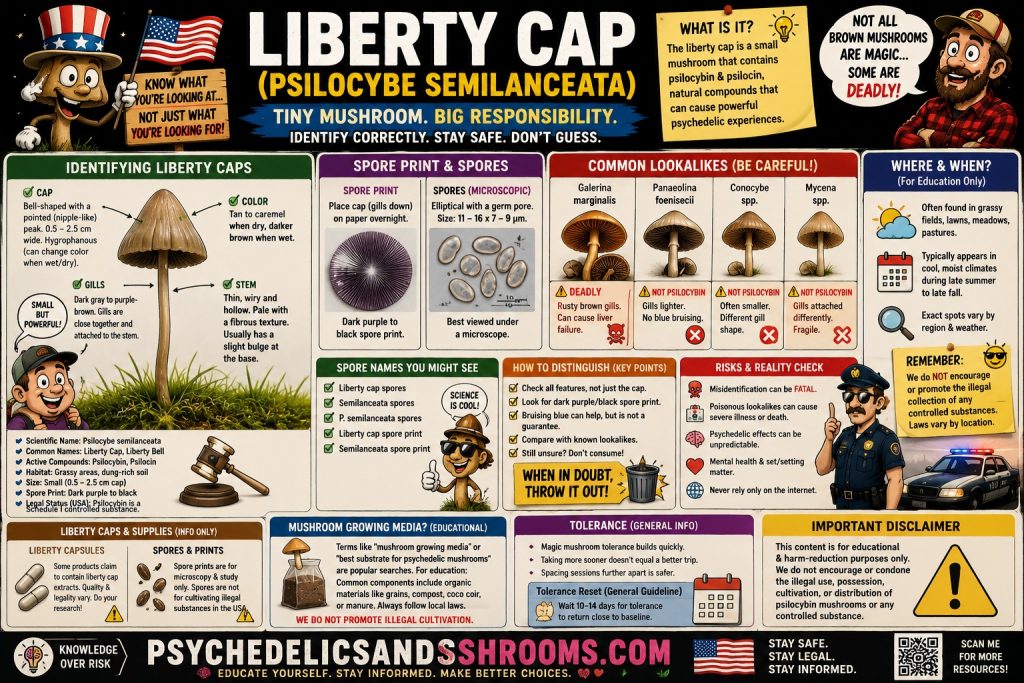
What Is a Liberty Cap?
The liberty cap, scientifically known as Psilocybe semilanceata, is a small mushroom species known for containing the psychoactive compounds psilocybin and psilocin.
It belongs to the genus Psilocybe, which contains numerous mushroom species associated with psilocybin.
The common name “liberty cap” refers partly to the mushroom’s characteristically shaped cap, which has historically been compared with the Phrygian or liberty cap used as a symbol of freedom.
Other names encountered online include:
- liberty mushroom caps;
- liberty bell mushrooms;
- Psilocybe semilanceata;
- P. semilanceata; and
- semilanceata.
Despite the memorable name, a mushroom shouldn’t be identified as P. semilanceata simply because its cap appears pointed.
Many unrelated small brown mushrooms can superficially resemble one another.
For broader educational information about fungi and psychedelic research, readers can explore psychedelicsandshrooms.com.
Psilocybe semilanceata and Psilocybin
Psilocybe semilanceata is a psilocybin-containing mushroom.
Psilocybin is converted in the human body into psilocin, a psychoactive compound that interacts strongly with serotonin receptors, particularly the 5-HT2A receptor.
This activity can produce changes in:
- perception;
- thought;
- mood;
- sensory processing;
- time perception; and
- sense of self.
The presence of psilocybin is also why liberty caps have significant legal implications.
Under U.S. federal law, psilocybin and psilocin remain Schedule I controlled substances.
What Does Psilocybe semilanceata Look Like?
Descriptions of Psilocybe semilanceata commonly mention a relatively small mushroom with a distinctive cap morphology.
However, written descriptions and photographs shouldn’t be used as stand-alone instructions for deciding whether a wild mushroom is safe or psychoactive.
Mycologists identify mushrooms using combinations of characteristics rather than a single feature.
These can include:
| Feature examined | Why mycologists examine it |
|---|---|
| Cap | Shape, surface and developmental changes |
| Gills | Attachment, spacing and maturation |
| Stem | Structure and other morphological features |
| Spore deposit | Helps narrow taxonomic possibilities |
| Microscopy | Reveals spores and other microscopic structures |
| Ecology | Helps establish whether an identification is biologically plausible |
| Geographic record | Determines whether a species is known from an area |
| Molecular analysis | Can resolve difficult identifications |
Even several matching characteristics don’t automatically make a mushroom safe to consume.
Why “Liberty Cap ID” Is Harder Than It Looks
Internet searches for liberty cap ID frequently produce photographs showing small mushrooms alongside arrows pointing to supposedly distinctive features.
This can create dangerous overconfidence.
Wild mushroom identification isn’t equivalent to recognizing a familiar consumer product.
Small brown mushrooms are particularly challenging because many species share broadly similar appearances.
Professional identification may incorporate:
- macroscopic morphology;
- microscopy;
- ecological context;
- taxonomic literature; and
- sometimes DNA sequencing.
A casual photograph often doesn’t capture enough information.
Liberty Cap Lookalikes
Liberty cap lookalikes are one of the most important safety issues associated with this topic.
Numerous small grassland or woodland mushrooms can appear superficially similar to someone without substantial mycological experience.
Possible confusion can involve mushrooms from genera such as:
- Panaeolus;
- Conocybe;
- Mycena;
- Galerina; and
- other small brown mushroom groups.
These genera aren’t chemically or toxicologically equivalent.
Some mushrooms in certain genera can be poisonous.
Therefore, recognizing something as a “small brown mushroom with a pointed cap” isn’t sufficient identification.
A particularly important warning about Galerina
Some Galerina species contain amatoxins, the same general toxin class responsible for many deadly mushroom poisonings.
That doesn’t mean every Galerina resembles a liberty cap or contains amatoxins. It illustrates why casual identification of small brown mushrooms can have serious consequences.
A mistake involving a psychoactive mushroom isn’t necessarily just a disappointing psychedelic experience.
It can become a poisoning emergency.
How to Identify Magic Mushrooms Safely
Searches such as how to identify magic mushrooms, how to recognise magic mushrooms, and how to identify psychedelic mushrooms often imply that a simple visual checklist exists.
It doesn’t.
There is no universal characteristic that identifies every psilocybin-containing mushroom.
For example:
Color isn’t enough.
Psychoactive mushrooms don’t share one universal cap color.
Cap shape isn’t enough.
Pointed or bell-shaped caps occur across unrelated fungi.
Bruising isn’t enough.
Color changes can occur for multiple biological and chemical reasons.
Habitat isn’t enough.
Different species can occupy overlapping environments.
A photograph isn’t enough.
Important structures may be absent or obscured.
An identification app isn’t enough.
Computer-vision systems can make mistakes, and the consequence of a mushroom-ID error can be severe.
No single “magic mushroom test” reliably determines edibility, psychoactivity, and species identity in the field.
Can Blue Bruising Identify Psilocybin Mushrooms?
Blue or blue-green bruising is frequently discussed in relation to certain psilocybin-containing mushrooms.
But it shouldn’t be treated as a universal safety test.
Not every psilocybin mushroom necessarily produces an obvious reaction under every condition, and visual discoloration isn’t enough to establish species identity.
The dangerous shortcut is:
“It turned blue, therefore it must be a safe magic mushroom.”
That conclusion isn’t scientifically justified.
Identification requires the whole organism and appropriate taxonomic evidence.
Liberty Cap Spore Print
The terms liberty cap spore print and semilanceata spore print refer to examination of spores released from the mushroom’s reproductive surface.
Spore-deposit characteristics are useful in mycology because spore coloration can help narrow the range of possible taxa.
However, a spore print isn’t a fingerprint.
Different mushroom species can produce deposits that appear similar to an inexperienced observer.
Professional taxonomy can additionally examine microscopic characteristics such as:
- spore dimensions;
- spore shape;
- germ-pore characteristics;
- cystidia; and
- other microscopic structures.
Consequently, matching an online photograph of a spore deposit doesn’t prove that a specimen is Psilocybe semilanceata.
Liberty Cap Spores and Semilanceata Spores
Liberty cap spores, semilanceata spores, and P. semilanceata spores are microscopic reproductive structures produced by the fungus.
Spores are important scientifically because they contribute to fungal reproduction and provide taxonomic information.
Researchers may examine spores microscopically to distinguish closely related organisms.
However, spores shouldn’t be confused with the mature psychoactive mushroom.
Questions concerning possession or cultivation also require attention to jurisdiction-specific law. U.S. federal and state rules aren’t necessarily identical, and laws can change.
Liberty Capsules: What Does the Term Mean?
The keyword liberty capsules can be ambiguous.
Sometimes it appears in searches related to liberty cap mushrooms, while in other contexts it can refer to unrelated commercial products or supplements.
A capsule marketed using mushroom terminology shouldn’t automatically be assumed to contain Psilocybe semilanceata, psilocybin, or any particular mushroom species.
Packaging isn’t chemical verification.
Unregulated products may contain ingredients different from what consumers expect.
Where and When to Find Magic Mushrooms
People frequently search where and when to find magic mushrooms while researching liberty caps.
From a biological perspective, fungal fruiting is influenced by environmental variables such as:
- climate;
- moisture;
- temperature;
- substrate;
- vegetation;
- geography; and
- seasonal ecological conditions.
Those relationships are legitimate subjects of fungal ecology.
However, providing precise locations, seasonal harvesting windows, or a step-by-step field-search strategy for finding a controlled-drug-producing mushroom would move beyond general education into practical procurement guidance.
A safer way to study the same biology is through herbarium records, university fungal collections, taxonomic databases, and legal culinary-mushroom field studies.
Why Mushroom Photos Aren’t Enough
“Mushroom identification pictures” are useful educational tools, but they have serious limitations.
A photograph may fail to show:
- the complete stem;
- the base;
- true colors under natural light;
- gill attachment;
- microscopic characteristics;
- texture;
- developmental stage; or
- the specimen’s ecological context.
Camera processing can also alter color.
Two mushrooms can look remarkably similar in photographs while being taxonomically unrelated.
Never consume a wild mushroom because an image search says it “looks right.”
Psilocybe semilanceata vs. Ordinary Edible Mushrooms
Liberty caps aren’t simply another culinary mushroom.
| Characteristic | Liberty cap | Common culinary mushrooms |
|---|---|---|
| Scientific name | Psilocybe semilanceata | Varies by species |
| Psilocybin | Present | Normally absent |
| Primary interest | Psychoactive/mycological research | Food |
| U.S. legal considerations | Significant | Generally ordinary food |
| Wild-ID risk | Potentially serious | Also potentially serious when wild-foraged |
| Safe to identify from photo alone? | No | No |
Even edible wild mushrooms require accurate identification because poisonous lookalikes exist.
Are Liberty Caps Poisonous?
The terminology can become confusing.
Liberty caps contain psychoactive compounds and can produce intoxication. Psilocybin isn’t generally discussed in toxicology in the same way as lethal amatoxin mushroom poisoning.
Nevertheless, psilocybin mushrooms aren’t harmless.
Potential adverse effects include:
- nausea;
- vomiting;
- anxiety;
- panic;
- confusion;
- impaired judgment;
- increased heart rate;
- changes in blood pressure;
- frightening perceptual experiences; and
- dangerous behavior.
An unidentified mushroom adds the possibility of completely different toxins.
The Greater Danger: Misidentification
When someone believes they consumed liberty caps but becomes severely ill, it is unsafe to assume the problem is simply “too much psilocybin.”
The specimen may have been incorrectly identified.
Dangerous mushroom toxins can affect:
- the liver;
- kidneys;
- nervous system;
- gastrointestinal tract; and
- other organs.
Some mushroom poisonings also have delayed symptoms.
That delay can falsely reassure someone who initially feels well.
What to Do After Eating an Unknown Mushroom
If someone has eaten an unidentified wild mushroom, don’t rely on internet photographs to determine whether treatment is necessary.
In the United States, contact America’s Poison Centers at 1-800-222-1222 for poison-exposure guidance.
Call 911 for severe symptoms such as:
- unconsciousness;
- seizure;
- serious breathing problems;
- collapse;
- severe confusion;
- extreme agitation; or
- rapidly worsening illness.
If possible, preserve:
- remaining mushroom specimens;
- uncooked samples;
- photographs;
- packaging; and
- information about when the exposure occurred.
These materials can help poison specialists and mycologists investigate the exposure.
Don’t induce vomiting unless instructed by an appropriate medical professional or poison specialist.
Liberty Caps and U.S. Law
Psilocybin and psilocin remain federally controlled substances in the United States.
The legal landscape surrounding psychedelics has nevertheless become complicated because some state and local jurisdictions have adopted policies concerning possession, enforcement, regulated programs, or psychedelic services.
Local reform doesn’t automatically eliminate federal restrictions.
Anyone researching the legal status should check current official government sources rather than relying on social-media posts or outdated articles.
Liberty Caps vs. Psilocybin Research
The growing scientific interest in psilocybin has also changed how people discuss mushrooms such as Psilocybe semilanceata.
Researchers have investigated psilocybin in controlled settings for areas including:
- depressive disorders;
- psychological distress;
- substance-use disorders; and
- other psychiatric research questions.
Clinical research, however, doesn’t involve casually identifying and consuming wild liberty caps.
Research typically uses characterized substances, screened participants, controlled protocols, professional supervision, and structured follow-up.
Those conditions are fundamentally different from wild mushroom use.
Scientific literature about psilocybin can be explored through PubMed.
Liberty Cap Identification Myths
Several common internet claims deserve correction.
“A nipple-shaped cap proves it’s a liberty cap.”
False. Cap shape alone isn’t species identification.
“Blue bruising proves it’s psychedelic.”
False. Bruising isn’t a universal identification test.
“If mushrooms grow together, they’re all the same species.”
False. Multiple fungal species can fruit close together.
“An app can tell whether it’s safe.”
No identification app should be treated as sufficient evidence for consuming a wild mushroom.
“A matching spore print confirms liberty caps.”
No. Spore-deposit color is one taxonomic characteristic among many.
“If someone online confirms my photo, it’s safe.”
Not necessarily. Photograph-based identification has substantial limitations, particularly when ingestion is being considered.
Frequently Asked Questions
1. What is a liberty cap mushroom?
The liberty cap is Psilocybe semilanceata, a small mushroom species known to contain the psychoactive compounds psilocybin and psilocin.
2. Are liberty caps the same as all magic mushrooms?
No. “Magic mushrooms” is a broad informal term covering multiple psilocybin-containing species. P. semilanceata is only one species.
3. Can you identify liberty caps from their pointed caps?
No. A pointed or bell-shaped cap isn’t sufficient for species identification, and unrelated mushrooms can look superficially similar.
4. What are liberty cap lookalikes?
Various small mushrooms can be confused with liberty caps by inexperienced observers. Some potentially dangerous fungi occur among broadly similar small brown mushroom groups, making casual identification risky.
5. Does a liberty cap spore print prove the mushroom’s identity?
No. Spore characteristics can contribute to professional identification, but spore-deposit color alone doesn’t establish species identity or safety.
6. Where can I learn more about Psilocybe semilanceata safely?
Mycology textbooks, herbarium collections, scientific publications, fungal databases, and educational resources at psychedelicsandshrooms.com can provide biological information without relying on risky self-identification.
Educational Resources
For further educational exploration of mushrooms, psilocybin, psychedelic research, and mushroom safety, visit psychedelicsandshrooms.com.
Scientific literature concerning psilocybin and Psilocybe can be explored through PubMed. For suspected mushroom poisoning in the United States, America’s Poison Centers provides poison-exposure guidance.
The safest principle for wild mushrooms remains straightforward: if species identification is uncertain, don’t consume the specimen.
