mushroom and shrooms
Jack Frost Mushroom: Effects, Jedi Mushrooms, Yeti & Johns Hopkins Psilocybin Research
Sep
What Is a Jack Frost Mushroom?
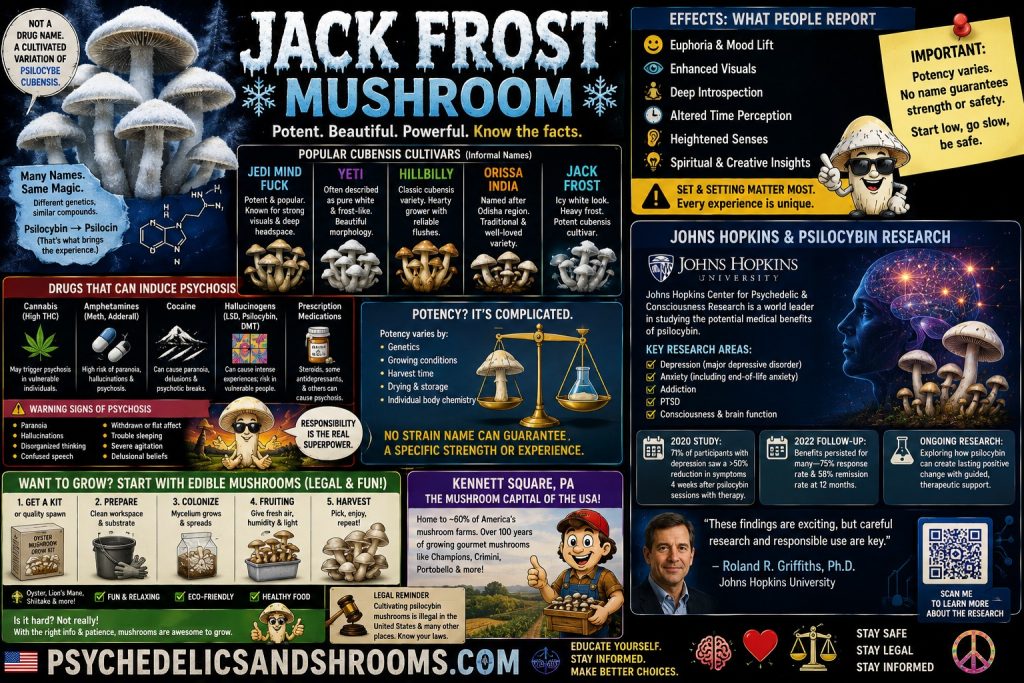
The Jack Frost mushroom is a name that psychedelic-mushroom communities use for certain cultivated mushrooms marketed or described as belonging to Psilocybe cubensis.
However, the name doesn’t represent a formal botanical rank. Online psychedelic-mushroom communities also use terms such as strain, variety, cultivar, and isolate loosely, even when those terms don’t correspond to formally recognized taxonomic categories.
This distinction matters because names such as:
- Jack Frost;
- Jedi Mind Fuck;
- Yeti;
- Hillbilly; and
- Orissa
may sound like pharmaceutical formulations with predictable chemistry.
They aren’t.
An informal mushroom name doesn’t establish chemical concentration, purity, identity, or expected psychological effects.
For broader educational information about mushrooms and psychedelic science, visit psychedelicsandshrooms.com.
Jack Frost Mushroom vs. Psilocybe cubensis
Scientists recognize Psilocybe cubensis as a species.
By contrast, “Jack Frost” functions as an informal cultivated label that people generally associate with that species.
Therefore, the hierarchy looks like this:
| Name | What it represents |
|---|---|
| Psilocybe cubensis | Scientific species |
| Jack Frost | Informal cultivated name |
| Jedi Mind Fuck | Informal cultivated name |
| Yeti | Informal cultivated name |
| Hillbilly | Informal cultivated name |
| Orissa | Informal cultivated/geographic-style name |
Scientific findings about P. cubensis shouldn’t automatically become highly specific claims about every informally named mushroom sold under one of these labels.
Why Is It Called Jack Frost?
The name generally refers to the pale or whitish appearance that people associate with mushrooms marketed under this label.
Online photographs often display pale fruiting bodies and other distinctive visual characteristics.
Nevertheless, photographs don’t provide chemical analysis.
Appearance alone cannot establish:
- psilocybin concentration;
- psilocin concentration;
- exact genetics;
- authenticity of the label; or
- how someone will respond after exposure.
This limitation becomes especially important when people encounter unregulated mushroom products.
Jack Frost Mushroom Effects
Searches for Jack Frost mushroom effects often return highly specific claims about euphoria, visuals, introspection, creativity, or emotional experiences.
However, readers should evaluate those claims cautiously.
If a specimen genuinely contains psilocybin, then psilocybin and psilocin primarily produce its effects—not the marketing name “Jack Frost.”
Reported psilocybin effects may include:
- altered visual perception;
- changes in time perception;
- intensified emotions;
- unusual thought patterns;
- altered sensory processing;
- feelings of connectedness;
- introspection; and
- changes in the sense of self.
At the same time, unwanted effects may include:
- anxiety;
- panic;
- confusion;
- nausea;
- increased heart rate;
- changes in blood pressure;
- impaired judgment; and
- frightening perceptual experiences.
Because of this variability, an informal mushroom name cannot reliably predict a particular experience.
Are Jack Frost Mushrooms Strong?
People often claim that “Jack Frost is extremely potent,” but such statements require chemical evidence.
Unlike standardized tablets, psilocybin-containing mushrooms can vary considerably.
Several factors may affect their composition, including:
- genetics;
- specimen;
- developmental stage;
- storage;
- processing;
- degradation; and
- analytical methodology.
Consequently, two dried mushroom products with identical labels may not contain identical concentrations.
Anecdotal reports cannot replace laboratory measurements.
What Are Jedi Mushrooms?
The phrases Jedi mushrooms, Jedi Mind Fuck, Jedi Mind Fuck mushroom, and Jedi Mind Fuck shrooms usually describe another informal name associated with cultivated Psilocybe cubensis.
Although the provocative name has become prominent online, it doesn’t identify a distinct, scientifically established psychedelic drug.
Instead, people generally use it as a community or commercial naming convention.
The primary psychedelic compounds of scientific interest remain psilocybin and psilocin.
Jedi Mind Fuck Mushroom Effects
Online accounts often assign specific personalities to named mushrooms.
For instance, people may describe one mushroom as:
- highly visual;
- philosophical;
- energetic;
- euphoric; or
- introspective.
Although these descriptions can sound persuasive, controlled comparative clinical trials don’t necessarily support them.
Moreover, expectations can influence subjective psychedelic experiences.
Therefore, someone who expects dramatic “Jedi Mind Fuck effects” after reading trip reports may interpret the experience through those expectations.
Jedi Mind Fuck Potency
The keyword Jedi Mind Fuck potency highlights another common problem in psychedelic-mushroom information.
Potency represents a chemical measurement question.
To answer it reliably, researchers need appropriate laboratory analysis rather than reputation or anecdote.
A mushroom’s name doesn’t provide a dependable measurement of its psilocybin content.
The same principle applies to:
- Jack Frost;
- Yeti;
- Hillbilly;
- Orissa; and
- other named P. cubensis selections.
Accordingly, readers should question claims that one variety is exactly “X times stronger” than another unless appropriate analytical data supports them.
What Are Yeti Mushrooms?
Yeti mushroom is another informal name that appears in Psilocybe cubensis cultivation communities.
Like Jack Frost, the name often relates to distinctive pale morphology.
Still, people shouldn’t confuse appearance with chemical standardization.
A white mushroom isn’t automatically:
- Yeti;
- Jack Frost;
- psychoactive;
- Psilocybe cubensis; or
- safe.
This distinction matters even more with wild mushrooms because misidentification can cause serious poisoning.
What Is an Orissa Mushroom?
People generally use Orissa mushroom and similar names for P. cubensis material that naming traditions associate with the Indian region historically called Orissa, now officially Odisha.
Mushroom communities commonly use geographic-style names.
However, a geographic label doesn’t guarantee a specimen’s origin or chemical characteristics.
Without traceable genetic and analytical information, readers shouldn’t treat an online name like a regulated designation of origin.
Hillbilly Mushroom Effects
“Hillbilly” represents another informal name associated with P. cubensis.
Search results may claim characteristic Hillbilly mushroom effects, but the same evidence problem remains.
Scientists have much stronger evidence about psilocybin’s general pharmacology than about reproducible psychological differences among every internet-named P. cubensis selection.
Furthermore, individual experiences can vary substantially.
Comparing Popular Mushroom Names
| Informal name | Common association | Scientifically standardized potency? | Effects reliably unique to name? |
|---|---|---|---|
| Jack Frost | P. cubensis | No | Not established |
| Jedi Mind Fuck | P. cubensis | No | Not established |
| Yeti | P. cubensis | No | Not established |
| Hillbilly | P. cubensis | No | Not established |
| Orissa | P. cubensis | No | Not established |
This comparison doesn’t prove that the mushrooms are genetically identical.
Instead, it shows that many online effect and potency rankings express more confidence than the available scientific evidence supports.
How Does Psilocybin Affect the Brain?
The body converts psilocybin into psilocin.
Psilocin interacts with serotonin receptors, and the 5-HT2A receptor plays a particularly important role in classic psychedelic effects.
Researchers examine how this signaling relates to:
- altered perception;
- changes in large-scale brain-network activity;
- emotional processing;
- cognitive flexibility;
- changes in self-referential processing; and
- psychedelic subjective experiences.
These mechanisms remain active areas of neuroscience research.
Jack Frost Mushroom Cultivation
Jack Frost mushroom cultivation represents another common search topic.
At a high level, fungi develop through biological processes involving spores or fungal cultures, mycelial growth, nutrient acquisition, and—under suitable environmental conditions—the formation of fruiting bodies.
That overview describes ordinary fungal biology.
However, detailed instructions for cultivating psilocybin-producing mushrooms could facilitate production of a controlled substance. Therefore, this article doesn’t provide substrate recipes, inoculation procedures, environmental parameters, timelines, yield optimization, or step-by-step Jack Frost cultivation instructions.
People who want to study mushroom cultivation can explore the same fundamental fungal biology with legal culinary species such as:
- oyster mushrooms;
- lion’s mane;
- shiitake; and
- button mushrooms.
Commercial edible-mushroom kits also provide an accessible option for beginners.
Is Jack Frost a Culinary Mushroom?
No. Jack Frost isn’t an ordinary culinary mushroom variety like shiitake, oyster, portobello, or lion’s mane.
Instead, people associate its name with psilocybin-containing P. cubensis.
This distinction also separates it from many functional or culinary mushroom supplements.
Consumers shouldn’t assume that every product using the word “mushroom” shares the same legal status, pharmacology, or safety profile.
Johns Hopkins Psychedelic Research
The Johns Hopkins Center for Psychedelic and Consciousness Research ranks among the most important institutions in modern psychedelic science.
Johns Hopkins launched the dedicated center in 2019 after receiving $17 million in private funding. Since then, its researchers have investigated psychedelic effects on brain function, behavior, mood, learning, memory, and potential therapeutic applications.
This work differs substantially from online discussions that compare Jack Frost with Jedi Mind Fuck or Yeti mushrooms.
Rather than ranking informally named mushroom “strains,” researchers generally study carefully characterized psilocybin under controlled protocols.
Johns Hopkins Psilocybin Study and Depression
A widely discussed 2020 Johns Hopkins study examined adults with major depressive disorder.
Twenty-four participants completed two psilocybin sessions with clinical monitors and supportive psychotherapy. After four weeks, 71% showed a greater than 50% reduction in depression scores, while 54% met the study’s criterion for remission.
Although these findings appeared promising, the study involved a small, controlled sample.
They don’t mean that eating Jack Frost, Jedi Mind Fuck, or another mushroom product represents an established treatment for depression.
The distinction between clinical psilocybin research and self-treatment with mushrooms remains essential.
What Happened in the Longer Follow-Up?
Johns Hopkins researchers later followed participants from that depression study.
In their 2022 report, improvements persisted for many participants during follow-up. At 12 months, 75% met the study’s response criterion, and 58% met its remission criterion. Researchers also emphasized that participants received psilocybin under carefully controlled conditions with supportive psychotherapy.
These findings therefore concern a specific clinical protocol.
They don’t establish equivalent benefits from unregulated mushroom use.
Johns Hopkins Psilocybin Research in 2026
The field continues to evolve.
Johns Hopkins currently describes its Center for Psychedelic and Consciousness Research as investigating potential therapeutic uses and the effects of psychedelics on the brain and mind.
In April 2026, Johns Hopkins also highlighted a consensus statement that called for rigorous scientific standards as researchers consider how psilocybin therapy might eventually enter clinical practice.
At the same time, Johns Hopkins explicitly notes that the FDA hasn’t approved psilocybin to treat mental disorders, despite ongoing research into depression, PTSD, substance-use disorders, and other conditions.
Johns Hopkins Mushroom Study vs. Taking Mushrooms
The difference can be summarized clearly:
| Clinical research | Unregulated mushroom use |
|---|---|
| Screened participants | Screening may be absent |
| Defined protocol | Uncontrolled conditions |
| Characterized intervention | Potency may be unknown |
| Trained monitors | Professional monitoring may be absent |
| Psychological preparation | Variable |
| Follow-up | Often absent |
| Adverse-event monitoring | Often absent |
For this reason, people shouldn’t convert scientific headlines about psilocybin into DIY treatment recommendations.
Johns Hopkins and Real-World Psilocybin Use
Researchers have also examined people who use psilocybin outside clinical laboratories.
Johns Hopkins reported on a prospective survey of naturalistic psilocybin use. The study observed average improvements across several measures, while a minority of participants reported continuing negative effects, including depressive symptoms and mood fluctuations. Because the research used a naturalistic observational design rather than the same controlled format as a clinical trial, readers should interpret causal conclusions cautiously.
That nuance becomes particularly important when people evaluate mushroom anecdotes online.
Are Jack Frost and Jedi Mushrooms Medically Proven Treatments?
No.
Research on psilocybin doesn’t validate particular informal mushroom names as medical treatments.
No established medical indications state that:
- Jack Frost treats depression;
- Jedi Mind Fuck treats anxiety;
- Yeti treats PTSD;
- Hillbilly treats addiction; or
- Orissa treats another psychiatric condition.
Such claims would exceed the available evidence.
Although psilocybin research shows promise in several areas, the field remains under development.
Risks of Psilocybin Mushrooms
Possible adverse effects include:
- nausea;
- anxiety;
- panic;
- confusion;
- temporary increases in heart rate or blood pressure;
- impaired judgment;
- frightening perceptual experiences; and
- psychological distress.
Foragers face an additional danger because misidentified wild mushrooms may contain toxins unrelated to psilocybin. Those toxins can cause severe liver, kidney, neurological, or gastrointestinal injury.
Therefore, never rely on an online photograph alone to decide whether a wild mushroom is safe to consume.
When to Seek Emergency Help
Seek urgent medical assistance when someone experiences:
- seizure;
- unconsciousness;
- severe agitation;
- suicidal or dangerous behavior;
- serious breathing problems;
- chest pain;
- severe confusion that creates immediate danger; or
- suspected poisoning from an unidentified mushroom.
In the United States, call 911 during an immediate emergency.
For suspected mushroom poisoning, contact America’s Poison Centers at 1-800-222-1222.
Kennett Square, PA and Mushrooms
The supporting keywords Kennett Square PA mushroom and Kennett mushrooms refer to a very different part of mushroom culture.
Kennett Square has a strong association with the U.S. commercial mushroom industry.
Its mushroom identity centers on mainstream agricultural production—especially culinary mushrooms—rather than psilocybin mushroom culture.
This distinction helps because “mushroom research” and “mushroom cultivation” encompass many legitimate fields, including:
- agriculture;
- food science;
- fungal genetics;
- ecology;
- medicine;
- toxicology; and
- neuroscience.
Frequently Asked Questions
1. What is a Jack Frost mushroom?
Jack Frost is an informal cultivated name generally associated with Psilocybe cubensis. It doesn’t represent a separate, scientifically standardized drug formulation.
2. What are the effects of Jack Frost mushrooms?
If the mushrooms contain psilocybin, they may alter perception, mood, time perception, sensory processing, and thinking. However, the Jack Frost name itself doesn’t reliably predict a specific experience or potency.
3. What is a Jedi Mind Fuck mushroom?
Jedi Mind Fuck is another informal name associated with cultivated P. cubensis. Controlled clinical research hasn’t firmly established claims that it produces a unique, predictable psychological profile.
4. Are Yeti, Hillbilly and Orissa mushrooms different?
People use these names for cultivated mushroom selections, but they don’t represent standardized pharmaceutical categories. Chemical composition can vary, and the names alone don’t establish potency.
5. Does Johns Hopkins study Jack Frost mushrooms?
Johns Hopkins’ psychedelic program primarily investigates psilocybin and psychedelic science through controlled research protocols—not internet “strain” rankings. Its research has included depression, addiction, consciousness, and other areas.
6. Has Johns Hopkins proved magic mushrooms cure depression?
No. Johns Hopkins studies have produced promising findings for psilocybin administered under carefully controlled conditions with psychological support, but those findings don’t establish unregulated mushrooms as a cure or justify self-treatment.
Educational Resources
For additional educational information about psilocybin, mushrooms, psychedelic science, and safety, visit psychedelicsandshrooms.com.
For primary institutional information, explore the Johns Hopkins Center for Psychedelic and Consciousness Research. Johns Hopkins’ current materials emphasize both the potential of psilocybin research and the need for rigorous clinical standards as the field develops.
The central takeaway remains straightforward: Jack Frost, Jedi Mind Fuck, Yeti, Hillbilly, and Orissa are informal mushroom names—not clinically standardized psilocybin medicines with guaranteed potency or effects.
