mushroom and shrooms
Golden Top Mushrooms: Identification, Characteristics, Habitat, and Important Facts
Jun
Golden Top mushrooms are among the most discussed mushroom species in online communities, mushroom identification forums, and educational discussions about fungi. Known for their distinctive golden-colored caps and unique appearance, Golden Top mushrooms have attracted attention from researchers, naturalists, and individuals interested in learning more about the fascinating world of fungi. Educational resources such as https://psychedelicsandshrooms.com/ help readers better understand mushroom species, fungal biology, and the differences between edible, medicinal, and psychoactive mushrooms through science-based information.
The term “Golden Top mushroom” is commonly associated with Psilocybe cubensis, one of the most widely recognized mushroom species in the world. While discussions about this species often focus on its historical and cultural significance, understanding its biology, habitat, and identifying characteristics provides valuable educational insight into fungal diversity.
As interest in mycology continues to grow throughout the United States, more people are seeking reliable information about mushrooms and fungal ecosystems. Learning about Golden Top mushrooms can help promote scientific literacy while encouraging safe and responsible mushroom education.
What Are Golden Top Mushrooms?
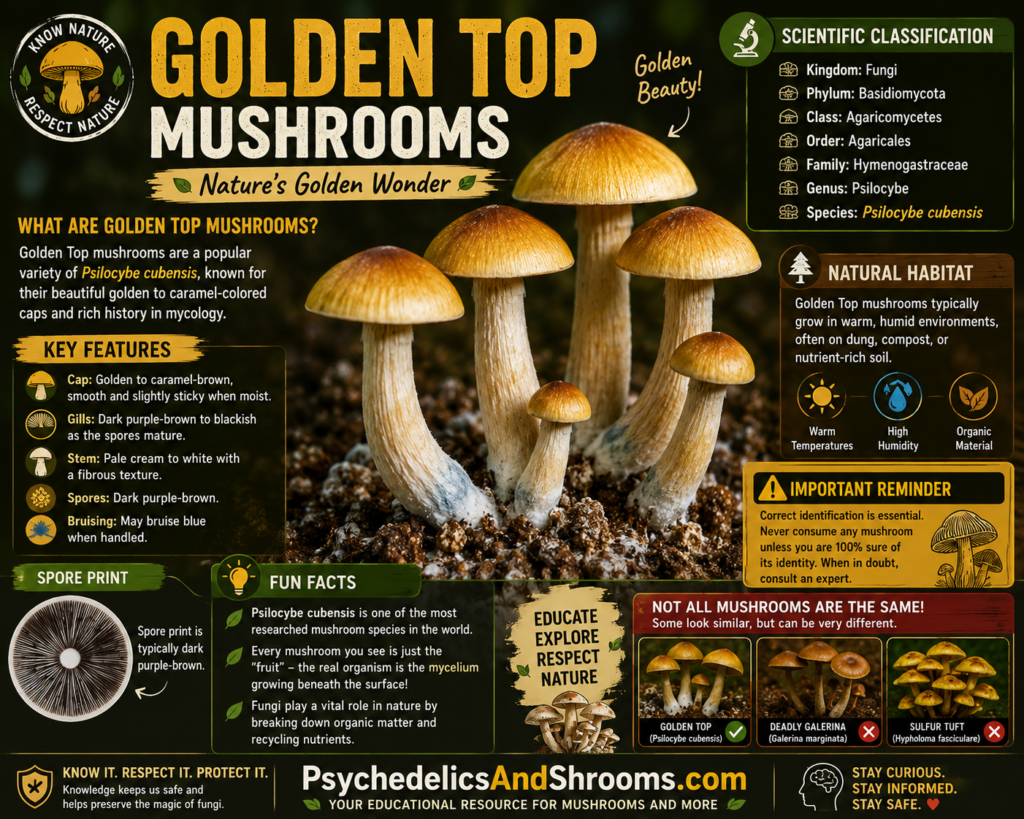
Golden Top mushrooms are commonly recognized by their golden to caramel-colored caps, pale stems, and characteristic mushroom structure. The name “Golden Top” comes from the appearance of the cap, which often develops warm golden or yellow-brown coloration depending on environmental conditions and maturity.
Like all fungi, Golden Top mushrooms belong to a complex biological kingdom separate from plants and animals. Mushrooms represent the fruiting body of an underground fungal network known as mycelium. This mycelial network plays an important ecological role by helping decompose organic matter and recycle nutrients throughout natural ecosystems.
Mycologists study mushroom species to better understand biodiversity, ecological relationships, and fungal evolution. Golden Top mushrooms are often discussed within broader educational conversations about fungal biology and mushroom identification.
Scientific Classification of Golden Top Mushrooms
Golden Top mushrooms are generally associated with the species Psilocybe cubensis, which belongs to the genus Psilocybe. This genus includes numerous mushroom species that have been studied by scientists for decades.
Fungal classification helps researchers distinguish species based on characteristics such as spore structure, cap morphology, habitat preferences, and genetic relationships. Advances in DNA sequencing have significantly improved scientists’ understanding of fungal diversity and species classification.
Educational resources continue to emphasize the importance of accurate mushroom identification because many mushroom species can appear visually similar while having very different properties.
Appearance and Identifying Characteristics
One of the reasons Golden Top mushrooms are easily recognized is their distinctive appearance. Mature specimens often develop caps ranging from golden-yellow to caramel brown. The cap may change color as the mushroom ages or dries.
The stem is usually pale cream or white and supports the cap above the growing surface. Underneath the cap, mushrooms develop gills that produce spores responsible for reproduction and species propagation.
Environmental conditions such as humidity, temperature, sunlight exposure, and substrate composition can influence the appearance of mushrooms. Because of these variations, visual identification alone is not always sufficient for confirming species identity.
Professional mycologists often use multiple identification methods, including microscopic examination and spore analysis.
Natural Habitat of Golden Top Mushrooms
Golden Top mushrooms are commonly associated with warm and humid environments. Fungi thrive in habitats where moisture, organic material, and suitable temperatures support fungal growth.
Many mushroom species play essential ecological roles as decomposers. By breaking down organic matter, fungi contribute to nutrient recycling and soil health within ecosystems.
Understanding fungal habitats helps researchers better appreciate the environmental importance of mushrooms and their contributions to biodiversity. Educational discussions about fungal ecology continue to highlight the vital role fungi play in natural systems.
For readers interested in learning more about mushroom species, habitat identification, and fungal science, educational resources are available through https://psychedelicsandshrooms.com/guides/.
Why Fungi Are Important to Ecosystems
Mushrooms are far more than just visible fruiting bodies. Beneath the surface, fungal mycelium networks connect with plant roots, assist nutrient exchange, and contribute to ecosystem stability.
Scientists increasingly recognize fungi as essential components of healthy forests, grasslands, and agricultural systems. Research suggests fungal networks may help improve nutrient distribution and support plant resilience in various environmental conditions.
Without fungi, many ecosystems would struggle to efficiently recycle organic material. This makes mushrooms an important subject of study for ecologists, conservationists, and environmental scientists.
Mushroom Safety and Identification Awareness
One of the most important aspects of mushroom education is understanding that mushroom identification should never rely solely on photographs or casual observation.
Many mushroom species share similar visual characteristics, making misidentification possible. Some mushrooms that appear harmless may contain compounds that can be harmful if consumed.
Educational websites such as Psychedelics and Shrooms encourage readers to approach mushroom identification responsibly and seek expert guidance when studying fungi in natural environments.
Learning about mushroom biology and identification helps promote safer interactions with fungi while supporting scientific understanding.
Golden Top Mushrooms and Public Interest
Interest in Golden Top mushrooms has increased significantly over the past decade due to growing public curiosity about fungi, mushroom research, and mycology education.
Books, documentaries, scientific publications, and university research programs have contributed to greater awareness of fungal science. This increased visibility has encouraged more people to learn about mushroom species and their ecological significance.
The broader field of mycology continues expanding as researchers investigate fungal genetics, environmental applications, sustainable agriculture, and medicinal compounds derived from fungi.
Educational content plays an important role in helping readers separate scientific information from misinformation while encouraging responsible learning.
The Growing Popularity of Mycology
Mycology, the scientific study of fungi, has experienced renewed interest throughout the United States and around the world. Citizen science projects, mushroom clubs, university programs, and environmental organizations continue promoting fungal education.
Modern researchers now recognize that fungi influence nearly every ecosystem on Earth. As a result, mushrooms have become an increasingly important subject within biology, ecology, conservation, and environmental science.
Golden Top mushrooms represent one example of how public curiosity about fungi can encourage broader interest in scientific learning and ecological awareness.
Final Thoughts on Golden Top Mushrooms
Golden Top mushrooms remain one of the most recognized mushroom types discussed in educational and mycological communities. Their distinctive appearance, ecological significance, and association with broader fungal research make them an important subject for those interested in mushroom science.
Understanding mushroom biology, habitat preferences, and identification principles helps promote informed discussions about fungi while encouraging responsible education. As interest in mycology continues to grow, reliable educational resources remain essential for helping the public better understand the remarkable diversity of the fungal kingdom.
For more educational articles about mushrooms, fungal biology, mycology research, and mushroom science, visit https://psychedelicsandshrooms.com/.
FAQs
What are Golden Top mushrooms?
Golden Top mushrooms are commonly associated with Psilocybe cubensis and are known for their distinctive golden-colored caps. Learn more about mushroom species at https://psychedelicsandshrooms.com/.
Why are they called Golden Top mushrooms?
The name comes from the mushroom’s golden or caramel-colored cap, which is one of its most recognizable identifying features.
Where are Golden Top mushrooms found?
Golden Top mushrooms are typically associated with warm and humid environments that support fungal growth and development.
Why are mushrooms important to ecosystems?
Mushrooms help break down organic matter, recycle nutrients, support biodiversity, and contribute to healthy ecosystems.
Can mushroom species be difficult to identify?
Yes. Many mushroom species appear similar, which is why proper identification methods and educational resources are important. Readers can explore more mushroom guides at https://psychedelicsandshrooms.com/guides/.
Where can I learn more about mushroom science?
You can find educational content about mushrooms, fungi, mycology, and ongoing research at https://psychedelicsandshrooms.com/.
