
mushroom and shrooms
DMT Drugs: Effects, Hallucinations, Risks, Research and U.S. Legal Status
Aug
What Are DMT Drugs?
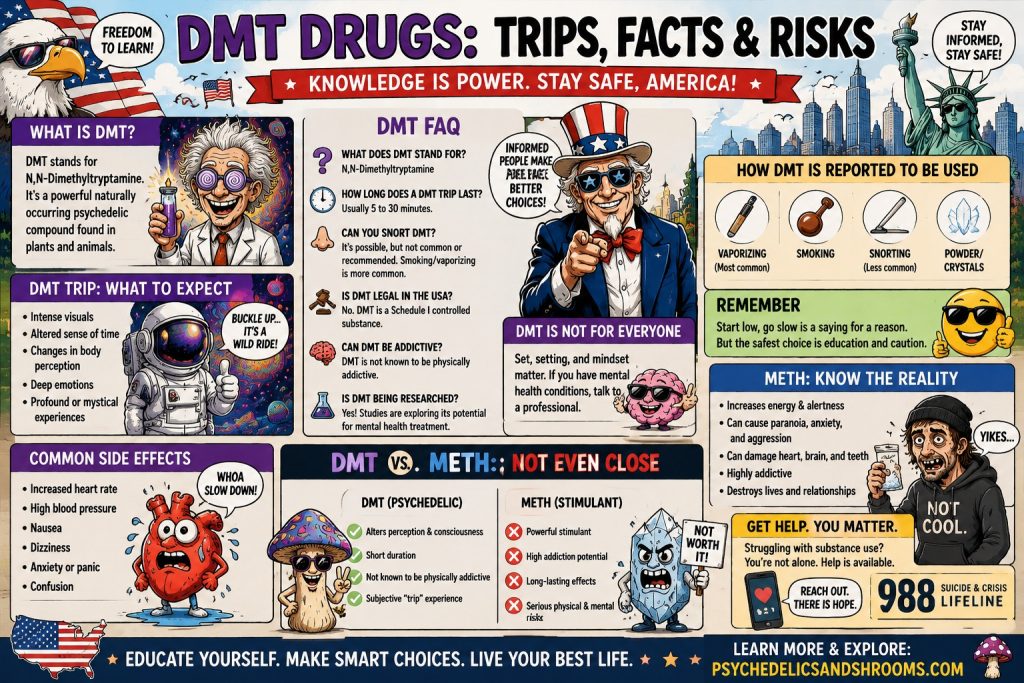
DMT drugs generally refers to substances containing N,N-dimethyltryptamine (DMT), a powerful serotonergic psychedelic compound. DMT occurs naturally in a variety of plants and has also been identified in animals. Scientists have studied its pharmacology, subjective effects, safety, and possible therapeutic applications for decades.
Online discussion can make DMT drugs appear relatively simple: take a substance, experience a short psychedelic “trip,” and return to normal. The scientific picture is more complicated.
DMT drugs can produce extremely intense changes in perception, consciousness, emotion, time perception, and sense of self. Adverse experiences are possible, and unregulated substances introduce additional uncertainty concerning identity, concentration, and contamination.
This article addresses informational searches such as what does DMT stand for, trip on DMT, DMT hallucinations, DMT bad trip, side effects of DMT drugs, and DMT treatment. It intentionally does not provide instructions for obtaining, dosing, smoking, snorting, or otherwise using an illegal drug.
For broader educational material about psychedelics and mushrooms, readers can explore psychedelicsandshrooms.com.
What Does DMT Stand For?
DMT stands for N,N-dimethyltryptamine.
It belongs to the tryptamine family of compounds and is structurally related to serotonin and other indole compounds.
DMT’s psychedelic activity is associated particularly with serotonin signaling and activation of the 5-HT2A receptor, a receptor also central to the effects of classic psychedelics such as psilocybin and LSD.
People sometimes use “DMT” loosely when discussing related substances. Importantly, N,N-DMT and 5-MeO-DMT are different compounds and should not be treated as interchangeable.
What Is Psychedelic DMT?
Psychedelic DMT is considered a classic serotonergic psychedelic.
Classic psychedelics alter perception and consciousness primarily through serotonin-related mechanisms. DMT is notable for producing particularly profound subjective effects under certain conditions.
Research participants and observational reports have described experiences involving dramatic visual phenomena, alterations in body perception, changes in spatial awareness, emotional intensity, and experiences interpreted as mystical or transcendent.
NIDA educational material describes DMT effects including increased heart rate, agitation, and hallucinations that can involve dramatically altered environments and body or spatial distortions.
These experiences are subjective. Their intensity does not prove supernatural interpretations or establish that hallucinated environments objectively exist.
What Is a Trip on DMT?
A trip on DMT refers to the acute psychedelic experience produced by the substance.
People may experience substantial changes in:
- visual perception;
- colors and patterns;
- awareness of their surroundings;
- time perception;
- body perception;
- emotional intensity;
- thought patterns; and
- sense of identity.
A psychedelic experience can be interpreted positively, negatively, spiritually, psychologically, or simply as an unusual pharmacological state.
The experience is not reliably predictable.
NIDA notes more generally that hallucinogenic experiences vary with factors including exposure, mood, expectations, personality, and surroundings.
DMT Hallucinations
DMT hallucinations are among the substance’s best-known effects.
The word hallucination describes perception occurring without a corresponding external stimulus. Psychedelic effects can also involve distortions of things that really are present rather than entirely fabricated perceptions.
Reported DMT phenomena can include geometric patterns, unusual colors, rapidly transforming scenes, spatial distortion, altered body boundaries, and complex imagery.
Some individuals report experiences involving apparently autonomous beings or entities.
These reports are scientifically interesting as subjective experiences, but neuroscience does not establish them as evidence that such perceived entities exist independently of the psychedelic state.
What Is a DMT Bad Trip?
A DMT bad trip is an intensely distressing psychedelic experience.
Possible experiences can include extreme fear, panic, confusion, paranoia, frightening imagery, a sense of losing control, or fear of dying.
NIDA describes adverse hallucinogenic experiences—or “bad trips”—as potentially involving terrifying thoughts, severe anxiety, despair, and fears concerning loss of control or death.
The relatively brief duration commonly associated with some DMT drugs experiences should not be interpreted as protection against psychological distress. An experience can feel extremely intense even when its acute pharmacological duration is comparatively short.
Side Effects of DMT
The side effects of DMT can be psychological and physiological.
Research has reported effects including:
| Area | Possible effects |
|---|---|
| Perception | Hallucinations and profound visual alterations |
| Psychological | Anxiety, fear, confusion or agitation |
| Cardiovascular | Increased heart rate and blood pressure |
| Gastrointestinal | Nausea in some contexts |
| Neurological/subjective | Dizziness and altered body perception |
| Emotional | Rapid or intense emotional experiences |
A 2025 systematic review of early-phase N,N-DMT trials found temporary increases in blood pressure and heart rate at higher exposures, while other studied administration contexts produced effects including mild nausea, dizziness, throat discomfort, or respiratory irritation. The authors emphasized that the evidence base remained small and that larger controlled trials are necessary.
This is an important distinction: results from screened volunteers under medical supervision cannot automatically establish the safety of uncontrolled recreational use.
Is DMT Safe?
It would be misleading to describe DMT simply as either “safe” or “deadly.”
A 2024 systematic review examining DMT drugs and ayahuasca found that serious adverse events appeared uncommon among healthy populations in controlled settings, while also documenting adverse events and emphasizing the need for additional randomized trials and longer follow-up.
A broader meta-analysis of classic psychedelic studies has similarly examined adverse events associated with DMT, psilocybin, LSD, and 5-MeO-DMT in research settings.
Controlled research differs significantly from unsupervised exposure.
Clinical trials can screen participants, characterize the drug, control the environment, monitor cardiovascular changes, and provide trained personnel if something goes wrong.
Unknown street material offers none of those guarantees.
Powdered DMT and DMT Pills
Searches for powdered DMT or DMT pill sometimes create the impression that appearance identifies a substance.
It does not.
A powder, crystal, capsule, or tablet cannot be reliably identified from appearance alone. Illicit-market substances may be mislabeled, adulterated, or substituted.
Similarly, a photograph cannot establish purity or concentration.
For public-health education, chemical identity matters considerably more than street appearance.
How to Take DMT: Why This Article Doesn’t Provide Instructions
Searches including how to take DMT, how to do DMT, best way to do DMT, dosage DMT, can you snort DMT, and how do you smoke DMT request practical drug-use instructions.
Providing a step-by-step method or dosing schedule would move beyond public education into facilitating illegal drug consumption.
The useful safety information is that route of exposure can substantially affect pharmacokinetics, onset, intensity, and risk. Researchers studying DMT use precisely controlled preparations and protocols rather than relying on informal internet instructions.
People should not interpret clinical research protocols as recreational-use recommendations.
How to Get DMT or Where Can You Get DMT?
Questions including how to get DMT, where do you get DMT, and where can you get DMT are purchasing or sourcing requests rather than scientific questions.
This article does not provide sellers, marketplaces, delivery services, extraction methods, or other procurement guidance.
In the United States, DMT is federally controlled. Research involving DMT operates under specific regulatory frameworks and should not be confused with ordinary consumer access.
DMT and LSD
DMT and LSD are both classic serotonergic psychedelics, but they are different molecules with different pharmacokinetic profiles.
Both produce important effects through serotonin 5-HT2A receptor activity. Research reviews comparing psychedelics emphasize differences in duration while continuing to investigate whether differences in receptor-binding profiles translate into clinically meaningful therapeutic differences.
Anecdotal claims that one psychedelic is simply a “stronger version” of another therefore oversimplify their pharmacology.
DMT and Mushrooms
The phrase DMT on mushrooms can refer either to comparisons between DMT and psilocybin mushrooms or to combining substances.
Psilocybin and DMT are chemically related tryptamines but are not the same compound.
Psilocybin is converted to psilocin in the body, while DMT has its own pharmacokinetic profile.
Combining psychoactive drugs can create additional unpredictability, so an educational article should not convert such searches into combination instructions.
Additional explanations of psychedelic terminology are available through psychedelicsandshrooms.com.
DMT and Weed Are Not the Same Thing
The search DMT weed can also create confusion.
Cannabis and DMT are pharmacologically distinct.
THC, the primary intoxicating cannabinoid in cannabis, acts substantially through cannabinoid receptors. DMT’s psychedelic effects are strongly associated with serotonin receptors.
Both substances can alter perception, but similar subjective descriptions do not mean they work through identical biological mechanisms.
DMT Treatment and Psychedelic Medicine
DMT treatment is an emerging research topic—not an established invitation to self-medicate.
Scientists are investigating whether DMT and related psychedelics could eventually have applications in psychiatry.
A 2025 systematic review examined early-phase DMT clinical trials involving healthy volunteers and people with major depressive disorder. The review found encouraging short-term tolerability results but emphasized the small number of trials and need for larger, well-controlled studies.
A comparative review of serotonergic psychedelics likewise concluded that therapeutic evidence remains limited for several psychedelic compounds and that additional research is required.
Clinical investigation should therefore not be translated into the claim that recreational DMT is a proven depression treatment.
DMT Research vs. Self-Treatment
This distinction is especially important in psychedelic medicine.
A clinical trial may involve:
Screening: Researchers evaluate whether participants meet inclusion and safety criteria.
Known substance: Researchers know what compound is administered.
Monitoring: Psychological and physiological responses can be observed.
Controlled protocols: Administration occurs according to approved research procedures.
Follow-up: Researchers can assess adverse events and outcomes.
Someone consuming an unidentified illicit substance has a fundamentally different risk environment.
For additional educational discussion of emerging psychedelic research, visit psychedelicsandshrooms.com.
DMT Is Not Crystal Meth
Your supporting keywords also include drugs crystal meth, meth rock, meth powder, and meth effects.
DMT and methamphetamine should not be conflated.
DMT is a classic psychedelic. Methamphetamine is a powerful central nervous system stimulant.
Their pharmacology, acute effects, dependence profiles, and health risks differ substantially.
This distinction is particularly important because internet slang and descriptions such as “crystal” or “powder” can cause unrelated substances to appear similar.
Physical appearance does not determine pharmacological identity.
What Does Meth Do to You?
Methamphetamine can produce increased alertness, wakefulness, energy, and cardiovascular stimulation.
Its risks can be substantial.
Repeated or problematic methamphetamine use can be associated with dependence, sleep disruption, psychiatric symptoms, cardiovascular problems, dental and nutritional problems, and significant impairment in everyday functioning.
The side effects of methamphetamine therefore belong to a different public-health discussion from DMT’s classic psychedelic effects.
Side Effects and Consequences of Methamphetamine
Potential meth effects and consequences of methamphetamine can involve multiple body systems.
Acute stimulant effects can include increased heart rate, blood pressure, body temperature, wakefulness, and agitation.
Psychiatric complications can include anxiety, paranoia, aggression, hallucinations, or stimulant-induced psychosis.
Chronic problematic use can have serious effects on physical health, cognition, relationships, employment, and mental health.
Questions such as how to use meth, how do you take meth, can you smoke meth, sniff meth, and how do people use meth are not necessary to understand these harms, so this article does not provide instructions for consuming it.
Why “DMT Drugs” and Meth Should Remain Separate SEO Topics
Search engines sometimes associate drug-related queries because users search broad terminology.
Scientifically, combining unrelated drugs into one category can reduce accuracy.
| Characteristic | DMT | Methamphetamine |
|---|---|---|
| Broad category | Classic psychedelic | Stimulant |
| Major signaling association | Serotonergic, especially 5-HT2A | Monoamine stimulant systems |
| Hallucinations | Characteristic acute psychedelic effect | Can occur, particularly in problematic use |
| Dependence concern | Different profile | Significant dependence potential |
| Clinical psychedelic research | Active research area | Not a classic psychedelic |
| U.S. regulation | Federally controlled | Federally controlled; limited legitimate medical formulation exists |
Understanding the drug category is more useful than assuming substances with similar street appearances have similar effects.
Frequently Asked Questions
What does DMT stand for?
DMT stands for N,N-dimethyltryptamine, a naturally occurring tryptamine compound known for powerful psychedelic effects.
What does a DMT trip feel like?
Reported experiences include intense visual phenomena, altered space and time perception, emotional changes, body distortion, and major changes in consciousness. Experiences vary substantially and can also become frightening.
What are the side effects of DMT?
Possible effects include increased heart rate and blood pressure, agitation, anxiety, hallucinations, dizziness, nausea, and intense psychological experiences. Clinical evidence remains limited compared with established medicines.
Can DMT cause a bad trip?
Yes. Psychedelic experiences can involve panic, frightening hallucinations, confusion, extreme anxiety, or fear of losing control.
Is DMT being researched as a treatment?
Yes. Early clinical research is investigating DMT in psychiatric contexts, including depression, but this remains an evolving research field rather than evidence supporting unsupervised self-treatment.
Are DMT and methamphetamine similar?
No. DMT is a serotonergic psychedelic, whereas methamphetamine is a powerful stimulant with a substantially different pharmacology and risk profile.
Where to Explore Further
For additional educational reading on psychedelic terminology, mushrooms, mental-health research, and psychoactive-substance awareness, explore psychedelicsandshrooms.com.
