
mushroom and shrooms
Opioids Drugs: Types, Medications, Painkillers, Addiction and Safety
Aug
What Are Opioids Drugs?
The search phrase opioids drugs generally refers to a large family of substances that interact with opioid receptors in the body. Some are prescription medications used medically for pain and other specific purposes, while others are illicit or unregulated substances carrying substantial risks.
Opioids can reduce pain, but they can also cause sedation, constipation, tolerance, physical dependence, opioid use disorder (OUD), and potentially fatal respiratory depression.
That combination of legitimate medical usefulness and serious risk is one reason opioids have become such an important public-health subject in the United States.
A recent medical review estimated that opioid use disorder affected approximately 9.37 million U.S. adults in 2022 and reported 53,774 U.S. deaths involving opioid overdose in 2024.
Readers researching psychoactive substances and their health implications can also explore educational resources at psychedelicsandshrooms.com.
Opioids, Opiates and Narcotics: What’s the Difference?
The terms opioid, opiate, and narcotic frequently overlap in everyday conversation, but they are not perfect synonyms.
An opioid is a broad term for substances that act on opioid receptors. This category includes naturally derived compounds, semisynthetic medications, and fully synthetic opioids.
Opiate has traditionally referred more specifically to naturally occurring substances derived from the opium poppy, although people often use it more broadly.
Narcotic is an older term with medical and legal meanings that can vary according to context. In everyday U.S. discussion, it is frequently associated with opioid drugs.
For modern health education, opioid is usually the most useful umbrella term.
Drugs With Opium
People searching drugs with opium are often trying to understand where opioids originated.
Opium comes from the opium poppy, Papaver somniferum. Naturally occurring opium alkaloids include morphine and codeine.
Modern opioid pharmacology extends far beyond the poppy.
Some medications are semisynthetic derivatives, while others are completely synthetic. Consequently, an opioid doesn’t have to literally contain opium.
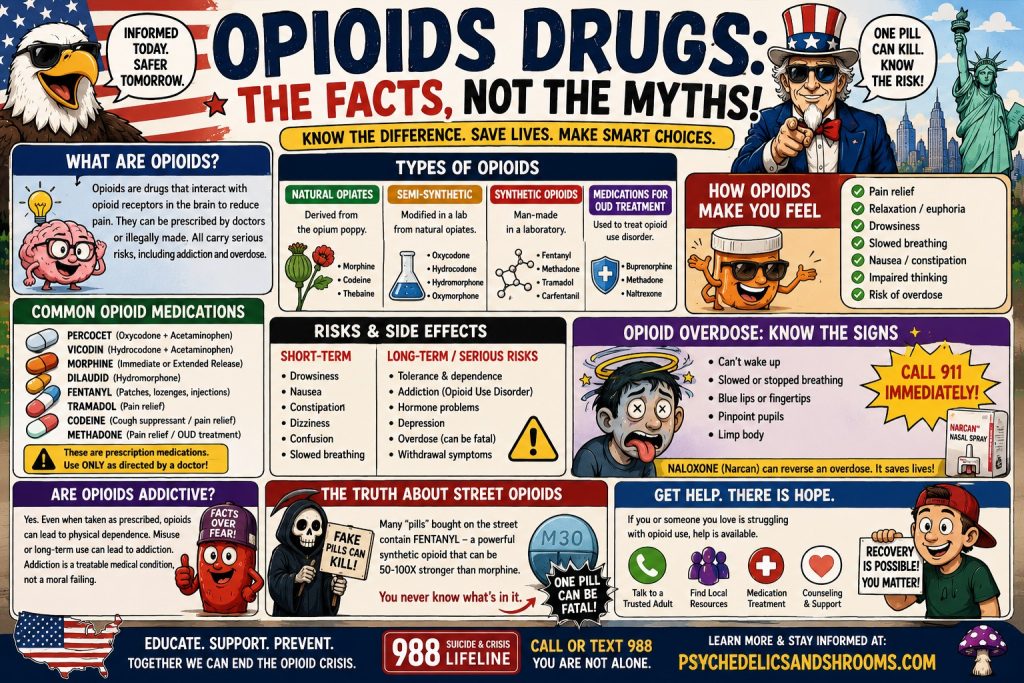
A useful simplified classification is:
| Category | Examples |
|---|---|
| Naturally occurring opiates | Morphine, codeine |
| Semisynthetic opioids | Oxycodone, hydrocodone, hydromorphone |
| Synthetic opioids | Fentanyl, methadone |
| OUD medications involving opioid receptors | Buprenorphine, methadone |
| Opioid antagonist | Naltrexone |
These medications have different medical indications, formulations, pharmacology, and risks.
What Are Opioid Medications?
Opioid medications are prescription drugs that act on opioid receptors.
In pain medicine, they can provide powerful analgesia. Examples include morphine, oxycodone, hydrocodone, hydromorphone, and fentanyl.
Other opioid-related medications serve different purposes. Methadone and buprenorphine, for example, are important evidence-based treatments for opioid use disorder.
A 2026 JAMA review reports that methadone, buprenorphine, and naltrexone are FDA-approved medications used for opioid use disorder, with methadone and buprenorphine reducing overdose and all-cause mortality.
Calling every opioid medication simply a “pain pill” therefore misses important differences between these drugs.
Opioid Painkillers
Opioid painkillers work partly by activating opioid receptors involved in pain signaling.
This can make them useful for appropriately selected patients with certain forms of significant pain.
However, stronger does not automatically mean better.
A review of safe opioid prescribing notes that opioids aren’t generally first-line therapy for chronic non-cancer pain or non-severe acute pain and that treatment decisions should balance potential analgesic benefits against adverse effects, overdose, and opioid-use-disorder risk.
Modern pain management can involve multiple approaches, including non-opioid medications, physical rehabilitation, behavioral strategies, interventional procedures, and opioid medications when clinically appropriate.
Are Opioid Pain Pills Legal?
The search legal opioids needs context.
Many opioid medications are legal prescription drugs when prescribed and used according to applicable medical and controlled-substance regulations.
Legal status does not mean harmless.
A prescription opioid can still cause:
- sedation;
- constipation;
- nausea;
- physical dependence;
- tolerance;
- respiratory depression;
- overdose; and
- opioid use disorder.
Likewise, possessing or distributing prescription-controlled substances outside lawful channels can have legal consequences.
The relevant distinction is therefore not simply “legal drug versus illegal drug.”
It is medically appropriate, regulated use versus unsafe or unauthorized use.
What Are Opiate Type Drugs?
The phrase opiate type drugs may refer to morphine, codeine, heroin, oxycodone, hydrocodone, and other opioid substances.
Scientifically, however, these drugs aren’t identical.
They differ in potency, duration, formulation, approved indications, metabolism, and overdose risk.
Some are legitimate prescription medicines. Others have no ordinary role as take-home pain medications in U.S. clinical practice.
Understanding the specific substance is therefore more useful than grouping everything under “opium drugs.”
Is Percocet an Opioid?
Yes.
Percocet is an opioid-containing prescription medication.
Traditional Percocet formulations combine oxycodone, an opioid analgesic, with acetaminophen, a non-opioid pain reliever.
That means searches such as Percocet an opioid and narcotic Percocet refer to the oxycodone component of the medication.
The acetaminophen component creates an additional safety consideration because excessive acetaminophen exposure can cause serious liver injury.
Percocet should therefore not be treated as interchangeable with oxycodone alone.
Narcotic Medications
The phrase narcotic medications is still widely used, but “opioid medications” is often more precise in clinical education.
Common prescription opioid analgesics include medications containing:
- oxycodone;
- hydrocodone;
- morphine;
- hydromorphone;
- codeine;
- fentanyl; and
- certain other opioid compounds.
These medications can have legitimate medical purposes.
Their controlled status reflects the fact that medical usefulness and misuse potential can exist simultaneously.
How Do Opioids Make You Feel?
How do opioids make you feel? is a common educational question, but there is no single experience.
When prescribed for pain, the intended effect is pain reduction.
Other effects can include sleepiness, relaxation, dizziness, nausea, slowed thinking, and constipation. Some people experience euphoria, which contributes to the misuse potential of certain opioids.
More importantly, opioids can suppress respiratory drive.
This means the dangerous effect isn’t always the one someone notices subjectively. During an opioid overdose, breathing can become dangerously slow or stop.
Combining opioids with other substances that depress the central nervous system can further increase risk.
Why Are Some Painkillers Addictive?
The phrase addictive painkillers usually refers to opioids because these medications interact with brain systems involved in reward as well as pain.
Repeated exposure can produce tolerance, meaning physiological adaptation may reduce some effects over time.
Physical dependence means the body adapts so that abrupt discontinuation can produce withdrawal.
Opioid use disorder, however, is a clinical disorder characterized by problematic opioid use causing significant impairment or distress.
These concepts overlap but are not identical.
A patient who develops expected physical dependence while taking medication exactly as prescribed does not automatically have an addiction.
Drug Addiction and Painkillers
Drug addiction painkillers is an important public-health topic because prescription opioids played a significant role in the development of the U.S. opioid crisis.
A major review describes opioid drugs as powerful analgesics with significant addiction potential and notes that the U.S. crisis initially involved prescription opioid overuse before increasingly involving heroin and illicit synthetic opioids such as fentanyl.
More recent evidence demonstrates why monitoring remains important even among people receiving legitimate prescriptions.
A 2024 analysis of nationally representative U.S. data found prescription opioid use disorder among adults reporting prescription opioid use, including some who did not report intentionally misusing their medication.
This doesn’t mean every patient prescribed an opioid becomes addicted.
It means clinicians and patients need to consider risk throughout treatment.
What Is Opium Drug Addiction?
Opium drug addiction is better discussed today using the clinical concept of opioid use disorder when diagnostic criteria are met.
OUD can involve behaviors such as difficulty controlling opioid use, continued use despite significant harm, and substantial interference with everyday responsibilities or functioning.
Addiction should not be reduced to a stereotype about “willpower.”
Modern addiction medicine recognizes opioid use disorder as a treatable health condition.
Treatment can involve medications, behavioral support, medical care, and services addressing housing, mental health, employment, and other factors affecting recovery.
Opioid Use Disorder Can Be Treated
One of the most important facts about opioid addiction is that effective treatment exists.
FDA-approved medications for opioid use disorder include:
Buprenorphine
Methadone
Naltrexone
A 2026 medical review concluded that methadone and buprenorphine reduce opioid-associated and all-cause mortality among people with OUD.
Despite this evidence, the same review estimated that only 25.1% of Americans with OUD received these medications in 2022.
This treatment gap remains an important public-health challenge.
Opioid Withdrawal
When physical dependence develops, suddenly reducing or stopping opioids can cause withdrawal.
Symptoms can include:
- anxiety;
- restlessness;
- insomnia;
- muscle or body pain;
- nausea;
- vomiting;
- diarrhea; and
- other uncomfortable symptoms.
Withdrawal and addiction are related concepts but should not automatically be treated as synonyms.
A person can develop physical dependence during legitimate medical treatment without necessarily meeting diagnostic criteria for OUD.
Clinical evaluation helps distinguish these situations.
Opioid Overdose
The most immediate life-threatening danger associated with opioids is overdose.
Opioid overdose can cause profound sedation and respiratory depression.
A person may become difficult or impossible to wake, and breathing may become dangerously slow or stop.
Naloxone is an opioid antagonist used to reverse opioid overdose. Current medical evidence strongly supports expanding access to naloxone among people at risk and their social networks. A 2026 review found community naloxone distribution was associated with substantially lower community opioid-overdose rates.
Suspected overdose requires emergency medical attention even when naloxone is administered.
Prescription Pills vs. Illicit Fentanyl
An especially important modern distinction concerns pharmaceutical opioids versus drugs circulating in the unregulated market.
A medication dispensed by a licensed pharmacy has a known formulation and manufacturing chain.
A pill obtained through an illicit source may only look like a prescription medication.
Counterfeit pills can contain illicitly manufactured fentanyl or other unexpected substances. Appearance, imprint, shape, or color alone cannot establish what an unregulated pill contains.
This makes unknown pills fundamentally different from medication dispensed directly through legitimate healthcare and pharmacy systems.
Are Opium Pills the Same as Prescription Opioids?
The phrase opium pills is often used casually but is not a useful description of most modern opioid medicines.
Prescription oxycodone or hydrocodone tablets, for example, are opioid medications but aren’t simply tablets filled with raw opium.
Modern pharmaceutical opioids contain defined active pharmaceutical ingredients manufactured into standardized formulations.
Precise drug names are therefore preferable to vague expressions such as “opium pills.”
Opioids vs. Psychedelics
Because opioid and psychedelic topics can appear together on drug-education websites, the distinction should be explicit.
Opioids such as oxycodone primarily produce their clinically relevant effects through opioid receptors.
Classic psychedelics such as psilocybin, LSD, and DMT act substantially through serotonin signaling, particularly the 5-HT2A receptor.
These are pharmacologically different drug categories with different risk profiles.
Readers interested in broader psychoactive-substance education can explore psychedelicsandshrooms.com and its educational material on psychedelic and substance research.
Opioid Medications: Benefits vs. Risks
| Potential medical role | Important risk |
|---|---|
| Relief of appropriately selected severe pain | Respiratory depression |
| Acute pain management in selected circumstances | Sedation and impairment |
| Cancer or palliative pain management | Constipation and other adverse effects |
| Certain specialized medical indications | Physical dependence |
| OUD treatment with specific medications | Requires appropriate clinical management |
| Controlled pain treatment | Potential opioid use disorder |
The goal of opioid education should not be to portray every prescription as inherently bad.
Instead, patients need accurate information allowing medical benefit to be weighed against genuine risk.
Frequently Asked Questions
What are opioid drugs?
Opioids are substances that interact with opioid receptors. They include natural opiates, semisynthetic drugs such as oxycodone, and synthetic opioids such as fentanyl and methadone.
Is Percocet an opioid?
Yes. Percocet traditionally combines the opioid oxycodone with the non-opioid pain reliever acetaminophen.
Are opioid medications legal?
Many opioid medications are legal controlled prescription drugs when prescribed and used within applicable laws. Their legal medical status does not eliminate dependence, overdose, or addiction risks.
How do opioids make you feel?
Effects vary. Intended medical effects include pain reduction, while other effects can include sedation, dizziness, nausea, constipation, relaxation, or sometimes euphoria. Dangerous exposure can suppress breathing.
Are opioid painkillers addictive?
Opioid medications can produce physical dependence and carry a risk of opioid use disorder. Risk differs between individuals and circumstances, and physical dependence alone isn’t identical to addiction.
Can opioid addiction be treated?
Yes. Evidence-based treatments include buprenorphine, methadone, and naltrexone. Methadone and buprenorphine are associated with reductions in overdose and overall mortality among people with OUD.
Where to Explore Further
For broader educational material about psychoactive substances, drug terminology, and emerging research, readers can explore psychedelicsandshrooms.com.
For peer-reviewed evidence, this recent PubMed review of medications for opioid use disorder, withdrawal and overdose summarizes current treatment evidence, including methadone, buprenorphine, naltrexone, and naloxone.
