mushroom and shrooms
Psilocybin Mushroom Spores: Biology, Spore Prints, Syringes and U.S. Legal Context
Aug
What Are Psilocybin Mushroom Spores?
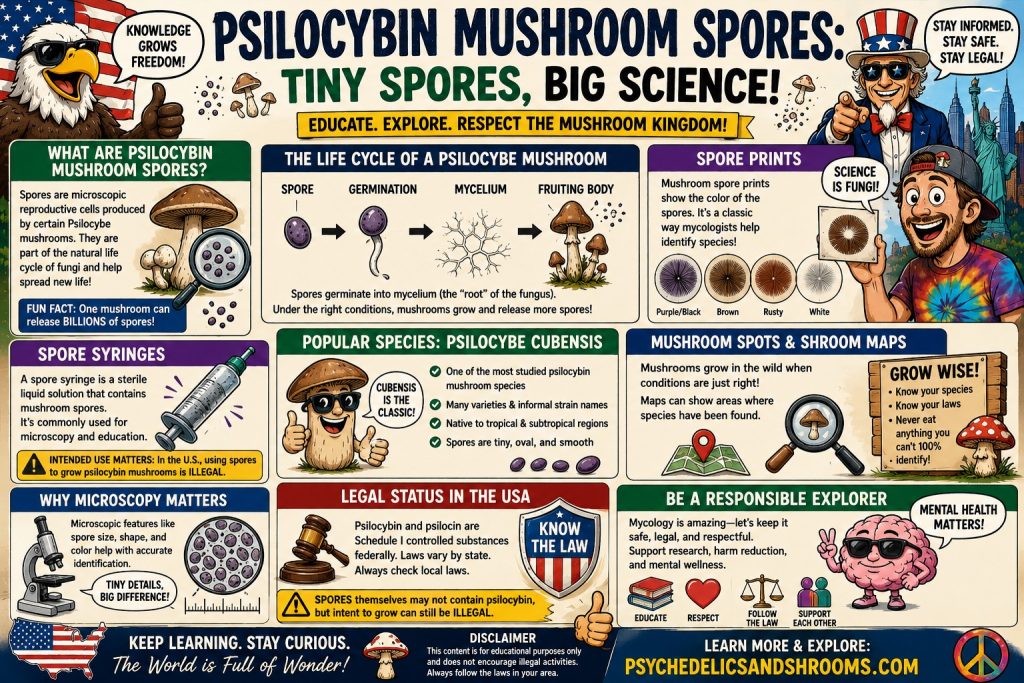
Psilocybin mushroom spores are microscopic reproductive cells produced by certain mushroom-forming fungi associated with psilocybin-containing species. They play a biological role somewhat analogous to seeds in plants, although fungi and plants reproduce through fundamentally different biological systems.
Searches for psilocybin spores, psychedelic mushroom spores, cubensis spores, and mushroom spores Psilocybe often mix together mycology, microscopy, cultivation, psychedelic chemistry, and purchasing intent.
Those subjects need to be separated carefully.
Spores themselves are primarily interesting from a biological and taxonomic perspective. Researchers and mycology enthusiasts can examine characteristics such as spore dimensions, shape, coloration, and microscopic structures when studying fungi.
This article focuses on biology, identification, microscopy, public health, and U.S. legal context. It does not provide instructions for cultivating psilocybin-producing mushrooms or sources for obtaining spores for illegal drug production.
Readers interested in broader mushroom and psychedelic education can explore psychedelicsandshrooms.com for additional informational resources.
What Exactly Is a Mushroom Spore?
A mushroom is only one visible stage in the life cycle of many fungi.
Much of a fungus can exist as mycelium, a network of microscopic filaments called hyphae growing through soil, wood, organic matter, or another substrate.
When environmental and biological conditions are appropriate, some fungi form fruiting bodies—the structures people ordinarily call mushrooms.
Those fruiting bodies can produce enormous numbers of microscopic spores.
Depending on the mushroom group, spores may be released from structures associated with:
- gills;
- pores;
- teeth;
- folds; or
- other specialized surfaces.
Wind, water, animals, and environmental movement can then distribute spores.
Are Mushroom Spores the Same as Seeds?
No.
The seed comparison can help beginners understand reproduction, but scientifically the structures are very different.
Seeds are multicellular reproductive structures produced by seed plants and typically contain an embryo plus stored resources.
Fungal spores are usually microscopic reproductive units with very different cellular biology.
Fungi also don’t belong to the plant kingdom.
They constitute their own biological kingdom and obtain nutrients differently from photosynthetic plants.
What Does “Psilocybin Spores” Mean?
The phrase psilocybin spores is convenient but can create a misconception.
It generally refers to spores originating from mushroom species known to produce psilocybin during other stages of their life cycle.
Psilocybin itself is a psychoactive tryptamine compound. Research describes psilocybin as a prodrug that is converted to psilocin, with psychedelic activity strongly associated with serotonin 5-HT2A receptor signaling.
Whether spores contain measurable controlled compounds—and how laws treat spores versus mature fungal material—is a separate question from whether the parent mushroom species is known for producing psilocybin.
That distinction becomes important when discussing U.S. law.
Mushroom Spores Psilocybe: Understanding the Genus
Psilocybe is a genus of mushrooms containing numerous species.
Some members are well known because they produce psilocybin and psilocin.
Scientific mushroom identification relies on more than a common name or photograph. Mycologists can examine macroscopic features as well as microscopic characteristics, ecological relationships, and increasingly DNA data.
Spores can contribute useful taxonomic information because characteristics such as their dimensions, shape, wall structure, and coloration can differ among fungal groups.
What Are Cubensis Spores?
Cubensis spores refers to spores associated with Psilocybe cubensis, one of the best-known psilocybin-producing mushroom species.
Online communities frequently attach numerous informal “strain” or cultivar names to P. cubensis. Those commercial or community labels should not automatically be interpreted as separate scientifically recognized species.
From a mycological perspective, establishing the underlying species is generally more informative than relying exclusively on an informal strain name.
This distinction is particularly useful for readers encountering dozens of different names online and assuming each represents a separate psychedelic mushroom species.
What Is a Mushroom Spore Print?
Mushroom spore prints are deposits of spores released from a mushroom’s spore-producing surface onto another surface.
Spore-print coloration has traditionally been one characteristic used in mushroom identification.
Depending on the species, prints may appear:
- white;
- cream;
- pink;
- brown;
- rusty;
- purple-brown;
- black; or
- other shades.
Color by itself does not establish species identity.
Two unrelated mushrooms can produce superficially similar spore colors, which is why responsible identification uses multiple characteristics rather than one test.
What Is a Psilocybe Spore Print?
A Psilocybe spore print simply means a spore deposit associated with a mushroom believed to belong to Psilocybe.
It is not equivalent to a laboratory certificate identifying the mushroom.
Species identification can involve examination of the mushroom’s cap, stem, gills, veil structures, habitat, substrate, microscopic characteristics, and sometimes molecular evidence.
This matters because incorrect wild-mushroom identification can have serious consequences.
A person should never conclude that an unknown mushroom is safe to consume merely because its spore print resembles an image found online.
What Is a Mushroom Spore Syringe?
A mushroom spore syringe is a container in which fungal spores are suspended in liquid.
The term describes a physical format rather than a mushroom species.
Online searches frequently associate syringes with mushroom cultivation. However, spore samples can also be discussed in microscopy and educational contexts.
For psilocybin-producing species, cultivation introduces controlled-substance and legal considerations, so this article does not provide procedural instructions for germinating spores, preparing substrates, inoculating materials, or producing psychedelic mushrooms.
Understanding what a spore syringe is does not require a cultivation tutorial.
Magic Mushroom Spore Syringe
The search magic mushroom spore syringe usually refers to a spore suspension associated with a psilocybin-producing mushroom species.
The phrase “magic mushroom” is an informal cultural term rather than a taxonomic category.
A more scientifically useful description identifies the actual fungal species.
This is particularly important because products advertised online may use colorful strain names, potency claims, or psychedelic imagery without providing rigorous evidence establishing biological identity.
Psilocybe Cubensis Spore Syringe
A Psilocybe cubensis spore syringe refers to a liquid spore preparation represented as containing spores from P. cubensis.
Microscopy can potentially reveal spore morphology, but a label alone should not be treated as independent authentication of species.
Consumers should also recognize that legal treatment can change when spores are intentionally germinated or used to produce controlled substances.
The legal question therefore cannot always be answered simply by asking whether an unopened spore sample itself contains psilocybin.
Mushroom Spores and Psilocybin Chemistry
One of the most interesting scientific questions concerns when psilocybin biosynthesis occurs during fungal development.
Psilocybin-producing fungi synthesize specialized tryptamine compounds through defined biochemical pathways. Genomic research has identified gene clusters associated with psilocybin biosynthesis and has helped scientists understand how these pathways evolved among fungi.
This illustrates why the phrase “psilocybin mushroom spores” should not automatically be interpreted as meaning “spores filled with psilocybin.”
The organism’s developmental stage matters.
Psychedelic Mushroom Spores vs. Psychedelic Mushrooms
A spore and a mature mushroom are biologically different structures.
| Feature | Spores | Mature mushroom |
|---|---|---|
| Primary biological role | Reproduction/dispersal | Spore-producing fruiting body |
| Typical visibility | Microscopic individually | Visible without magnification |
| Useful for microscopy | Yes | Tissue can also be examined |
| Morphological identification | Limited features | Many macroscopic features available |
| Relationship to psilocybin | Depends on developmental chemistry | Certain species can contain psilocybin/psilocin |
| Legal considerations | Jurisdiction-dependent | Psilocybin-containing material is federally controlled in the U.S. |
Keeping these categories separate improves both scientific and legal accuracy.
Are Psilocybin Mushroom Spores Legal in the United States?
This question requires nuance.
Psilocybin and psilocin remain federally controlled substances in the United States. DEA currently lists both as Schedule I controlled substances.
However, legal treatment of spores associated with psilocybin-producing mushrooms can differ because the spores and mature psilocybin-containing mushrooms are not chemically identical stages.
State laws can also differ from federal treatment, and laws involving possession, intent, cultivation, and controlled-substance production may create additional legal consequences.
Therefore, statements such as “mushroom spores are legal everywhere in America” are too broad.
People should consult current official federal and state law applicable to their jurisdiction rather than relying on a seller’s description.
Spore Prints for Sale: Why Purchasing Claims Need Caution
Searches for spore prints for sale are commercial queries.
This educational article does not recommend vendors or provide sourcing links for spores intended to produce controlled substances.
Instead, consumers should recognize several issues surrounding online biological-material listings.
A seller’s label does not independently establish:
- species identity;
- contamination status;
- geographic origin;
- genetic identity;
- legality in the buyer’s jurisdiction; or
- intended use.
For ordinary legal culinary mushroom cultures and educational specimens, reputable scientific or mycological sources should provide transparent species information.
For controlled-substance-related fungi, applicable laws require additional attention.
What Are “Mushroom Spots”?
The phrase mushroom spots can mean several things depending on search intent.
It may refer to places where wild mushrooms fruit, visible markings on mushroom caps, fungal growth locations, or even unrelated plant diseases.
Wild mushrooms occur where environmental conditions and ecological relationships support them.
Factors can include:
- moisture;
- temperature;
- season;
- soil;
- decaying organic matter;
- associated trees;
- rainfall; and
- local fungal ecology.
The appearance of mushrooms in one location one year does not guarantee identical fruiting in the same location every year.
What Is a Shroom Map?
A shroom map generally refers to a geographic resource showing reported mushroom observations or species distributions.
Distribution maps can be genuinely valuable for ecological research.
Citizen-science databases allow people to document fungal biodiversity and help researchers understand where species have been observed.
However, a map showing that a species occurs within a state or county does not establish that every similar-looking mushroom found there belongs to that species.
Geography is only one component of identification.
A distribution map should therefore be treated as an ecological reference rather than a guide for consuming wild mushrooms.
Why Mushroom Identification Requires More Than a Photo
Wild mushroom identification is inherently challenging.
Important characteristics can include:
Cap: shape, texture, color and surface features.
Gills or pores: attachment, spacing, coloration and structure.
Stem: texture, shape and internal characteristics.
Veil structures: rings or remnants around the stem or cap.
Stem base: potentially important structures can occur underground.
Spore characteristics: color, shape and microscopic features.
Habitat: soil, wood, dung, leaf litter or associated trees.
Season and geography: useful supporting evidence.
No single feature should automatically determine edibility.
Psilocybin Mushroom Identification Has Additional Risks
Misidentifying a wild mushroom can have consequences far beyond receiving an unexpected psychedelic effect.
Some poisonous mushrooms can cause serious gastrointestinal illness, neurological toxicity, liver failure, kidney injury, or death.
An unknown mushroom should therefore never be consumed simply because it resembles an online photograph of Psilocybe.
Likewise, bruising color, cap color, habitat, or a spore print alone cannot establish safety.
Professional mycology relies on combinations of characteristics.
Psilocybin Research vs. Mushroom Cultivation
Interest in psychedelic science has grown considerably in the United States.
Researchers are investigating psilocybin in carefully controlled clinical environments for several psychiatric indications. A large 2024 systematic review and meta-analysis found that psilocybin-assisted interventions showed antidepressant effects in randomized trials while also emphasizing the need to consider study limitations and safety.
Clinical research should not be confused with home cultivation.
Researchers use standardized protocols, characterized compounds, participant screening, professional monitoring, and regulatory authorization.
Growing an uncontrolled mushroom product does not reproduce those conditions.
Readers interested in the broader scientific distinction can explore educational material at psychedelicsandshrooms.com.
Why Spores Matter to Mycology
Removing psychedelic culture from the discussion reveals something much larger: spores are fundamental to fungal biology.
Scientists study spores to investigate:
- taxonomy;
- fungal evolution;
- biodiversity;
- geographic distribution;
- reproduction;
- environmental dispersal;
- genetics; and
- ecosystem relationships.
Mushrooms also perform essential ecological roles.
Many fungi decompose organic matter. Others form mutually beneficial relationships with plant roots, while some function as pathogens.
Studying spores therefore contributes to our understanding of entire ecosystems—not merely psychedelic mushrooms.
Frequently Asked Questions
What are psilocybin mushroom spores?
They are microscopic reproductive structures produced by mushroom species associated with psilocybin production. Spores represent a different developmental stage from mature mushrooms.
Are cubensis spores the same as mushrooms?
No. Cubensis spores are reproductive cells associated with Psilocybe cubensis. A mature mushroom is a multicellular fruiting body produced later in the fungal life cycle.
What is a mushroom spore print?
A spore print is a visible deposit created when large numbers of microscopic spores fall from a mushroom’s spore-producing surface. Its color can help with identification but cannot identify a species by itself.
What is a mushroom spore syringe?
It is a liquid suspension containing fungal spores. For controlled-substance-related fungi, legal considerations surrounding intended use and cultivation are important.
Are psilocybin spores legal everywhere in the USA?
No universal claim should be made. Psilocybin and psilocin remain federally controlled, while laws affecting spores, cultivation, possession, and intent can differ by jurisdiction. Current official law should be checked.
Can a shroom map identify a mushroom?
No. Distribution maps can show where a species has previously been observed, but identification requires examination of the actual specimen and multiple diagnostic characteristics.
Where to Explore Further
For broader educational information about mushroom biology, psychedelics, and emerging research, readers can explore psychedelicsandshrooms.com, including its general mushroom educational resources and psychedelic research information.
For scientific context, PubMed provides peer-reviewed literature concerning psilocybin pharmacology and psychedelic research.
