mushroom and shrooms
Edible Mushrooms: Types, Identification, Wild Species & Safety Guide
Aug
Mushrooms are among the most diverse foods humans eat. Familiar supermarket varieties such as white button, cremini, portobello, oyster, and shiitake represent only a small portion of the world’s fungi.
An edible mushroom is a fungal fruiting body considered suitable for human consumption when correctly identified and appropriately prepared. Some species are cultivated commercially, while others are traditionally collected from forests and other natural environments.
Wild mushrooms introduce an important complication: there is no universal visual test that proves a mushroom is edible.
Color, smell, insects, bruising, whether an animal ate it, or a photograph from an app cannot independently establish safety. Some edible mushrooms have dangerous look-alikes.
For broader educational material about mushroom biology and identification, readers can explore psychedelicsandshrooms.com.
Types of Edible Mushrooms
Thousands of fungal species produce fruiting bodies, but only a fraction are routinely consumed.
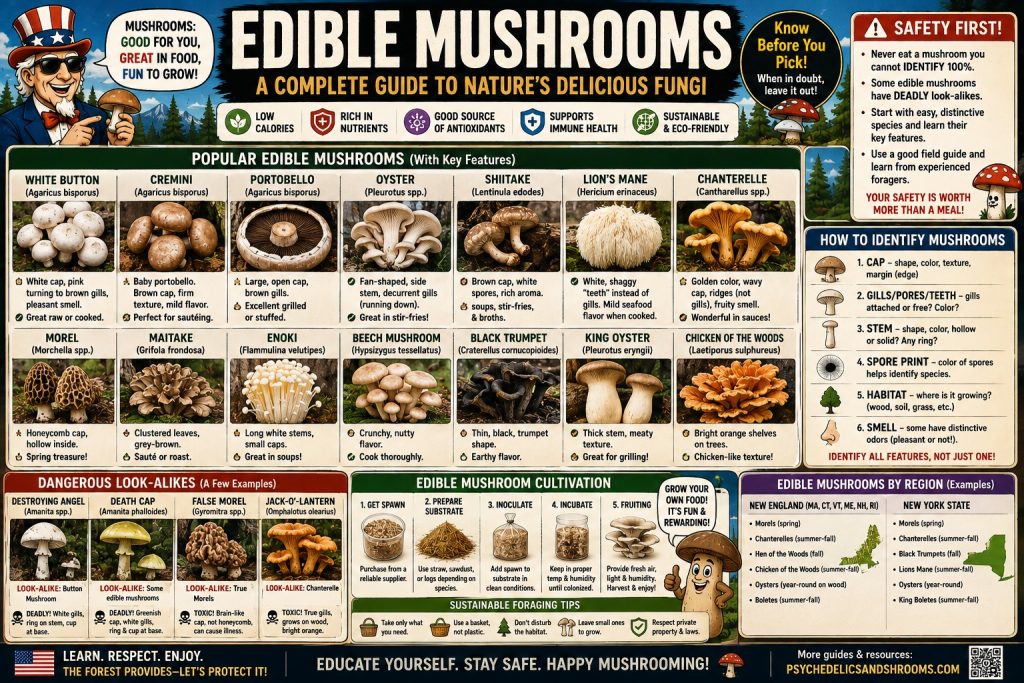
Here are several well-known edible mushrooms.
| Mushroom | Scientific name | Typical appearance | Common use |
|---|---|---|---|
| White button | Agaricus bisporus | White rounded cap | Soups, pizza, salads |
| Cremini | Agaricus bisporus | Brown rounded cap | Sautéing, sauces |
| Portobello | Agaricus bisporus | Large brown cap | Grilling, roasting |
| Oyster | Pleurotus spp. | Shelf/fan-shaped caps | Stir-fries, sautéing |
| Shiitake | Lentinula edodes | Brown cap | Soups, noodles |
| Lion’s mane | Hericium erinaceus | White cascading “teeth” | Sautéing |
| Maitake | Grifola frondosa | Clustered gray-brown fronds | Roasting, soups |
| Enoki | Flammulina filiformis | Long stems when cultivated | Soups, cooked dishes |
| Morels | Morchella spp. | Honeycomb-like cap | Seasonal cooking |
| Chanterelles | Cantharellus spp. | Yellow/orange, ridged underside | Sautéing, sauces |
One interesting fact is that white button, cremini, and portobello mushrooms are different commercial forms of the same species, Agaricus bisporus.
What Do Mushrooms Look Like?
There is no single mushroom shape.
A classic mushroom may have a:
- cap;
- gills;
- stem;
- ring; and
- enlarged or structured stem base.
But fungi can also produce:
- pores rather than gills;
- teeth or spines;
- shelves;
- cups;
- coral-like branches;
- puffballs;
- irregular masses; and
- clustered fronds.
Lion’s mane, for example, looks nothing like a supermarket button mushroom.
This enormous structural diversity is one reason mushroom identification requires more than matching a photograph.
Mushroom Identification Chart: What Experts Examine
A useful mushroom identification chart should describe characteristics rather than simply divide mushrooms into “good” and “bad.”
| Identification feature | What to examine |
|---|---|
| Cap | Shape, texture, surface, color and margin |
| Underside | Gills, pores, teeth or another structure |
| Gills | Color, spacing and attachment |
| Stem | Shape, texture, hollowness and markings |
| Ring | Present or absent |
| Stem base | Bulb, cup/volva or other structures |
| Bruising | Whether damaged tissue changes color |
| Spore print | Color of deposited spores |
| Substrate | Soil, wood, tree, grass, dung, etc. |
| Growth pattern | Solitary, clustered or overlapping |
| Ecology | Associated trees and habitat |
| Season | When the fruiting body appeared |
| Geography | Where the specimen was found |
Microscopic and DNA characteristics may be necessary for difficult groups.
How to Tell if a Mushroom Is Edible
There is no safe shortcut.
Questions such as “How can you tell if a mushroom is edible?” are sometimes answered online with supposed rules:
Silver turns black around poisonous mushrooms.
If animals eat it, humans can eat it.
Poisonous mushrooms always have bright colors.
Mushrooms that peel easily are edible.
Cooking destroys mushroom toxins.
These aren’t reliable universal rules.
The correct process is species-level identification followed by verification that the identified species is considered edible and appropriately prepared.
If identification remains uncertain, don’t eat it.
Identifying Edible Wild Mushrooms
Edible wild mushrooms require considerably more caution than commercially cultivated mushrooms.
A competent identification considers multiple independent features simultaneously.
For example, a collector might examine:
- overall fruiting-body structure;
- cap characteristics;
- underside structure;
- stem and stem base;
- spore characteristics;
- bruising or staining;
- smell;
- substrate;
- associated trees;
- geographic distribution; and
- season.
No single characteristic should normally carry the entire identification.
Pictures of Edible Wild Mushrooms
Photographs are extremely useful for learning—but they have limits.
An edible fungi picture can demonstrate characteristic morphology. It cannot show every feature needed to identify the mushroom in your hand.
A photograph may conceal:
- the stem base;
- gill attachment;
- internal tissue;
- bruising;
- spore color;
- smell;
- habitat; and
- microscopic structures.
Lighting can also dramatically alter apparent color.
Therefore, images of edible wild mushrooms should be treated as educational references, not permission to eat a specimen.
Mushroom Identification Apps
Computer vision has made mushroom-identification apps surprisingly capable of suggesting possibilities.
But “suggesting” is the critical word.
An image-recognition system may confuse closely related species or fail to account for regional variation.
An app can help generate possibilities for further investigation. It shouldn’t be the sole basis for deciding whether a wild mushroom is safe to consume.
The same applies to asking online, “What kind of mushroom is this?”
A photograph without ecological and structural information may not provide enough evidence for a reliable identification.
White Wild Mushrooms
A wild mushroom with a white cap should never be assumed edible because it resembles a supermarket mushroom.
White mushrooms occur across many unrelated fungal groups.
Some are edible.
Others are poisonous.
Particularly important are white species within Amanita, including mushrooms commonly called destroying angels. Several contain amatoxins capable of causing severe liver injury and death.
This is why “white top mushroom” isn’t an identification.
It is merely a description.
Brown-Gilled Mushroom Identification
Brown gills can also occur in numerous species.
When identifying a brown-gilled mushroom, experts may examine:
- whether gills start pale and become brown;
- spore-print color;
- cap texture;
- stem characteristics;
- presence or absence of a ring;
- bruising reactions;
- odor; and
- habitat.
Some Agaricus species are edible, including the commercially cultivated Agaricus bisporus.
Other Agaricus species can cause gastrointestinal illness.
Similarity to a grocery-store mushroom isn’t sufficient evidence.
Oyster Mushrooms and Poisonous Look-Alikes
Oyster mushrooms (Pleurotus species) are among the world’s most popular edible fungi.
Typical characteristics can include:
- fan- or oyster-shaped caps;
- growth on wood;
- overlapping clusters;
- pale gills running toward the attachment point; and
- short, off-center, or inconspicuous stems.
However, several unrelated fungi can appear superficially oyster-like.
The name false oyster is also applied inconsistently to different fungi depending on region and source.
This illustrates a fundamental identification principle:
Common names alone aren’t sufficient.
Scientific identification and multiple physical/ecological characteristics provide a stronger foundation.
Morel Mushrooms
True morels (Morchella species) are prized edible wild mushrooms.
Their caps have a distinctive honeycomb or pitted appearance.
However, the term false morel is used for several other fungi, including Gyromitra species.
Some false morels contain gyromitrin-related toxins and have caused serious poisonings.
Beginners shouldn’t assume every wrinkled or brain-like spring mushroom is a true morel.
Chanterelles
Chanterelles are another famous wild edible group.
Many species have yellow-to-orange fruiting bodies and structures beneath the cap that look more like blunt folds or ridges than thin, blade-like true gills.
They also have look-alikes.
This demonstrates why identification guides often emphasize underside structure rather than cap color alone.
“Yellow mushroom” is nowhere near specific enough to determine edibility.
Lion’s Mane
Lion’s mane (Hericium erinaceus) demonstrates how unusual edible fungi can look.
Instead of a conventional cap and gills, it produces cascading white tooth-like structures.
Other Hericium species can have related appearances.
Lion’s mane is now cultivated commercially in the United States, making cultivated products a substantially simpler option for consumers than attempting to identify unknown wild fungi.
Maitake
Maitake (Grifola frondosa), also called hen of the woods, forms large clusters of overlapping gray-to-brown fronds.
It is associated with hardwood trees, particularly around oak.
Again, habitat is part of identification.
A photograph showing only a cluster without the tree, substrate, underside, and other characteristics provides incomplete evidence.
Edible Yard Mushrooms
Finding mushrooms in a lawn doesn’t mean they’re edible.
Yards can support numerous fungi because lawns contain:
- decaying roots;
- buried wood;
- organic matter;
- soil fungi; and
- tree-associated mycorrhizal species.
Some lawn mushrooms cause gastrointestinal illness, while others may contain more serious toxins.
Children and pets are particularly important considerations.
Unknown mushrooms should be removed from areas where young children or pets may ingest them, preferably while preserving a specimen or photographs if poisoning becomes a concern.
New England Mushrooms
New England’s forests support extraordinary fungal diversity because the region contains hardwood forests, conifers, wetlands, urban landscapes, and strongly seasonal weather.
Wild mushroom communities can include:
- boletes;
- chanterelles;
- morels;
- oyster mushrooms;
- Hericium species;
- Russula species;
- Lactarius/Lactifluus species;
- puffballs;
- polypores;
- Amanita species; and
- countless smaller fungi.
Some are edible.
Some aren’t considered food.
While some are poisonous.
The category New England mushroom therefore says nothing by itself about edibility.
Edible Mushrooms in Massachusetts
Massachusetts supports numerous edible wild mushroom species, but it also supports poisonous fungi.
Wild-food interest in the state commonly includes groups such as chanterelles, morels, oyster mushrooms, hen of the woods, chicken-of-the-woods species, and certain boletes.
But every specimen requires individual identification.
The presence of an edible species in Massachusetts doesn’t mean a mushroom resembling it is automatically that species.
Yellow Mushrooms in Massachusetts
A yellow mushroom in Massachusetts could belong to many different genera.
Color alone cannot establish identity.
Depending on morphology and habitat, yellow coloration can appear among:
- chanterelle-like fungi;
- waxcaps;
- boletes;
- Amanita species;
- Russula species;
- small woodland mushrooms; and
- lawn fungi.
A yellow mushroom should therefore be described using its complete anatomy, not simply color.
Poisonous Mushrooms in Massachusetts
Potentially dangerous mushrooms also occur throughout the northeastern United States.
Of particular concern are mushrooms containing amatoxins.
Amatoxin poisoning can be deceptive because gastrointestinal symptoms may initially improve before severe liver injury develops.
This delayed pattern is one reason suspected mushroom poisoning requires prompt professional evaluation.
Other toxic mushrooms can cause gastrointestinal, neurological, kidney-related, or cholinergic syndromes.
Edible Mushrooms in New York State
New York’s enormous geographic and ecological diversity also supports extensive fungal biodiversity.
The state includes forests where people encounter:
- oyster mushrooms;
- morels;
- chanterelles;
- maitake;
- Hericium species;
- boletes;
- puffballs;
- polypores; and
- many other groups.
New York also contains dangerous toxic species.
Regional presence should be used as one component of identification—not as proof.
Wild Mushroom Types
A mushroom guide often organizes fungi by major visible structures.
Gilled mushrooms
Thin plates radiate beneath the cap.
Boletes
The underside typically contains pores rather than gills.
Polypores
Often shelf-like and associated with wood.
Tooth fungi
Produce downward-pointing teeth or spines.
Puffballs
Produce spores internally rather than on exposed gills.
Cup fungi
Produce cup- or disc-shaped fruiting bodies.
Coral fungi
Have branching structures resembling underwater coral.
Learning these structural categories is more useful than memorizing cap colors.
Poisonous Mushrooms Can Resemble Edible Ones
The greatest danger in wild mushroom identification isn’t an obviously strange fungus.
It is a poisonous mushroom that resembles something edible.
Potential consequences range from vomiting to organ failure.
Important toxin groups include:
| Toxin/syndrome | Potential consequence |
|---|---|
| Amatoxins | Severe liver injury |
| Orellanine | Delayed kidney injury |
| Gyromitrin-related toxins | GI and neurological toxicity |
| Muscarine | Sweating, salivation, cardiovascular effects |
| Ibotenic acid/muscimol | Neurological effects |
| Various GI irritants | Vomiting and diarrhea |
Cooking doesn’t universally neutralize mushroom toxins.
Mushroom Names, Lists and Pictures
A mushroom names list and pictures can be an excellent learning tool when it emphasizes that images are examples rather than definitive identification.


5
Useful visual guides should show multiple views whenever possible:
- top of cap;
- underside;
- complete stem;
- stem base;
- cross-section;
- habitat; and
- several developmental stages.
A single perfect specimen isn’t representative of every mushroom within a species.
Edible Mushroom Cultivation
Edible mushroom cultivation offers an alternative to uncertain wild harvesting.
Commercial and home cultivation commonly focuses on legal culinary species such as:
- oyster mushrooms;
- shiitake;
- lion’s mane;
- wine cap;
- button/cremini mushrooms; and
- various gourmet Pleurotus species.
Cultivation allows growers to begin with a known species rather than identifying an unknown mushroom discovered outdoors.
Growing Edible Mushrooms
Unlike plants, mushrooms don’t grow from seeds.
Cultivation usually begins with fungal mycelium propagated through a material known as spawn.
Different edible species favor different substrates.
| Edible mushroom | Common cultivation substrate |
|---|---|
| Oyster | Straw or hardwood-based substrate |
| Shiitake | Hardwood logs or sawdust blocks |
| Lion’s mane | Hardwood-based substrate |
| Wine cap | Outdoor wood-chip beds |
| Button/cremini | Prepared compost |
Successful cultivation involves maintaining suitable moisture, temperature, fresh-air exchange, sanitation, and species-appropriate substrate conditions.
Commercial kits can simplify these variables for beginners.
This discussion concerns legal culinary mushrooms, not controlled psychedelic species.
Cultivated vs. Wild Edible Mushrooms
| Factor | Cultivated mushrooms | Wild mushrooms |
|---|---|---|
| Identity | Usually known | Must be established |
| Look-alike risk | Low from reputable source | Potentially substantial |
| Availability | Often predictable | Seasonal |
| Environment | Controlled | Variable |
| Beginner suitability | Generally better | Requires expertise |
| Poisoning risk from misidentification | Very low when commercially sourced | Can be serious |
For beginners interested primarily in eating mushrooms rather than studying taxonomy, cultivated mushrooms are the safer starting point.
What to Do After Eating an Unknown Mushroom
Don’t wait for severe symptoms if a potentially poisonous mushroom has been eaten.
In the United States, contact Poison Control at 1-800-222-1222 for guidance. Call 911 for severe symptoms, loss of consciousness, breathing problems, seizures, or another immediate emergency.
If possible, preserve:
- an uneaten specimen;
- all mushroom pieces;
- photographs;
- information about where it grew; and
- the approximate time of ingestion.
These details can help identification and medical decision-making.
Don’t induce vomiting unless a healthcare or poison-control professional specifically instructs you to do so.
Frequently Asked Questions
1. How can you tell if a mushroom is edible?
There is no universal test. A wild mushroom needs reliable species-level identification using multiple anatomical, ecological, geographic, and sometimes microscopic characteristics before its edibility can be assessed.
2. Are white wild mushrooms edible?
Some are, but others are dangerously poisonous. White color alone cannot establish edibility, and several potentially deadly Amanita species can appear predominantly white.
3. Can I identify edible mushrooms from pictures?
Pictures are useful educational tools but shouldn’t be the sole basis for eating a wild mushroom. Important characteristics may not be visible in a photograph.
4. Are mushrooms growing in my yard safe to eat?
Their location in a yard provides no guarantee of safety. Lawns can support edible, inedible, and poisonous fungi.
5. What edible mushrooms grow in New England?
Numerous edible species occur in New England, including certain chanterelles, morels, oysters, maitake, Hericium species, and boletes. Individual specimens still require expert identification.
6. Is growing edible mushrooms safer than foraging?
For beginners, cultivating known culinary species or purchasing them from reputable food suppliers greatly reduces the dangerous look-alike problem associated with wild foraging.
Educational Resources
For broader educational information about mushroom biology, culinary fungi, poisonous species, and the differences between functional and psychedelic mushrooms, explore psychedelicsandshrooms.com.
For poisoning emergencies and prevention information, consult America’s Poison Centers. Scientific mushroom-poisoning literature can also be explored through PubMed mushroom poisoning research.
